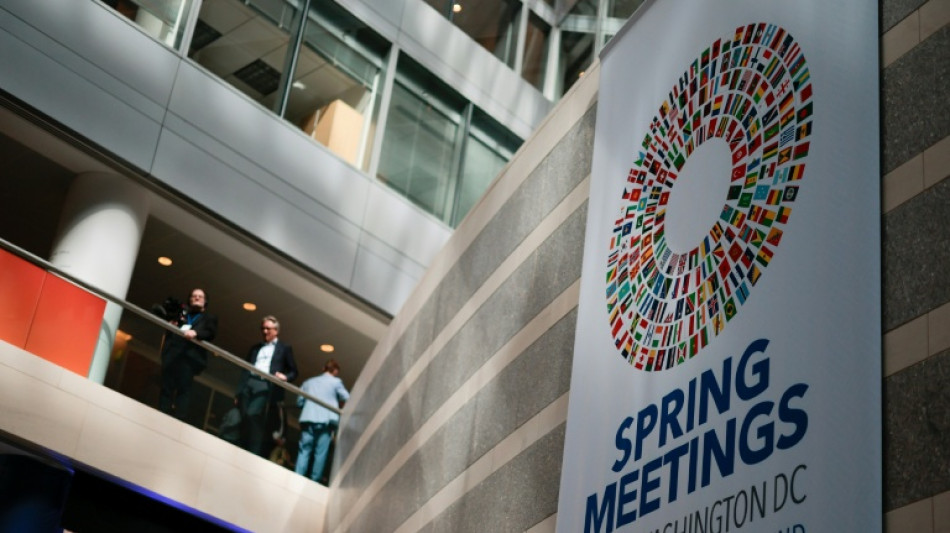
IMF warns of war's human impact far from Middle East / Photo: Kent Nishimura - AFP

IMF economists warned Thursday that the war in Iran could have “very, certainly severe” consequences far outside the region – especially for energy-importing countries.
Countries in East Asia and Sub-Saharan Africa are among the countries most affected now -- and who could suffer the most -- outside the region, as the conflict stretches on.
Ironically, the ongoing virtual closure of the Strait of Hormuz -- through which about one-fifth of the world's oil and gas passes -- has been a windfall for some petroleum-exporting nations, like Nigeria or Algeria.
But for those that rely on imports for food, fertilizer, and energy, the elevated prices are proving worrisome.
"Oil impacted importers, particularly non-resource-rich and fragile states, face deteriorating trade balances, rising living costs and limited buffers" to absorb future shocks," warned Abebe Selassie, the International Monetary Fund (IMF) Director for Africa, at a press conference Thursday.
"The human consequences are almost certain to be severe," he added.
IMF economists are briefing government officials and media on their latest economic analysis as they hold their spring meetings alongside the World Bank this week in Washington.
- Hitting the most vulnerable -
Sub-Saharan Africa -- which for IMF statistical purposes does not include Sudan and parts of the Horn of Africa -- could see 20 million people pushed towards hunger, an IMF report said.
For Sahel countries, where poverty is widespread, factors that are expected to drive up the cost of food include scarce, expensive fertilizer and rising transportation costs.
"Already transportation costs are very high for people in urban areas, rural areas even more so," Selassie explained. "We are already seeing quite a bit of a pinch from the crisis on people, impoverishing people -- it's making life difficult for people."
The economic effects of the crisis hit at a time when international aid is in steep decline, another source of concern for the IMF.
The aid declines aren't a temporary ebb, but are "more structural," Selassie said. "It is falling hardest on the region's most vulnerable countries -- fragile states and low-income economies -- that depend on aid, not as a supplement but as a critical source of budget financing for healthcare and food assistance."
- Heavy oil reliance -
Further afield, small Pacific islands are of great concern, said the IMF's Asia-Pacific Director Krishna Srinivasan, due to their heavy reliance energy imports and the amount of time it takes ships to reach them -- even when shipping disruptions are minimal.
Zooming out, the entire region -- not just small islands -- faces unique risks because it spends almost double what Europe does on oil and gas, as a percent of GDP.
Some countries, such as Malaysia and Thailand spend around 10 percent of their GDP on oil and gas -- a sign of how reliant they are on energy imports.
- Downgrades like 2008 -
None of this is to downplay the effects in the Middle East, where the IMF's regional director, Jihad Azour, told reporters that their updated estimates of economic activity are "among the largest six-month downgrades to regional growth projections we have made since the global financial crisis."
Markets are now demanding higher interest rates across the board, further driving up the cost of borrowing for countries in the region that were already facing difficulties.
Here again, food is a pressure issue, especially in the region's poorest.
"Food items already account for 45 to 50 percent of total imports in Yemen, Sudan, Somalia and more than half of their population are already experiencing food insecurity," Azour said.
So what's to be done?
IMF officials have repeated the same mantra all week: governments should adopt only temporary, limited measures to avoid further stretching already thin budgets.
S.Fujimoto--JT