The Japan Times - The mysterious Denisovans

EUR -
AED 4.245422
AFN 73.401814
ALL 95.804757
AMD 435.965634
ANG 2.068976
AOA 1059.867575
ARS 1591.163342
AUD 1.662972
AWG 2.083038
AZN 1.966265
BAM 1.94891
BBD 2.329145
BDT 141.920077
BGN 1.975617
BHD 0.436399
BIF 3432.721897
BMD 1.155799
BND 1.478337
BOB 7.991127
BRL 6.053954
BSD 1.156401
BTN 108.778233
BWP 15.76003
BYN 3.427501
BYR 22653.652921
BZD 2.326027
CAD 1.596106
CDF 2635.220696
CHF 0.915164
CLF 0.026847
CLP 1060.08668
CNY 7.976748
CNH 7.978414
COP 4279.228805
CRC 537.719801
CUC 1.155799
CUP 30.628663
CVE 110.523215
CZK 23.997735
DJF 205.408705
DKK 7.471799
DOP 69.781379
DZD 153.347817
EGP 60.718954
ERN 17.336979
ETB 181.799172
FJD 2.574194
FKP 0.863643
GBP 0.864786
GEL 3.114871
GGP 0.863643
GHS 12.656569
GIP 0.863643
GMD 84.948126
GNF 10147.912253
GTQ 8.850937
GYD 241.963368
HKD 9.036323
HNL 30.65145
HRK 7.534532
HTG 151.649086
HUF 387.012298
IDR 19497.166894
ILS 3.601295
IMP 0.863643
INR 108.589009
IQD 1514.09619
IRR 1517736.956086
ISK 143.180131
JEP 0.863643
JMD 182.16069
JOD 0.81949
JPY 184.317547
KES 149.965029
KGS 101.073668
KHR 4638.219471
KMF 493.525975
KPW 1040.235338
KRW 1738.575448
KWD 0.354391
KYD 0.963739
KZT 557.988928
LAK 24947.91342
LBP 103501.765934
LKR 363.707242
LRD 212.261977
LSL 19.579412
LTL 3.412773
LVL 0.699131
LYD 7.368225
MAD 10.780717
MDL 20.221468
MGA 4819.680415
MKD 61.615606
MMK 2427.370797
MNT 4125.586287
MOP 9.313179
MRU 46.382229
MUR 53.71034
MVR 17.85711
MWK 2007.622765
MXN 20.545711
MYR 4.582161
MZN 73.857548
NAD 19.567341
NGN 1601.717471
NIO 42.440814
NOK 11.204655
NPR 174.048174
NZD 1.990012
OMR 0.444409
PAB 1.156466
PEN 3.999644
PGK 4.980913
PHP 69.343255
PKR 322.525259
PLN 4.275473
PYG 7524.462005
QAR 4.21169
RON 5.094294
RSD 117.419875
RUB 93.618683
RWF 1687.465983
SAR 4.336132
SBD 9.294975
SCR 16.325644
SDG 694.635484
SEK 10.810057
SGD 1.481156
SHP 0.867148
SLE 28.374686
SLL 24236.531641
SOS 659.961346
SRD 43.158092
STD 23922.697853
STN 24.73409
SVC 10.119354
SYP 128.233843
SZL 19.531726
THB 37.75127
TJS 11.07381
TMT 4.045295
TND 3.395158
TOP 2.782885
TRY 51.232737
TTD 7.863504
TWD 36.902912
TZS 2970.470673
UAH 50.773748
UGX 4278.982517
USD 1.155799
UYU 46.815494
UZS 14100.743605
VES 534.0834
VND 30455.293595
VUV 138.127264
WST 3.164809
XAF 653.674182
XAG 0.016216
XAU 0.000256
XCD 3.123604
XCG 2.084312
XDR 0.811939
XOF 651.301235
XPF 119.331742
YER 275.831064
ZAR 19.578083
ZMK 10403.583014
ZMW 21.655467
ZWL 372.166684
  • RBGPF

    -13.5000

    69

    -19.57%

  • JRI

    0.2400

    12.1

    +1.98%

  • NGG

    1.9600

    84.29

    +2.33%

  • BCC

    1.0800

    74.65

    +1.45%

  • VOD

    0.0600

    14.72

    +0.41%

  • CMSC

    0.0400

    22.91

    +0.17%

  • RYCEF

    0.3000

    15.9

    +1.89%

  • BCE

    -0.3400

    25.49

    -1.33%

  • RIO

    0.7700

    87.54

    +0.88%

  • RELX

    0.0100

    32.47

    +0.03%

  • CMSD

    0.0500

    22.68

    +0.22%

  • GSK

    1.7500

    54.7

    +3.2%

  • BTI

    0.6900

    58.45

    +1.18%

  • AZN

    1.3600

    187.14

    +0.73%

  • BP

    0.6200

    45.41

    +1.37%

The mysterious Denisovans
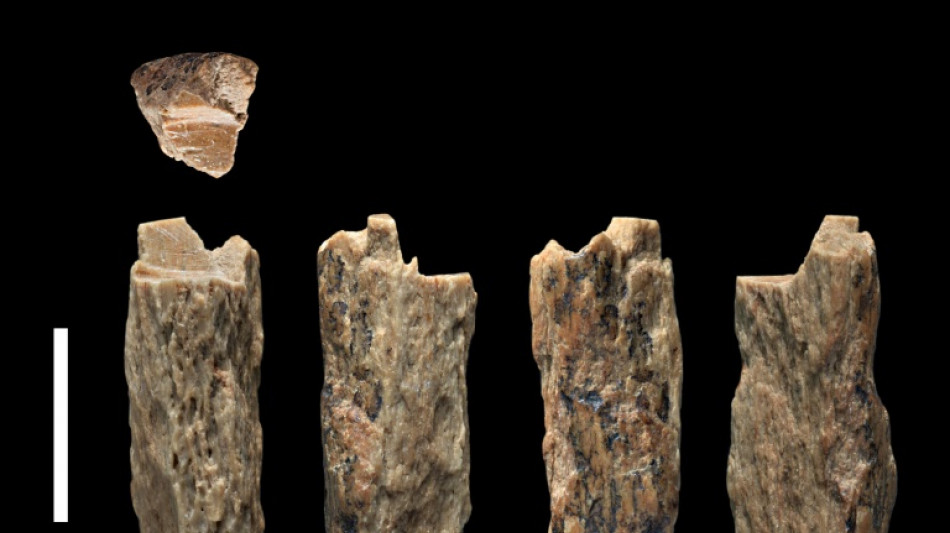
The mysterious Denisovans / Photo: Ian Cartwright - University of Oxford/Max Planck Institute/AFP/File

The mysterious Denisovans

Little is known of the mysterious Denisovans. These distant relatives of the Neanderthals roamed eastern and southern Eurasia but left little trace of their time on Earth.

Text size:

"Hominin Denisova" was discovered by Swedish paleogeneticist Svante Paabo, the winner of this year's Nobel prize in medicine.

In 2012, Paabo and his team sequenced the DNA of a remarkably well-preserved fragment of bone, 40,000 years old, found four years earlier in the Denisova cave in southern Siberia.

The result was astounding -- they had come across an entirely novel hominin, distinct from Neanderthals and even more from Homo sapiens, aka modern humans.

The Denisovans shared a common ancestor with the Neanderthals until their populations diverged 380,000 to 470,000 years ago.

This was much later than the split between modern humans and Neanderthals/Denisovans, which occurred between 550,000 and 760,000 years ago.

In the same cave, paleontologists later discovered the fossil of a young girl who was part Neanderthal, part Denisovan, proving that these two archaic species interbred.

But while we know the Neanderthals disappeared around 40,000 years ago, we have little idea as to when our other closest evolutionary relative went extinct.

We don't know what the Denisovans looked like either as they left only rare fossilised traces of their time on Earth other than the fragments found in Siberia and a jawbone discovered on the Tibetan Plateau in 2019.

The work of Paabo and his team at the Max Planck Institute in Leipzig have nonetheless shed some light on our mysterious ancestor.

By comparing DNA sequences, they found a "gene flow" between both Denisovan and Neanderthals, and between Denisovans and modern humans.

In other words, before they went extinct, Denisovans also interbred with our species.

Up to six percent of Denisovan DNA is still found in present-day humans in Asia-Pacific and southeast Asia -- Australian Aborigines, Melanesians and the Negritos of the Philippines -- suggesting our far-distant relative roamed over a vast swathe of east and south Eurasia.

Neanderthals, by contrast, lived in western Eurasia.

Scientists believe the ancient ancestors of today's Melanesians interbred with Denisovans from southeast Asia, far from the frozen mountains of Siberia and Tibet.

Proof that the Denisovans had spread as far as the warm tropics of Asia was lacking until a missing link -- a child's tooth at least 130,000 years old -- was discovered in a cave in Laos in 2018.

One of the biggest remaining mysteries is why modern humans were so successful in their expansion and why the Denisovans and Neanderthals went extinct, after having adapted to a Eurasian environment for several hundred thousand years.

M.Saito--JT