The Japan Times - Balkan nations offer lessons on handling cow virus sowing turmoil

EUR -
AED 4.232111
AFN 75.483338
ALL 93.285126
AMD 422.259
AOA 1057.884483
ARS 1728.27314
AUD 1.637355
AWG 2.074282
AZN 1.948129
BAM 1.956537
BBD 2.325376
BDT 142.913814
BHD 0.435364
BIF 3450.549574
BMD 1.152379
BND 1.480393
BOB 13.964198
BRL 5.891306
BSD 1.154535
BTN 109.874896
BWP 15.61488
BYN 3.418287
BYR 22586.626891
BZD 2.321974
CAD 1.615497
CDF 2604.376508
CHF 0.934643
CLF 0.02673
CLP 1055.440971
CNY 7.777463
CNH 7.774433
COP 3641.932253
CRC 525.197761
CUC 1.152379
CUP 30.538041
CVE 110.303663
CZK 24.256194
DJF 205.597417
DKK 7.475499
DOP 67.275332
DZD 153.346558
EGP 57.370946
ERN 17.285684
ETB 186.347968
FJD 2.551309
FKP 0.856496
GBP 0.85733
GEL 3.013436
GGP 0.856496
GHS 13.570757
GIP 0.856496
GMD 85.276242
GNF 10139.201975
GTQ 8.809317
GYD 241.539903
HKD 9.040442
HNL 30.944652
HRK 7.534482
HTG 150.95029
HUF 366.519917
IDR 20604.535143
ILS 3.465739
IMP 0.856496
INR 109.762882
IQD 1512.462949
IRR 1584348.162378
ISK 142.411184
JEP 0.856496
JMD 183.008911
JOD 0.81702
JPY 182.503455
KES 149.119782
KGS 100.775889
KHR 4683.930475
KMF 492.065825
KRW 1633.531568
KWD 0.356065
KYD 0.962162
KZT 541.02372
LAK 26086.822873
LBP 103388.630514
LKR 387.81603
LRD 208.397567
LSL 18.831591
LTL 3.402675
LVL 0.697063
LYD 7.359771
MAD 10.772009
MDL 20.088564
MGA 4963.869122
MKD 61.548176
MMK 2419.480296
MNT 4144.000792
MOP 9.328972
MRU 46.285429
MUR 54.242586
MVR 17.815708
MWK 2001.953827
MXN 19.792091
MYR 4.714415
MZN 73.639049
NAD 18.831591
NGN 1572.438973
NIO 42.484154
NOK 10.977222
NPR 175.800197
NZD 1.962346
OMR 0.443084
PAB 1.15453
PEN 3.902569
PGK 5.100921
PHP 70.185659
PKR 320.527693
PLN 4.302263
PYG 6867.585958
QAR 4.220243
RON 5.256461
RSD 117.34213
RUB 94.667126
RWF 1696.038636
SAR 4.32528
SBD 9.297794
SCR 16.700579
SDG 692.002662
SEK 10.945041
SGD 1.476837
SLE 28.349629
SOS 659.848463
SRD 43.636562
STD 23851.917062
STN 24.509229
SVC 10.101804
SZL 18.816085
THB 38.093084
TJS 10.650564
TMT 4.039088
TND 3.386158
TRY 54.974007
TTD 7.816943
TWD 37.203862
TZS 3050.926677
UAH 51.697166
UGX 4300.600712
USD 1.152379
UYU 46.497307
UZS 13759.121235
VES 869.137148
VND 30185.989698
VUV 137.145062
WST 3.144168
XAF 656.204091
XAG 0.017901
XAU 0.000268
XCD 3.114361
XCG 2.080784
XDR 0.816107
XOF 656.204091
XPF 119.331742
YER 272.941263
ZAR 18.773693
ZMK 10372.788581
ZMW 21.965271
ZWL 371.065543
  • RBGPF

    0.0000

    69.74

    0%

  • GSK

    0.7100

    52.17

    +1.36%

  • BCC

    -0.5400

    84.26

    -0.64%

  • CMSD

    -0.0600

    21.98

    -0.27%

  • NGG

    0.1500

    80.41

    +0.19%

  • CMSC

    -0.0100

    21.72

    -0.05%

  • BCE

    0.7100

    22.77

    +3.12%

  • RYCEF

    -0.3800

    20.62

    -1.84%

  • RIO

    -1.8600

    99.65

    -1.87%

  • JRI

    -0.0100

    12.66

    -0.08%

  • RELX

    -0.8600

    35.75

    -2.41%

  • AZN

    -0.4300

    161.07

    -0.27%

  • VOD

    0.6900

    16

    +4.31%

  • BTI

    -0.5400

    58.73

    -0.92%

  • BP

    1.0200

    42.23

    +2.42%

Balkan nations offer lessons on handling cow virus sowing turmoil
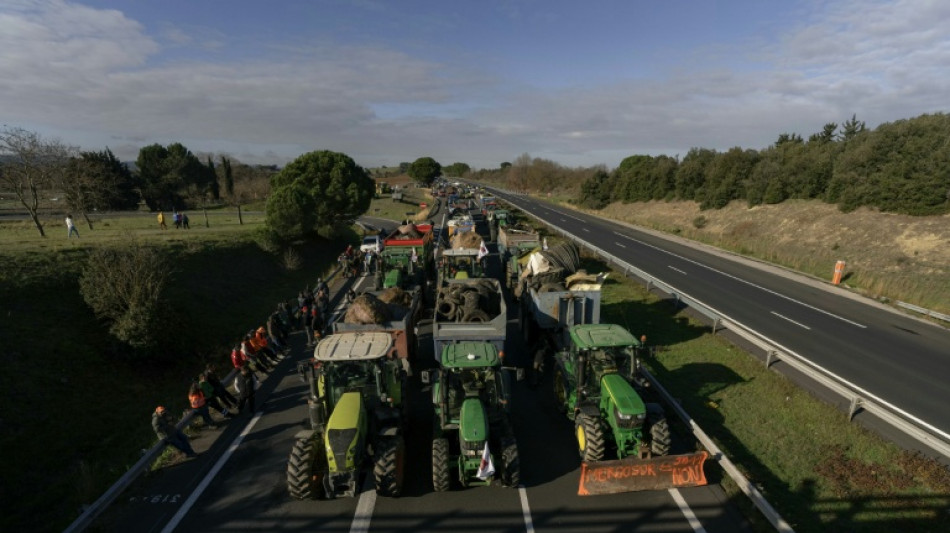
Balkan nations offer lessons on handling cow virus sowing turmoil / Photo: Idriss BIGOU-GILLES - AFP

Balkan nations offer lessons on handling cow virus sowing turmoil

An outbreak of a highly contagious cattle disease has left France, the world's top exporter of live animals, struggling since June to prevent devastating impacts on its industry, amid growing protests by farmers.

Text size:

But in 2016 several Balkan nations curtailed major epidemics of the same disease through swift action, mass vaccination and culls in about three months.

With no cases reported since 2018, Tamas Petrovic, head of virology at the Scientific Veterinary Institute in the Serbian city of Novi Sad, said the Balkans' response could offer lessons for this new outbreak.

- Early alert -

When lumpy skin disease (LSD), or nodular dermatitis, was detected in nearby Greece and Bulgaria, Serbia was placed on alert and formed a task force to monitor its spread, said Petrovic, who was involved in the response.

Although the viral disease poses no risk to humans, it severely affects milk production and fertility and can be fatal in cattle.

As the prolonged incubation of the disease made it difficult to track and contain, officials quickly turned to vaccination, the researcher said.

But with no registered vaccine in Europe at the time, imports were ordered from South Africa.

Within a week of its arrival in Serbia, the vaccine was tested, and the first cattle vaccinations began.

- Mass vaccination -

Mass vaccination was carried out in phases, with one million doses eventually administered across the country.

By first targeting large swaths of livestock in infected districts and then broadening out in three phases, the outbreak was quickly controlled, he said.

"We stopped the disease within two to three months after it entered the country," Petrovic said.

By 2018 the European Food Safety Authority (EFSA) said that more than 70 per cent of the Balkan region's cattle were vaccinated.

- Culls -

But vaccination alone did not stop the disease -- several culls were needed across the region.

"If the disease appears, the euthanasia of the entire herd is mandatory," Petrovic said.

But rapid action meant fewer than 1,000 cattle were slaughtered in Serbia, out of a total herd of close to 900,000, Petrovic said.

Insect controls across the entire region also helped prevent the spread of diseases through mosquitoes, ticks and flies.

- 'A good example' -

Petrovic said the Balkans proved to be "more than a good example" in controlling the disease.

Croatia's preventive vaccination, after EU approval, meant LSD was never reported in the country, despite outbreaks nearby in Serbia and Montenegro.

Its vaccination programme effectively stopped the disease from entering the bloc at the time, he said.

Bosnia and Herzegovina also carried out vaccination and booster campaigns between 2016 and 2018.

As of 2019, the EFSA said that the disease had not been detected in the region, and preventive vaccination programmes continued in high-risk areas.

The main lesson from that crisis was that experts must take the lead, Petrovic said.

"The state and politicians acted in line with the experts and followed what needed to be done -- and they did it," he insisted.

K.Nakajima--JT