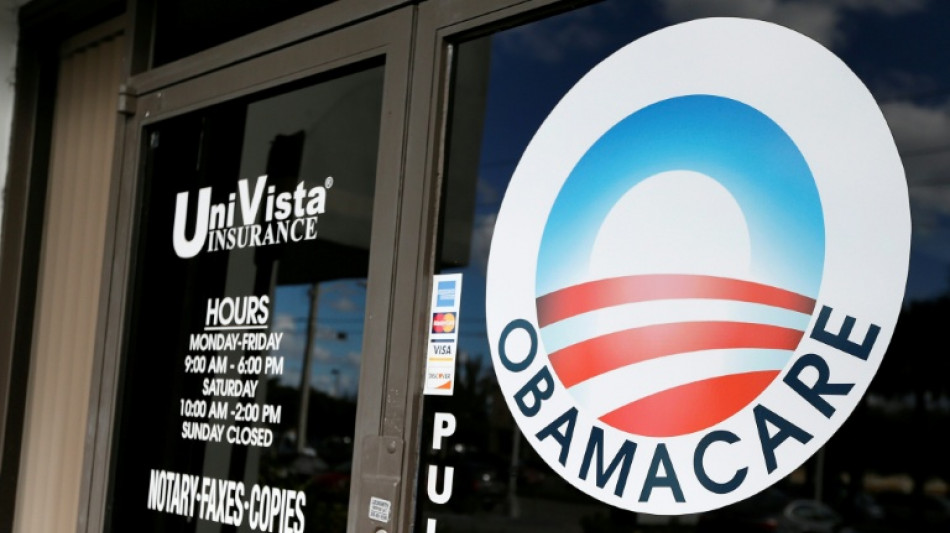
Panic across US as health insurance costs set to surge / Photo: RHONA WISE - AFP

Rachel Mosley, a Florida pre-school teacher, recently learned her family's health insurance premiums are set to nearly triple to a staggering $4,000 a month next year when US government subsidies expire.
Like more than 20 million middle-class Americans, Mosley and her husband until now have benefited from subsidies connected to the Affordable Care Act, better known as Obamacare.
But under US President Donald Trump, these subsidies are set to expire at the end of the year -- and Republicans for now are refusing to negotiate their extension.
The explosive issue is core to the budget standoff between Republicans and Democrats, which has triggered a shutdown that has paralyzed the American federal government for a month.
And on November 1, insurance renewals and enrollments open -- leaving households across the country to learn their new rates with terror.
"I had some tears on my front porch," Mosley -- a mother of five kids, who makes around $24,000 a year as a teacher -- told AFP.
Combined with her salary and her husband's work as a physician's assistant, she said "it's a third of our income."
"I can't possibly imagine how we could pay it."
Mosley, 46, works part-time because she had a heart attack last year -- she thought she was in perfect health but nearly died.
So canceling insurance altogether isn't an option: if "I have to go to the hospital for a heart attack or stroke...how would I pay the bill?"
"I really wouldn't be able to pay."
It's an impossible choice with rippling effects nationwide.
Audrey Horn, a 60-year-old retiree from Nebraska, is in similar panic.
Her premium is currently fully covered by the federal government, but it is set to go from more than $1,740 to more than $2,430 -- and that substantial subsidy is in limbo.
Horn's husband works for a small construction company and is paid by the hour. She said they're already feeling the impact of inflation and simply do not have the budget to absorb such a health care increase.
"I balance my checkbook to the penny," she told AFP, saying they share a very small house and drive old cars.
"We don't have a lot."
- Societal 'burden' -
In the US, about half of American workers receive health insurance through their employers.
The rest -- employees of small businesses, self-employed individuals, people working part-time, and those working multiple jobs or doing contract work -- are largely covered through "Obamacare."
The program's subsidies were created with the goal to "bridge the gap" between the enormous price of US health insurance and what people can actually pay, explained Mark Shepard, a Harvard economist and public policy expert.
The subsidies got a boost during the worst of the Covid-19 pandemic, but are now set to decrease or even disappear -- even as the cost of living continues to soar.
KFF, a health policy think tank, said the expiration would mean the average premium cost of $888 in 2025 would spike to $1,906 next year.
The Congressional Budget Office estimates that dramatic increase will mean 4 million Americans will lose their health insurance.
"There's going to be a burden on the overall society," said Shepard, because people will still show up uninsured, frequently to emergency rooms.
When that happens people accumulate debts that can easily amount to tens of thousands of dollars -- and when they're unable to pay, "the hospitals or local governments or state governments end up bearing the burden of that cost," he said.
Mosley has called and written to her Republican senators in recent days, urging them to reconsider their positions.
She hasn't received a response.
On the other side of the country, Claire Hartley, who owns a California yoga studio, is making similar calls -- and asking her Democratic representatives to "stand firm."
Hartley received notice that premiums for her, her husband and their 18-year-old daughter would go from $1,100 a month to $2,022 next year.
"The longer the Republicans wait, the more people are going to get these notices," she told AFP, voicing hope that people will become more aware of the political battle and what's at stake.
She's urging people to contact their reps and say "'wait, I can't afford this. You can't cave to these demands.'"
S.Yamada--JT