The Japan Times - US aid cuts strain response to health crises worldwide: WHO

EUR -
AED 4.301814
AFN 77.708293
ALL 96.176014
AMD 446.924892
ANG 2.097203
AOA 1074.135394
ARS 1698.74032
AUD 1.770078
AWG 2.108444
AZN 1.991912
BAM 1.950236
BBD 2.36247
BDT 143.341038
BGN 1.955079
BHD 0.441654
BIF 3477.877376
BMD 1.171358
BND 1.512285
BOB 8.104876
BRL 6.444114
BSD 1.172958
BTN 106.59388
BWP 15.491801
BYN 3.437408
BYR 22958.617481
BZD 2.359079
CAD 1.615232
CDF 2635.555553
CHF 0.933339
CLF 0.027334
CLP 1072.249192
CNY 8.248644
CNH 8.245095
COP 4499.162784
CRC 585.330013
CUC 1.171358
CUP 31.040988
CVE 109.951301
CZK 24.352124
DJF 208.874957
DKK 7.471771
DOP 75.364979
DZD 151.627638
EGP 55.766478
ERN 17.570371
ETB 182.088389
FJD 2.670112
FKP 0.872551
GBP 0.87877
GEL 3.15685
GGP 0.872551
GHS 13.489513
GIP 0.872551
GMD 86.100851
GNF 10199.898985
GTQ 8.982373
GYD 245.399857
HKD 9.112316
HNL 30.903829
HRK 7.536638
HTG 153.611735
HUF 387.432543
IDR 19557.696563
ILS 3.773032
IMP 0.872551
INR 105.882157
IQD 1536.622469
IRR 49340.51376
ISK 148.001104
JEP 0.872551
JMD 188.262873
JOD 0.830488
JPY 182.223503
KES 151.004694
KGS 102.43541
KHR 4696.600275
KMF 491.969805
KPW 1054.235599
KRW 1732.367947
KWD 0.359502
KYD 0.977515
KZT 604.617565
LAK 25412.604561
LBP 105039.563247
LKR 363.105585
LRD 207.617653
LSL 19.697785
LTL 3.458716
LVL 0.708543
LYD 6.354896
MAD 10.733975
MDL 19.752728
MGA 5298.881924
MKD 61.532571
MMK 2460.108883
MNT 4156.475757
MOP 9.398924
MRU 46.520274
MUR 53.941062
MVR 18.050801
MWK 2033.897151
MXN 21.056371
MYR 4.7891
MZN 74.861814
NAD 19.697785
NGN 1705.356781
NIO 43.166842
NOK 11.969757
NPR 170.550408
NZD 2.028622
OMR 0.450384
PAB 1.172953
PEN 3.951227
PGK 4.986772
PHP 68.718886
PKR 328.725128
PLN 4.214535
PYG 7878.555568
QAR 4.276698
RON 5.092357
RSD 117.397841
RUB 94.202038
RWF 1707.82745
SAR 4.39328
SBD 9.562266
SCR 15.804605
SDG 704.56838
SEK 10.937063
SGD 1.513547
SHP 0.878822
SLE 27.872113
SLL 24562.796602
SOS 670.387339
SRD 45.305812
STD 24244.746356
STN 24.430299
SVC 10.263761
SYP 12951.888916
SZL 19.680933
THB 36.933012
TJS 10.779545
TMT 4.111467
TND 3.425327
TOP 2.820349
TRY 50.041619
TTD 7.957331
TWD 36.794115
TZS 2900.810779
UAH 49.466868
UGX 4176.08534
USD 1.171358
UYU 45.889075
UZS 14222.422448
VES 320.06667
VND 30847.713845
VUV 142.118205
WST 3.269295
XAF 654.090834
XAG 0.017758
XAU 0.000271
XCD 3.165653
XCG 2.113978
XDR 0.813479
XOF 654.093618
XPF 119.331742
YER 279.193074
ZAR 19.608123
ZMK 10543.631377
ZMW 26.949227
ZWL 377.176809
  • SCS

    0.0200

    16.14

    +0.12%

  • CMSC

    0.0400

    23.34

    +0.17%

  • RBGPF

    0.4100

    82.01

    +0.5%

  • BCC

    0.5100

    75.84

    +0.67%

  • NGG

    -0.2600

    75.77

    -0.34%

  • RYCEF

    -0.3100

    14.64

    -2.12%

  • RIO

    0.1700

    75.99

    +0.22%

  • BCE

    -0.2800

    23.33

    -1.2%

  • CMSD

    0.0150

    23.38

    +0.06%

  • VOD

    0.0000

    12.7

    0%

  • BTI

    -0.4500

    57.29

    -0.79%

  • RELX

    -0.2600

    40.82

    -0.64%

  • JRI

    -0.0500

    13.51

    -0.37%

  • GSK

    -0.4600

    48.78

    -0.94%

  • BP

    -1.4900

    33.76

    -4.41%

  • AZN

    -0.2100

    91.35

    -0.23%

US aid cuts strain response to health crises worldwide: WHO
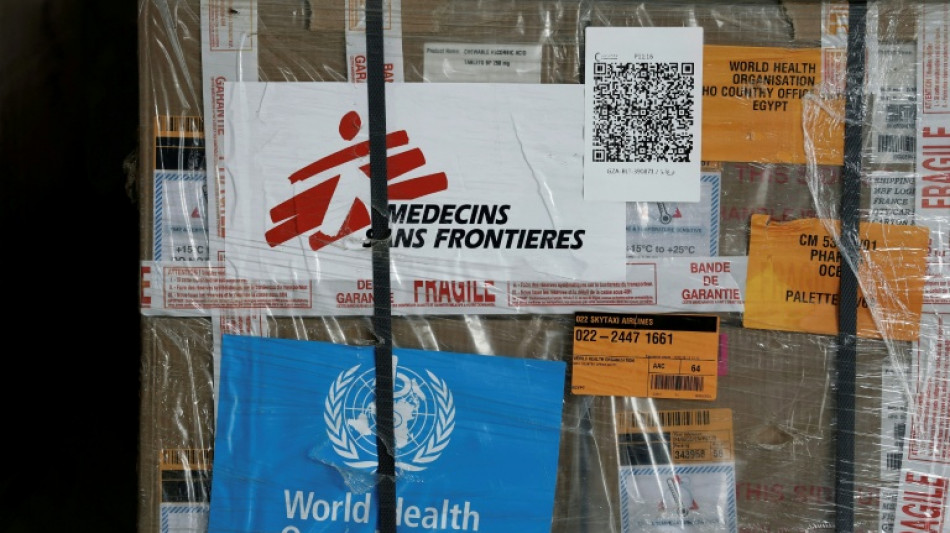
US aid cuts strain response to health crises worldwide: WHO / Photo: Benoit Tessier - POOL/AFP

US aid cuts strain response to health crises worldwide: WHO

The United States slashing foreign aid risks piling pressure on already acute humanitarian crises across the globe, a World Health Organization official said Sunday, also warning against withdrawing from the UN agency.

Text size:

Since taking office in January, President Donald Trump has effectively frozen foreign aid funding, moved to dismantle the US Agency for International Development (USAID) and other programmes, and announced plans to leave the WHO.

Washington, which had long been the WHO's biggest donor, did not pay its 2024 dues, and it remains unclear if the United States will meet its membership obligations for 2025

The agency, already facing a gaping deficit this year, has proposed shrinking its budget by a fifth, likely reducing its reach and workforce, according to an earlier AFP report citing an internal email.

"The WHO with its partners have a significant role in sustaining healthcare systems, rehabilitation of healthcare systems, emergency medical team training and dispatching, pre-placement of trauma kits," Hanan Balkhy, the WHO's regional director for the Eastern Mediterranean, told AFP.

"Many of these programmes have now stopped or are not going to be able to continue," she said.

The funding cuts will likely hinder the ability to continue delivering robust aid to communities in desperate need of care.

Balkhy cited the ongoing conflicts in Gaza, Sudan, and Yemen as areas where healthcare institutions and aid programmes were already under pressure before the funding shakeups.

In the Gaza Strip, where more than a year and a half of fighting has seen large swaths of the Palestinian territory reduced to rubble and few hospitals remain functioning, the public health situation is dire.

"The emergency medical team support, procurement of the medications and the rehabilitation of the health care facilities, all of that has been immediately impacted by the freeze of the US support," said Balkhy.

In Sudan, the WHO is facing mounting issues amid a bloody civil war that has displaced millions, with several areas hit by at least three different disease outbreaks -- malaria, dengue and cholera, according to Balkhy.

"We work significantly to identify emerging and re-emerging pathogens to keep the Sudanese safe, but also to keep the rest of the world safe. So it will impact our ability to continue to do surveillance, detection of diseases," she added.

A US departure from the WHO will also undercut long established channels of communication with leading research facilities, universities and public health institutions that are based in the United States.

That in turn would likely prevent the easy sharing of information and research, which is pivotal to heading off global public health crises like an emerging pandemic, said Balkhy.

"These bacteria and viruses, number one, know no borders. Number two, they are ambivalent to what's happening in the human political landscape."

S.Ogawa--JT