The Japan Times - From Covid to cancer: High hopes for Nobel mRNA vaccines

EUR -
AED 4.234559
AFN 72.641835
ALL 96.248565
AMD 434.904915
ANG 2.064044
AOA 1057.340806
ARS 1585.415706
AUD 1.673188
AWG 2.078361
AZN 1.957338
BAM 1.959852
BBD 2.322602
BDT 141.493133
BGN 1.970908
BHD 0.434666
BIF 3425.437109
BMD 1.153044
BND 1.48497
BOB 7.997534
BRL 6.036994
BSD 1.153179
BTN 109.301864
BWP 15.898074
BYN 3.432596
BYR 22599.658021
BZD 2.319164
CAD 1.59854
CDF 2635.280598
CHF 0.919074
CLF 0.027048
CLP 1067.995456
CNY 7.969204
CNH 7.979305
COP 4248.931725
CRC 535.504768
CUC 1.153044
CUP 30.55566
CVE 110.493432
CZK 24.511117
DJF 205.349878
DKK 7.472427
DOP 68.642207
DZD 153.427511
EGP 60.873218
ERN 17.295657
ETB 178.265943
FJD 2.602881
FKP 0.863702
GBP 0.865999
GEL 3.107433
GGP 0.863702
GHS 12.635122
GIP 0.863702
GMD 84.750785
GNF 10110.771248
GTQ 8.825283
GYD 241.395336
HKD 9.032858
HNL 30.617431
HRK 7.534216
HTG 151.163167
HUF 388.806939
IDR 19579.029239
ILS 3.631631
IMP 0.863702
INR 109.355882
IQD 1510.629592
IRR 1514292.392246
ISK 143.611654
JEP 0.863702
JMD 181.515261
JOD 0.817548
JPY 184.375734
KES 149.895922
KGS 100.833793
KHR 4618.548282
KMF 492.350276
KPW 1037.841215
KRW 1740.831224
KWD 0.354837
KYD 0.960999
KZT 557.48528
LAK 25080.524635
LBP 103264.286246
LKR 363.252555
LRD 211.60021
LSL 19.801824
LTL 3.404639
LVL 0.697464
LYD 7.361218
MAD 10.777782
MDL 20.255139
MGA 4805.873033
MKD 61.643865
MMK 2424.318926
MNT 4127.884218
MOP 9.304497
MRU 46.043389
MUR 53.927637
MVR 17.825829
MWK 1999.585924
MXN 20.794199
MYR 4.627166
MZN 73.691653
NAD 19.801824
NGN 1594.716963
NIO 42.437919
NOK 11.194637
NPR 174.878782
NZD 2.001828
OMR 0.443344
PAB 1.153169
PEN 4.017022
PGK 4.983302
PHP 69.751094
PKR 321.84457
PLN 4.283362
PYG 7539.587172
QAR 4.204392
RON 5.098416
RSD 117.407553
RUB 93.914995
RWF 1684.003378
SAR 4.326795
SBD 9.272749
SCR 16.106748
SDG 692.979097
SEK 10.87695
SGD 1.483956
SHP 0.865081
SLE 28.307763
SLL 24178.763955
SOS 659.059667
SRD 43.355598
STD 23865.678189
STN 24.550649
SVC 10.08986
SYP 127.441644
SZL 19.80002
THB 37.800276
TJS 11.018566
TMT 4.047184
TND 3.399829
TOP 2.776252
TRY 51.264903
TTD 7.835164
TWD 36.864537
TZS 2970.802359
UAH 50.546198
UGX 4295.881207
USD 1.153044
UYU 46.676498
UZS 14063.07368
VES 537.339322
VND 30368.290466
VUV 138.027623
WST 3.176444
XAF 657.31592
XAG 0.016391
XAU 0.000256
XCD 3.116158
XCG 2.078306
XDR 0.814962
XOF 657.31592
XPF 119.331742
YER 275.17389
ZAR 19.68986
ZMK 10378.76945
ZMW 21.707878
ZWL 371.279626
  • RYCEF

    -0.5800

    14.72

    -3.94%

  • BCC

    0.8200

    75.11

    +1.09%

  • CMSC

    -0.0400

    22.78

    -0.18%

  • NGG

    0.0000

    82.4

    0%

  • AZN

    6.5400

    189.94

    +3.44%

  • BCE

    -0.1900

    25.28

    -0.75%

  • GSK

    0.3650

    54.305

    +0.67%

  • RIO

    1.2800

    87.07

    +1.47%

  • RELX

    -0.0350

    32.035

    -0.11%

  • RBGPF

    -13.5000

    69

    -19.57%

  • JRI

    -0.1500

    11.92

    -1.26%

  • VOD

    -0.0300

    14.6

    -0.21%

  • CMSD

    -0.1400

    22.61

    -0.62%

  • BP

    0.3700

    46.54

    +0.8%

  • BTI

    0.4499

    57.875

    +0.78%

From Covid to cancer: High hopes for Nobel mRNA vaccines
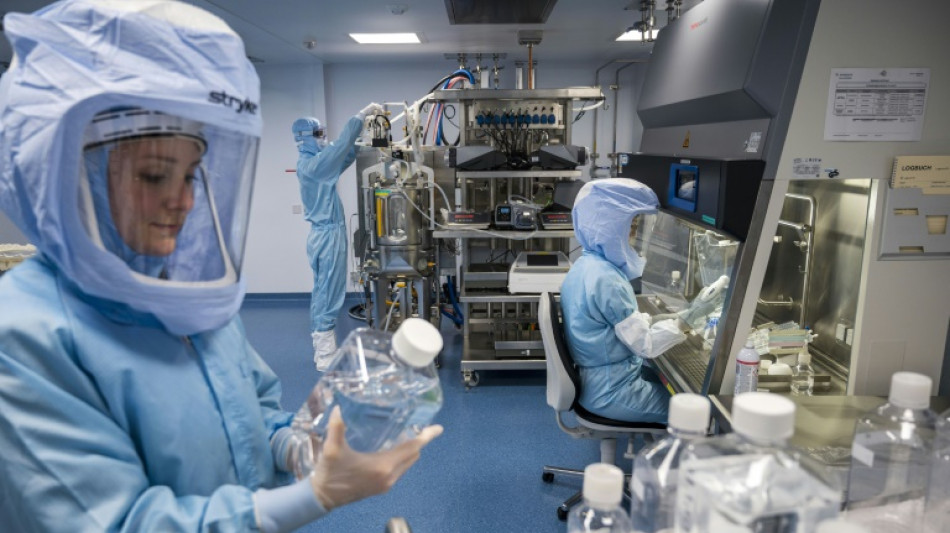
From Covid to cancer: High hopes for Nobel mRNA vaccines / Photo: Thomas Lohnes - AFP/File

From Covid to cancer: High hopes for Nobel mRNA vaccines

The coronavirus pandemic brought global renown to the mRNA technology that underpins vaccines from Pfizer/BioNTech and Moderna, and on Monday earned a Nobel Prize for two scientists who have been key to its development.

Text size:

Katalin Kariko of Hungary and Drew Weissman of the United States won the Nobel Medicine Prize for their work on "nucleoside base modifications that enabled the development of effective mRNA vaccines against COVID-19".

These types of jabs are new but researchers have been working for decades to try to figure out how to use messenger RNA (ribonucleic acid) for other vaccinations and to treat illnesses from AIDS to cancer.

- How does it work? -

Messenger RNA's job in the body is to help deliver specific instructions from DNA to cells.

In the case of the Pfizer/BioNTech and Moderna jabs, lab-generated mRNA tells human cells to create antigens -- proteins that are similar to ones found in the Covid-19 virus.

Thanks to those antigens, a person's immune system learns how to fight the virus and neutralise Covid if it enters the body.

After the cells create these proteins, the body breaks down the mRNA instructions and gets rid of them.

Such direct communication with cells is revolutionary -- classic vaccines aimed to provoke an immune response by injecting a neutralised form of a virus or antigens into the system.

- Where did this come from? -

The first big breakthrough, in the late 1970s, was in using mRNA to make test-tube cells produce proteins.

A decade later, scientists were able to get the same results in mice, but mRNA still had two major drawbacks as a medical tool.

For one thing, cells in live animals resisted synthetic mRNA, provoking a dangerous immune response.

On top of that, mRNA molecules are fragile, making them difficult to deliver to the system without altering them.

In 2005, Kariko and Weissman of Penn State University published a groundbreaking study showing that a lipid -- or fat molecule -- envelope could safely deliver mRNA without negative effects.

The research caused a buzz in the pharmaceutical community and start-ups dedicated to mRNA therapies began to pop up around the world.

- What else can mRNA do? -

Scientists have worked on developing mRNA jabs for illnesses like seasonal flu, rabies and Zika, as well as those that have remained vaccine-resistant until now, including malaria and AIDS.

Researchers have also started testing personalised treatments on cancer patients, using samples of the proteins in their tumours to create specialised mRNA.

This then triggers the immune system to target specific cancer cells.

"The mRNA platform is versatile," University of Pennsylvania biochemist Norbert Pardi told AFP. "Any protein can be encoded as mRNA so there are many potential applications."

M.Matsumoto--JT