The Japan Times - Opec+ likely to maintain oil output levels

EUR -
AED 4.244436
AFN 73.389503
ALL 96.041475
AMD 437.227891
ANG 2.068863
AOA 1059.809568
ARS 1591.117901
AUD 1.663809
AWG 2.082925
AZN 1.95873
BAM 1.954592
BBD 2.335977
BDT 142.332035
BGN 1.975509
BHD 0.436313
BIF 3444.885879
BMD 1.155736
BND 1.48259
BOB 8.014012
BRL 6.040997
BSD 1.159793
BTN 109.092106
BWP 15.805369
BYN 3.437405
BYR 22652.420245
BZD 2.332679
CAD 1.597868
CDF 2635.077814
CHF 0.915938
CLF 0.026863
CLP 1060.688624
CNY 7.976305
CNH 7.983216
COP 4277.782432
CRC 539.269051
CUC 1.155736
CUP 30.626997
CVE 110.196419
CZK 24.476637
DJF 206.535037
DKK 7.471618
DOP 69.927086
DZD 153.324525
EGP 60.76882
ERN 17.336036
ETB 181.097361
FJD 2.598383
FKP 0.863596
GBP 0.865357
GEL 3.1147
GGP 0.863596
GHS 12.680109
GIP 0.863596
GMD 84.943654
GNF 10165.761288
GTQ 8.876476
GYD 242.648987
HKD 9.035831
HNL 30.712152
HRK 7.532279
HTG 152.086665
HUF 387.510676
IDR 19534.245254
ILS 3.607282
IMP 0.863596
INR 108.781896
IQD 1519.467505
IRR 1517654.369857
ISK 143.206866
JEP 0.863596
JMD 182.687885
JOD 0.819347
JPY 184.298222
KES 149.910497
KGS 101.068161
KHR 4651.145599
KMF 493.499383
KPW 1040.178735
KRW 1741.537699
KWD 0.354915
KYD 0.966507
KZT 559.596576
LAK 25005.762183
LBP 103706.496104
LKR 364.767721
LRD 212.827547
LSL 19.536695
LTL 3.412587
LVL 0.699093
LYD 7.395525
MAD 10.808973
MDL 20.279642
MGA 4834.054262
MKD 61.622775
MMK 2427.238714
MNT 4125.361797
MOP 9.339568
MRU 46.21164
MUR 53.891528
MVR 17.856098
MWK 2011.174446
MXN 20.55545
MYR 4.617149
MZN 73.903122
NAD 19.53661
NGN 1599.98893
NIO 42.683805
NOK 11.207202
NPR 174.54888
NZD 1.9938
OMR 0.444374
PAB 1.159783
PEN 4.010639
PGK 5.010925
PHP 69.637122
PKR 323.708741
PLN 4.281654
PYG 7546.401433
QAR 4.229668
RON 5.094603
RSD 117.440085
RUB 93.618694
RWF 1693.560664
SAR 4.335627
SBD 9.29447
SCR 16.592438
SDG 694.597244
SEK 10.810885
SGD 1.482844
SHP 0.867101
SLE 28.373451
SLL 24235.212834
SOS 662.793245
SRD 43.155748
STD 23921.396123
STN 24.484974
SVC 10.148772
SYP 128.226865
SZL 19.547089
THB 37.968233
TJS 11.105189
TMT 4.045075
TND 3.403382
TOP 2.782734
TRY 51.276297
TTD 7.88616
TWD 36.924603
TZS 2976.087716
UAH 50.922669
UGX 4291.329287
USD 1.155736
UYU 46.95078
UZS 14145.319039
VES 534.054338
VND 30438.611836
VUV 138.119748
WST 3.164637
XAF 655.554687
XAG 0.016593
XAU 0.00026
XCD 3.123433
XCG 2.090317
XDR 0.815303
XOF 655.560356
XPF 119.331742
YER 275.815943
ZAR 19.686745
ZMK 10403.013897
ZMW 21.717766
ZWL 372.146432
  • RBGPF

    -13.5000

    69

    -19.57%

  • BCC

    1.0800

    74.65

    +1.45%

  • BCE

    -0.3400

    25.49

    -1.33%

  • CMSC

    0.0400

    22.91

    +0.17%

  • RIO

    0.7700

    87.54

    +0.88%

  • NGG

    1.9600

    84.29

    +2.33%

  • RELX

    0.0100

    32.47

    +0.03%

  • CMSD

    0.0500

    22.68

    +0.22%

  • BP

    0.6200

    45.41

    +1.37%

  • GSK

    1.7500

    54.7

    +3.2%

  • BTI

    0.6900

    58.45

    +1.18%

  • JRI

    0.2400

    12.1

    +1.98%

  • RYCEF

    0.3700

    16.06

    +2.3%

  • AZN

    1.3600

    187.14

    +0.73%

  • VOD

    0.0600

    14.72

    +0.41%

Opec+ likely to maintain oil output levels
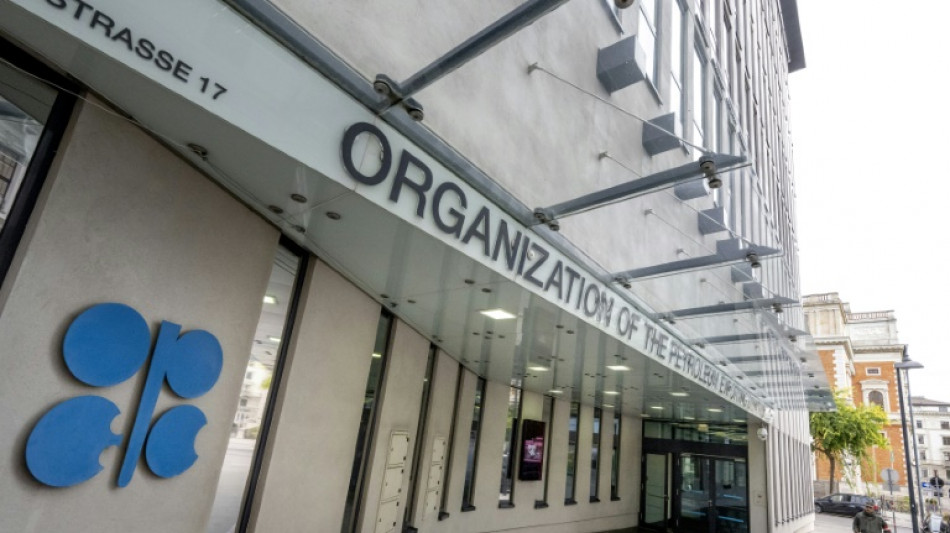
Opec+ likely to maintain oil output levels / Photo: JOE KLAMAR - AFP/File

Opec+ likely to maintain oil output levels

Major oil-producing countries led by Saudi Arabia and Russia look set to maintain their current output levels at a meeting Sunday, ahead of fresh sanctions against Moscow coming into force.

Text size:

The 13-member Organization of the Petroleum Exporting Countries (OPEC) is due to consult with 10 other oil-producing nations, including Russia, to review their decision in October to cut production by two million barrels per day.

The OPEC+ videoconference will take place from 1100 GMT Sunday.

On Friday, the EU, G7 and Australia agreed a $60-per-barrel price cap on Russian oil, which will come into effect on Monday or soon after, alongside an EU embargo on maritime deliveries of Russian crude oil.

It will prevent seaborne shipments of Russian crude to the European Union, which account for two thirds of the bloc's oil imports from Russia, an attempt to deprive Moscow's war chest of billions of euros.

While Russia denounced the incoming price cap on Saturday, threatening to suspend deliveries to any country that adopted the measure, Ukraine suggested the cap should have been set even lower.

For OPEC+, the big unknown in the oil equation is how heavily sanctions will hit Russian supply.

"The uncertainty for Russian supply is significant", DNB analysts said. OPEC would therefore "aim for a low-profile meeting that leaves existing production quotas unchanged".

- An 'uncomfortable position' -

Moscow's threat to suspend deliveries to countries abiding by the price cap would put "some in a very uncomfortable position", said OANDA analyst Craig Erlam: "Choosing between losing access to cheap Russian crude or facing G7 sanctions".

The choice of a virtual OPEC+ meeting instead of an in-person conference at the Vienna headquarters, suggested a policy rollover, UniCredit analyst Edward Moya said.

But "deeper oil output cuts" could still not be ruled out at this stage.

Amid economic gloom fuelled by soaring inflation and fears of China's weaker energy demand due to its Covid-related restrictions, the two global crude benchmarks remained close to their lowest level of the year, far from their March peaks.

Since the group's last meeting in early October, Brent North Sea oil and its US equivalent, WTI, have lost more than six percent of their value.

But speculation that a further OPEC+ production cut might still be on the table boosted prices throughout the week.

"OPEC+ might feel compelled to adopt a more aggressive stance" by cutting or threatening to cut production even further, UniCredit analyst Edoardo Campanella said.

"Russia might also retaliate by leveraging its influence within OPEC+ to push for more production cuts down the road, thus exacerbating the global energy crisis," he added.

K.Inoue--JT