The Japan Times - Small US farm copes with fuel hikes from Mideast war

EUR -
AED 4.193161
AFN 73.073718
ALL 94.138849
AMD 419.575587
ANG 2.044236
AOA 1047.582358
ARS 1691.189375
AUD 1.660896
AWG 2.055194
AZN 1.941446
BAM 1.954754
BBD 2.295772
BDT 140.484861
BGN 1.930604
BHD 0.429774
BIF 3391.115941
BMD 1.141774
BND 1.474424
BOB 7.893778
BRL 5.92444
BSD 1.13989
BTN 107.706393
BWP 15.490715
BYN 3.305732
BYR 22378.776576
BZD 2.292474
CAD 1.623232
CDF 2597.536421
CHF 0.922428
CLF 0.026755
CLP 1053.012399
CNY 7.757158
CNH 7.765464
COP 3933.412515
CRC 517.027993
CUC 1.141774
CUP 30.257019
CVE 110.206056
CZK 24.247233
DJF 202.981434
DKK 7.474454
DOP 67.784339
DZD 151.962952
EGP 56.174356
ERN 17.126615
ETB 181.485248
FJD 2.566994
FKP 0.865302
GBP 0.861623
GEL 3.014363
GGP 0.865302
GHS 12.892105
GIP 0.865302
GMD 83.913975
GNF 9992.74284
GTQ 8.696349
GYD 238.432473
HKD 8.952139
HNL 30.50857
HRK 7.532053
HTG 148.981621
HUF 353.999702
IDR 20464.021049
ILS 3.411108
IMP 0.865302
INR 108.229757
IQD 1496.29524
IRR 1571081.457826
ISK 144.000278
JEP 0.865302
JMD 179.484002
JOD 0.80956
JPY 184.911459
KES 147.83728
KGS 99.848573
KHR 4578.515147
KMF 493.246501
KPW 1027.597283
KRW 1766.102258
KWD 0.353459
KYD 0.949892
KZT 553.443987
LAK 25565.32623
LBP 102073.805207
LKR 383.275003
LRD 207.449045
LSL 18.748189
LTL 3.371363
LVL 0.690648
LYD 7.323083
MAD 10.715585
MDL 20.147224
MGA 4850.405731
MKD 61.625518
MMK 2397.32604
MNT 4087.469212
MOP 9.208075
MRU 45.842385
MUR 53.936843
MVR 17.651743
MWK 1983.261748
MXN 19.956582
MYR 4.63572
MZN 72.902063
NAD 18.747865
NGN 1575.819726
NIO 41.947931
NOK 11.346799
NPR 172.329828
NZD 2.022031
OMR 0.439001
PAB 1.13989
PEN 3.89683
PGK 5.004367
PHP 69.791523
PKR 316.96457
PLN 4.288561
PYG 6941.28741
QAR 4.162336
RON 5.241909
RSD 117.367569
RUB 87.917037
RWF 1673.305023
SAR 4.287701
SBD 9.208456
SCR 15.322575
SDG 685.631614
SEK 11.095449
SGD 1.476434
SHP 0.85245
SLE 28.316491
SLL 23942.440684
SOS 652.525787
SRD 42.810257
STD 23632.423089
STN 24.487117
SVC 9.973666
SYP 126.20271
SZL 18.842173
THB 38.00339
TJS 10.566448
TMT 4.007628
TND 3.363953
TOP 2.749119
TRY 53.263204
TTD 7.748855
TWD 36.400795
TZS 2997.161032
UAH 51.156838
UGX 4177.765497
USD 1.141774
UYU 45.86587
UZS 13737.652333
VES 710.461668
VND 30017.246744
VUV 136.075843
WST 3.175141
XAF 655.606345
XAG 0.01962
XAU 0.000285
XCD 3.085702
XCG 2.054301
XDR 0.815364
XOF 655.606345
XPF 119.331742
YER 272.425469
ZAR 18.776992
ZMK 10277.333557
ZMW 20.636962
ZWL 367.650864
  • RBGPF

    0.6100

    65.61

    +0.93%

  • CMSC

    0.1300

    22.06

    +0.59%

  • BCE

    -0.6600

    22.26

    -2.96%

  • NGG

    0.7500

    83.76

    +0.9%

  • JRI

    0.0700

    12.86

    +0.54%

  • BCC

    -1.7600

    79.26

    -2.22%

  • CMSD

    0.1300

    21.9

    +0.59%

  • GSK

    0.3100

    52.81

    +0.59%

  • RIO

    0.5500

    94.29

    +0.58%

  • AZN

    2.5400

    190.95

    +1.33%

  • RELX

    -0.0500

    31.29

    -0.16%

  • RYCEF

    0.2900

    18.68

    +1.55%

  • VOD

    -0.2000

    13.69

    -1.46%

  • BP

    0.2200

    37.35

    +0.59%

  • BTI

    -0.0200

    62.74

    -0.03%

Small US farm copes with fuel hikes from Mideast war
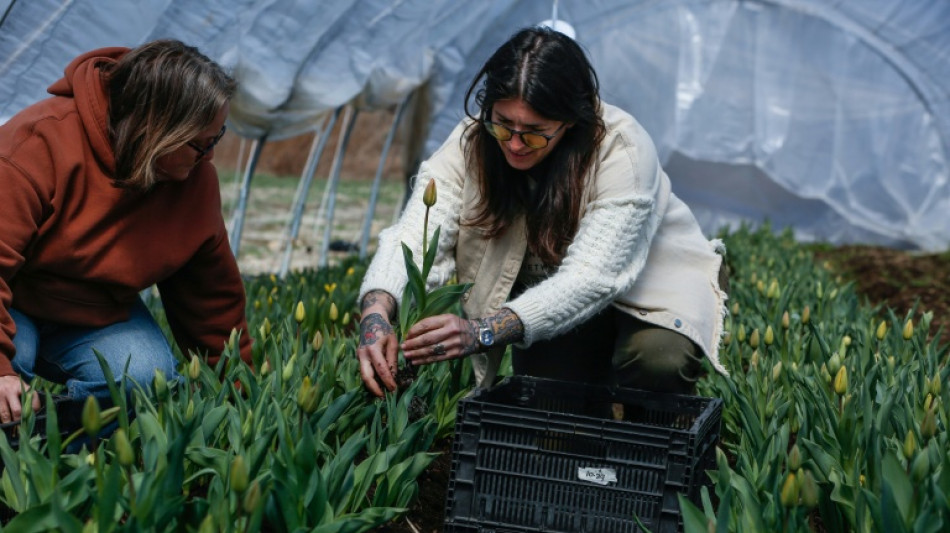
Small US farm copes with fuel hikes from Mideast war / Photo: kena betancur - AFP

Small US farm copes with fuel hikes from Mideast war

An hour's drive north of New York City, the greenhouses at Cropsey Farm are seeing their first leaves of kale, spinach and arugula emerge. But the farmer who runs the outfit is obsessed with something else: the soaring price of fuel.

Text size:

Every year, Sue Ferreri typically allows a 10 percent "buffer" for production budgeting, "but it's well above that now...We're looking at 20, 25 percent, and it's mainly due to the diesel cost," she told AFP.

Fuel prices have jumped after the US-Israeli attack on Iran on February 28, which led to a blockage of shipping in the Strait of Hormuz, a key conduit of oil and fertilizer.

Earlier this week, a gallon (3.8 liters) of diesel -- the fuel most used on the farm located in New City -- rose as high as $5.70 compared with $3.70 in February.

It's essential to the entire operation here: irrigating young plants, spraying fertilizers and plowing the soil.

Shipping costs are up, too, Ferreri said, describing "insane" prices for the delivery of essential farm equipment. Recently when she wanted to order a $60 piece of equipment, the shipping cost was $200, she said.

- 'Pricey' -

Eight people grow flowers, vegetables and fruit using sustainable farming practices on the ten-hectare (25-acre) farm. Customers include restaurant owners as well as local residents who buy produce in a restored 18th-century barn.

Cropsey Farm was already hit by fuel prices hikes following the war in Ukraine and had begun adapting its methods even before the Middle East conflict broke out.

Now, that shift is accelerating.

"We've been switching more to smaller equipment just because it's more efficient on fuel and it can still do what we need it to do," said head mechanic Jonah Monahan.

For example, an ATV and walk-behind tractor are now on the farm -- both far less energy-intensive than the typical tractor.

But, added Monahan, "for big jobs, we still need the main tractor, which gets pricey."

In one greenhouse, two women lifted tulip plants out of the ground and used a hand-drawn rolling cart to transport them to a refrigerated shed to await sale.

Everything is done to squeeze fuel costs.

- 'Relief' -

Beyond the tool adaptations, Ferreri said the farm is also shifting to "regenerative" practices, such as plowing the soil less deeply and maximizing space by rotating crops or pairing plants.

The rapid adjustments at Cropsey, typical of a small operation, have not yet reached larger farms, said Ben Brown, an agriculture researcher at the University of Missouri.

"At this point, most farms are left with taking the higher prices and figuring out how to make it work financially," Brown said.

"However, if elevated prices were to continue, we would expect to see producers shift some acreage to lower energy dependent crops," he said.

Ferreri said the fragile ceasefire agreed between Washington and Tehran gave her some "relief."

"But as a farmer, you can't trust the weather," she said. "We have to just anticipate the worst, hope for the best, and that's kind of where we're at."

Y.Kimura--JT