Fund for climate-exposed Pacific nation invests in fossil fuels / Photo: TORSTEN BLACKWOOD - AFP/File

A trust fund set up to help a South Pacific nation gravely threatened by climate change has invested in coal mining, gas exploration and the world's largest crude oil refinery, an AFP investigation has revealed.
Low-lying Pacific island nation Tuvalu said it was reviewing the "fossil fuel exposure" of the $200 million fund after it was presented with AFP's findings.
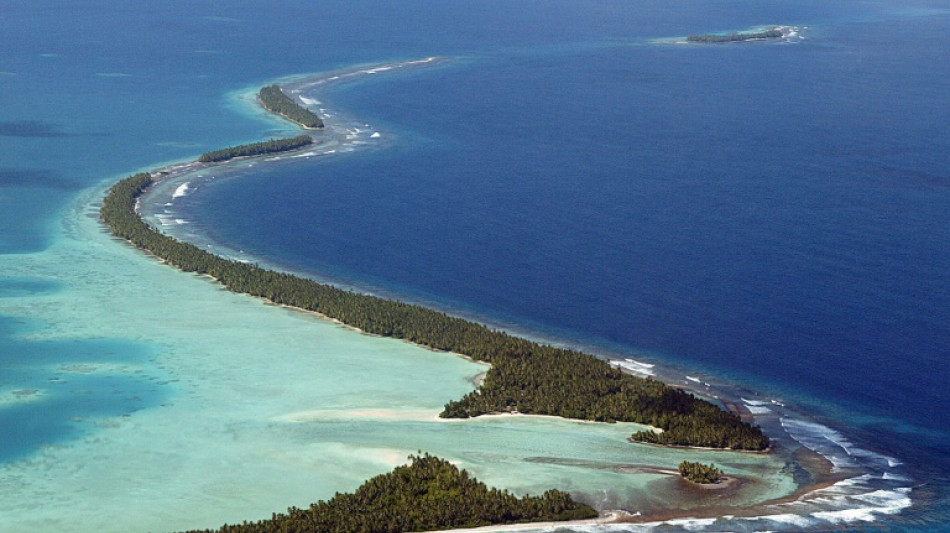
Few countries are more exposed to climate change than Tuvalu, a chain of coral atolls reckoning with acidifying oceans, tropical disease and rising seas.
Land is already so scarce across the archipelago halfway between Australia and Hawaii that the international airport runway doubles as a makeshift sports field.
With a fragile economy and few natural resources, Tuvalu relies on a government trust fund to help foot the spiralling costs of the climate crisis.
Tuvalu has entrusted management of its single-largest financial asset to advisory firm Mercer, which has invested in funds holding stakes in major fossil fuel companies, according to financial records and government reports reviewed by AFP.
Tuvalu climate activist Richard Gokrun said it was "really shocking" to see the nation tied up with fossil fuel companies.
"We stand strong for the phase-out of fossil fuels, because we see the impacts to our country," the former weather forecaster told AFP from the capital of Funafuti.
"The major changes that we are seeing are sea-level rise. We are starting to see new places are getting flooded or inundated."
The Tuvalu Trust Fund was established in 1987 with help from Australia, New Zealand and the United Kingdom, providing crucial revenue to a nation reliant on foreign aid.
Mercer took over management in 2022.
- 'Adverse impacts' -
Tuvalu's expectations are laid out in the fund's "investment objectives".
"Tuvalu is particularly susceptible to the adverse impacts of climate change and it is appropriate to reflect this in the investment strategy," the document states.
The fund must minimise its exposure to "fossil fuel reserves and carbon emissions" where possible, the document adds.
Mercer invested Tuvalu's money in funds specialising in sectors like "Australian shares", "international shares" and "emerging markets", according to a quarterly report dated September 2025.
Mercer is not required to list each of the dozens of companies in these funds, but does publish the 10 biggest holdings.
AFP analysed this data for 14 Mercer funds held by Tuvalu.
Mercer's "emerging markets" fund invested in Indian multinational Reliance Industries, according to holdings data from December 2025.
Reliance Industries owns the Jamnagar petrochemical complex in western India, a sprawling industrial facility described as the largest single-site crude oil refinery in the world.
It pumped out nearly 20 million tonnes of planet-heating carbon dioxide in 2022, making it the world's highest-emitting oil refinery, according to non-profit Climate Trace.
- Funds for fossil fuels -
Tuvalu is also invested in a Mercer fund that that holds American utilities The Southern Company and Duke Energy, the second and third-largest greenhouse gas emitters in the United States, according to the Political Economy Research Institute.
The Southern Company paid $60 million to "groups and firms involved in climate disinformation campaigns between 1993 and 2004", the US-based Energy and Policy Institute found in a 2024 report.
And Mercer put Tuvalu's money into funds invested in mining behemoth Rio Tinto and Australian oil-and-gas giant Woodside Energy, which government data says are among Australia's 10 largest greenhouse gas emitters.
Investments in Woodside are particularly awkward for Tuvalu, which was scathing when Australia approved a 40-year extension for Woodside's North West Shelf gas project in 2025.
Climate Minister Maina Talia warned then that the project's emissions threatened Tuvalu's very "survival", urging Australia to reject the extension.
About 12 percent of the Tuvalu Trust Fund -- or $25 million -- is invested in Mercer's "Australian shares fund", which has its largest holding in mining and metals firm BHP, one of Australia's most valuable companies and the world's biggest miner.
BHP has significantly divested from thermal coal in recent years, but still has a stake in Australian mines digging up the fossil fuel for steelmaking.
- 'Death sentence' -
Tuvalu will receive a rare burst of international attention later this year when it hosts leaders for a special summit ahead of the UN's COP31 climate conference, billed as a chance to show how climate change is battering the region.
Tuvalu is targeting the COP process to find "new contributors" to its trust fund, according to a September government report.
Its Prime Minister Feleti Teo has made clear that he believes "opening, subsidising and exporting fossil fuels is immoral and unacceptable".
"To put it plainly -- it is a death sentence for us if larger nations continue to open new fossil fuel projects," he said in 2024.
But Mercer's investments appear to show "virtually no formal consideration for climate change", said University of Otago climate finance expert Sebastian Gehricke.
AFP's reporting "clearly warrants further investigation," added Ivan Diaz-Rainey, a finance professor at Australia's Griffith University.
He urged "full disclosure of holdings and a clear account of what actions have been taken to give effect to the fund's commitments to climate action".
A spokeswoman said Tuvalu Trust Fund (TTF) was reviewing its exposure to fossil fuels in light of AFP's reporting.
"Since Tuvalu is particularly susceptible to the adverse impacts of climate change, the TTF continues to seek to minimise the fund's exposure to fossil fuel reserves and carbon emissions," she added.
Mercer said: "We do not provide commentary or analysis on our clients or their investment portfolios."
M.Fujitav--JT