The Japan Times - Birdocracy: Noisy jackdaws take a 'vote' before flying

EUR -
AED 4.226116
AFN 72.484564
ALL 96.182262
AMD 434.226617
ANG 2.059567
AOA 1055.047861
ARS 1606.761048
AUD 1.627037
AWG 2.073853
AZN 1.951818
BAM 1.959791
BBD 2.316818
BDT 141.148638
BGN 1.966633
BHD 0.434377
BIF 3417.112023
BMD 1.150543
BND 1.471467
BOB 7.977313
BRL 6.020096
BSD 1.150342
BTN 106.102972
BWP 15.685075
BYN 3.426842
BYR 22550.638264
BZD 2.313622
CAD 1.574673
CDF 2605.979288
CHF 0.906053
CLF 0.026514
CLP 1046.902172
CNY 8.003463
CNH 7.928384
COP 4261.426328
CRC 540.304881
CUC 1.150543
CUP 30.489383
CVE 111.171185
CZK 24.440063
DJF 204.474061
DKK 7.471968
DOP 70.585989
DZD 152.150595
EGP 60.258071
ERN 17.258142
ETB 181.066687
FJD 2.544943
FKP 0.868589
GBP 0.863764
GEL 3.129132
GGP 0.868589
GHS 12.52371
GIP 0.868589
GMD 84.545692
GNF 10096.01242
GTQ 8.81703
GYD 240.792401
HKD 9.009037
HNL 30.569725
HRK 7.533869
HTG 150.768309
HUF 390.470805
IDR 19501.699927
ILS 3.592495
IMP 0.868589
INR 106.643583
IQD 1507.211027
IRR 1519924.524143
ISK 143.196852
JEP 0.868589
JMD 180.948452
JOD 0.815763
JPY 183.060578
KES 148.876787
KGS 100.614779
KHR 4623.453064
KMF 493.583173
KPW 1035.488483
KRW 1703.637446
KWD 0.35324
KYD 0.95856
KZT 555.485925
LAK 24707.90576
LBP 103072.587895
LKR 358.202496
LRD 210.837225
LSL 19.283533
LTL 3.397254
LVL 0.695952
LYD 7.375132
MAD 10.809382
MDL 20.014929
MGA 4780.505228
MKD 61.555164
MMK 2415.728298
MNT 4108.916096
MOP 9.277171
MRU 46.154035
MUR 53.822169
MVR 17.787472
MWK 1998.492943
MXN 20.352294
MYR 4.52221
MZN 73.516569
NAD 19.283201
NGN 1572.147317
NIO 42.248052
NOK 11.131043
NPR 169.77181
NZD 1.963384
OMR 0.442385
PAB 1.150352
PEN 3.944637
PGK 4.950212
PHP 68.624155
PKR 321.317798
PLN 4.268819
PYG 7466.202899
QAR 4.191715
RON 5.09574
RSD 117.422104
RUB 93.479269
RWF 1678.641899
SAR 4.317748
SBD 9.26378
SCR 16.550105
SDG 691.476442
SEK 10.74516
SGD 1.471892
SHP 0.863205
SLE 28.299616
SLL 24126.31904
SOS 657.531932
SRD 43.22762
STD 23813.912372
STN 24.851724
SVC 10.065583
SYP 127.163723
SZL 19.283427
THB 37.196862
TJS 11.042882
TMT 4.032652
TND 3.360775
TOP 2.77023
TRY 50.825234
TTD 7.800952
TWD 36.767201
TZS 2997.163714
UAH 50.712202
UGX 4342.880846
USD 1.150543
UYU 46.765632
UZS 13927.31994
VES 513.425396
VND 30247.769385
VUV 137.564939
WST 3.146982
XAF 657.301129
XAG 0.01425
XAU 0.00023
XCD 3.109399
XCG 2.073139
XDR 0.819796
XOF 662.172783
XPF 119.331742
YER 274.409844
ZAR 19.186429
ZMK 10356.283278
ZMW 22.40181
ZWL 370.474302
  • RBGPF

    0.1000

    82.5

    +0.12%

  • RYCEF

    -0.1500

    16.4

    -0.91%

  • CMSC

    0.0000

    22.99

    0%

  • NGG

    -0.0100

    90.89

    -0.01%

  • GSK

    0.3800

    53.77

    +0.71%

  • BCC

    1.7200

    71.72

    +2.4%

  • RIO

    2.0300

    89.86

    +2.26%

  • BCE

    0.6521

    25.9

    +2.52%

  • CMSD

    -0.0400

    22.95

    -0.17%

  • JRI

    -0.0500

    12.54

    -0.4%

  • BTI

    1.0100

    60.94

    +1.66%

  • RELX

    0.3300

    34.47

    +0.96%

  • VOD

    0.1900

    14.6

    +1.3%

  • BP

    0.2300

    42.9

    +0.54%

  • AZN

    2.1100

    192.01

    +1.1%

Birdocracy: Noisy jackdaws take a 'vote' before flying
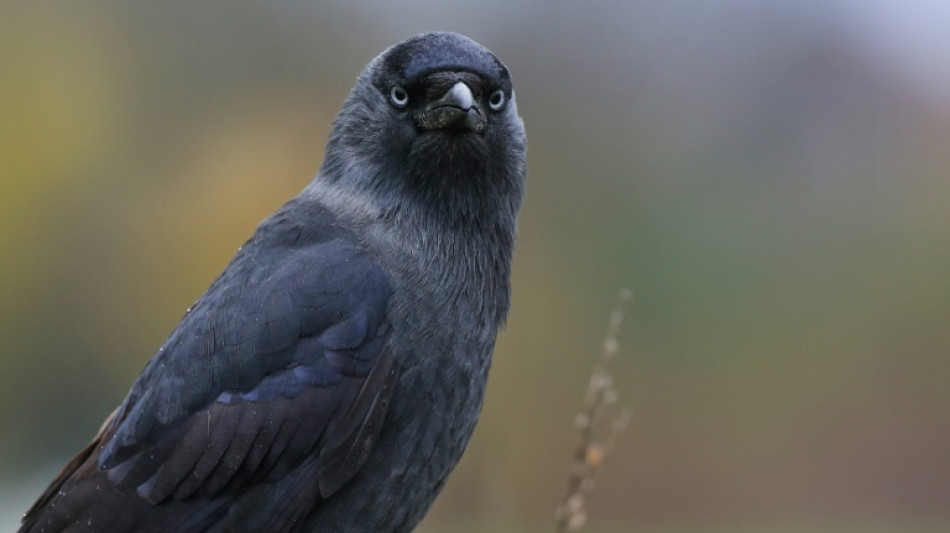
Birdocracy: Noisy jackdaws take a 'vote' before flying / Photo: Thomas Warnack - dpa/AFP/File

Birdocracy: Noisy jackdaws take a 'vote' before flying

A crescendo of calls from hundreds of noisy jackdaws can often be heard right before they take to the sky all at once, right around sunrise on cold winter mornings.

Text size:

Now, scientists who studied their daily activities in detail say these small black crows rely on "democratic" decision-making to coordinate their actions for the collective good.

The findings were published Monday in Current Biology.

"By establishing consensus to leave the roost early and in large flocks, birds may reduce predation risk, facilitate access to useful foraging information" and increase access to mates, wrote the authors.

Jackdaws -- which may get their name from their brief "Jack"-like squawk -- are found across Europe, North Africa and Asia, and form large groups known as "clatterings."

Prior research on consensus decision-making in animals had focused on small groups or members of a family.

Jackdaw roosts were interesting for size as well as diversity, comprising individuals of different ages, sexes, family groups and colonies spread across treetops.

It's likely individuals would have varying preferences about when to take off. But sticking together offers advantages, such as lowered risk of being hunted by birds of prey or small mammals.

To investigate, the team from the University of Exeter and other institutions recorded hours of audio and video of six different jackdaw roosts in Cornwall, Britain, with roost sizes varying from 160 to nearly 1,500 birds.

They found that the timing of departure was tightly linked to calling intensity with the group.

Occasionally, the birds left in dribs and drabs across 20 minutes, but most of the time they set out en masse, with hundreds of birds taking off within a span of four seconds.

On most mornings, the call intensity rose in the hour leading up to the biggest group departure -- but sometimes got delayed by rain or heavy cloud cover -- which led the team to conclude the vocalizations were a reliable source of information.

To confirm cause and effect, the researchers played recordings to the birds to see if they could get them to take off earlier than they would otherwise -- and succeeded in engineering departures that were on average 6.5 minutes earlier.

"Through their calls, jackdaws appear to effectively signal their willingness to leave, providing large groups with a means of achieving consensus to perform cohesive, collective departures from the roost," the team concluded.

On the few times the birds left in a steady stream, rather than in a big group, the calls did not crescendo to a high, indicating the birds had failed to reach consensus.

In future, the team wants to study how human activity -- such as noise pollution -- may hinder bird dynamics and their ability to communicate.

K.Yoshida--JT