Protesters Target Amazon on Black Friday Over Labor, Environmental and Political Concerns

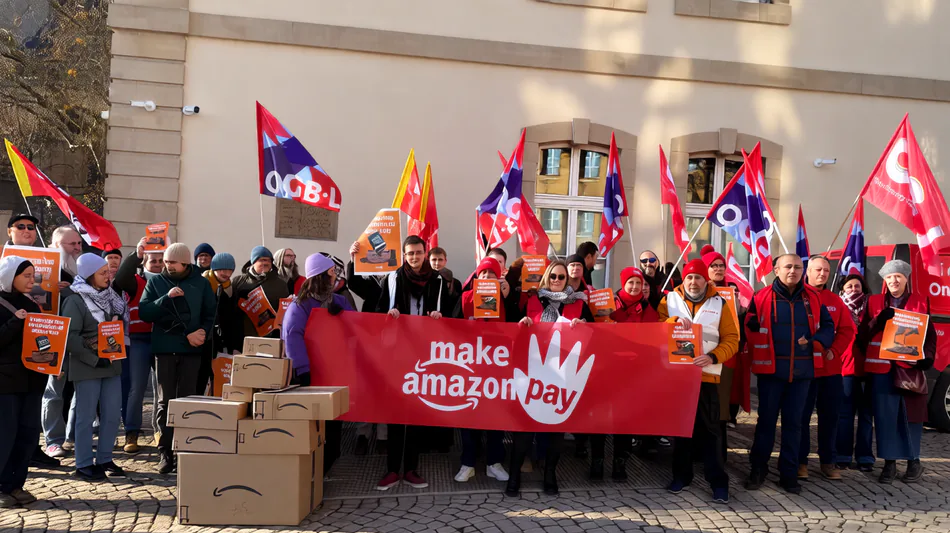
Activists from the 'Make Amazon Pay' collective demonstrated at Place Clairefontaine in Luxembourg on Black Friday, citing concerns over labor rights, ecological damage, and geopolitical ties. The protest highlighted tensions between the e-commerce giant’s local economic influence and regulatory scrutiny, as Amazon responded by defending its workplace standards and employment practices.
A coalition of activists known as the 'Make Amazon Pay' collective gathered at Place Clairefontaine in Luxembourg on Black Friday to stage a demonstration against the operations of the e-commerce giant. The protest addressed a wide spectrum of grievances, ranging from labor conditions and human rights violations to environmental concerns associated with the company’s expansion.
Magali Paulus, representing the organization Cell, highlighted the ecological footprint generated by Amazon’s logistics network. While acknowledging the convenience of home delivery, she pointed out that the model generates significant carbon dioxide emissions. The issue is compounded by the company’s increasing reliance on artificial intelligence, which requires the construction of large data centers. Paulus noted that these facilities raise serious concerns regarding energy and water consumption.
"This has an immense ecological impact and we can't even calculate it correctly yet," Paulus said. She cited data indicating that Amazon’s emissions had already increased by 16 percent by 2025. "At that time, there were no such large data centres, which means that it is still getting bigger and more catastrophic."
Patrick Bosch, speaking on behalf of BDS Luxembourg, focused on the company’s political engagements. He pointed to a contract signed in 2021 between Amazon, Google, and the Israeli government. The agreement involves supplying a service cloud to the Israeli military. Bosch stated that the contract formally prohibits both companies from suspending services to the Israeli army, regardless of any violations of international law. Consequently, he called for a boycott of Amazon.
Labor rights were also a central theme of the demonstration. Manon Meiresonne of the OGBL trade union addressed recent complaints filed by Amazon employees with the ITM, the Inspectorate of Labour and Mines. She emphasized that workers are not disposable resources but individuals with families, private lives, and fundamental rights.
"Amazon must understand that these employees are not resources that can be disposed of at will," Meiresonne said. "They are human beings, with families, a private life, rights and dignity. We ask Amazon to respect the Luxembourg Labour Code."
André Marques of The Left political party discussed the company’s leverage in the local economy. With over 4,500 employees, Amazon holds significant sway, which Marques argued could threaten democratic processes by using the prospect of layoffs as leverage against the government. He compared the situation to the role of Arbed, the former Luxembourgish steel company, in the 1970s. When problems arose at Arbed, they became national crises, shifting power from the government to the corporation.
Jean-Sébastien Zippert of the Tax Justice Network addressed Amazon’s tax contributions. Although Amazon is often cited as a model for tax compliance due to its extensive activity in Luxembourg, Zippert argued that the company remains a champion of tax avoidance. He disputed figures released by Amazon in February, which claimed the company paid $20.7 billion in taxes across Europe by 2024. Zippert noted that these numbers were exaggerated because they included fees for security systems rather than just corporate taxes.
Prior to the publication of this report, an Amazon spokesperson provided a statement to the RTL editorial team regarding the demonstration. The company described the 'Make Amazon Pay' collective as intentionally misleading and accused them of promoting a false narrative. The spokesperson asserted that Amazon provides competitive pay, benefits, and opportunities from day one for its more than 1.5 million direct employees worldwide.
"The fact is at Amazon we provide great pay, great benefits, and great opportunities — all from day one," the statement read. "We directly employ more than 1.5 million people around the world, and provide a modern, safe, and engaging workplace whether you work in an office or at one of our operations buildings."
During a subsequent telephone exchange with RTL, the spokesperson was informed that Amazon typically does not respond to media inquiries and had failed to answer specific questions regarding working conditions. RTL had previously asked Amazon about the number of employees working on June 23, whether they received holiday supplements, and how the company recorded working hours and overtime. The company was also asked how it designated senior management and ensured employees' right to disconnect.
Amazon extended its own deadline for response but did not answer the specific questions directly. Instead, it issued a broader statement highlighting its recognition as a Top Employer in Luxembourg for three consecutive years, ranking first in 2025 and 2026. The company noted that among its over 4,250 employees in Luxembourg, only a limited number support international retail events like Prime Day. It added that those who volunteered to work on the recent Prime Day, which fell on a public holiday, were compensated according to the law.
Despite these claims, Minister of Labour Marc Spautz confirmed later in the month that the ITM was conducting an investigation into Amazon’s compliance with the Labour Code, validating at least one point of contention raised by critics.
Following the telephone exchange, the Amazon spokesperson sent another email to RTL distribution lists, sharing the reporter's mobile number and requesting that the company's position be reflected in full across all coverage, channels, and languages. Neither the trade unions nor the 'Make Amazon Pay' collective had requested or insisted on including their viewpoint in RTL articles about Amazon, such as when the company recently opened a new logistics centre in Dudelange.
In related developments, Amazon has warned that a proposed labor bill in New York could increase order costs for consumers.
S.Fujimoto--JT