Hanoi hits the brakes on petrol bike ban / Photo: Nhac NGUYEN - AFP/File

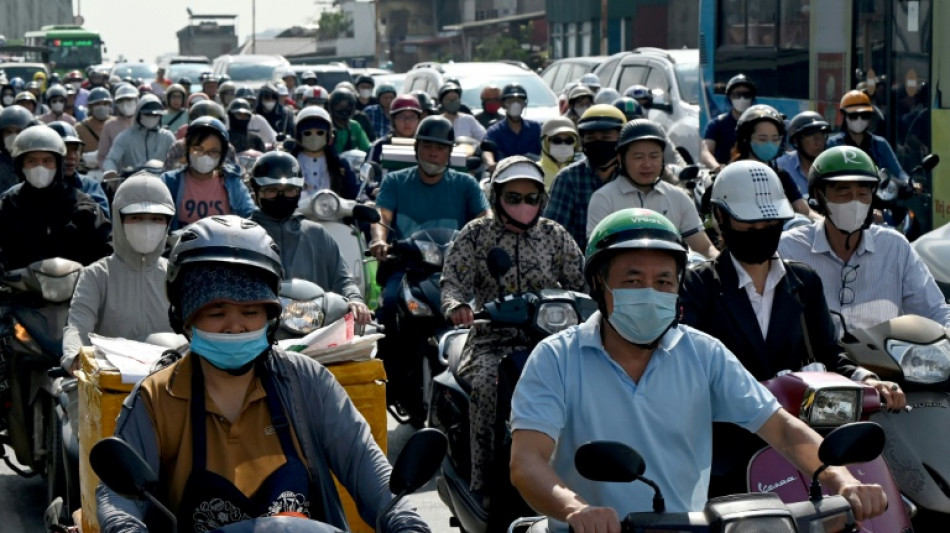
Millions of exhaust-belching motorbikes zip through Hanoi's narrow streets every day fuelling its chronic air pollution, but authorities have backtracked from an ambitious plan to ban them in favour of electric two-wheelers.
Vehicular emissions account for more than half of the capital's pollution problem -- some days it tops world rankings for hazardous air -- but the city runs on two-wheelers, the vast majority of them powered by fossil fuels.
Vietnam's Communist government last year announced a plan to bar petrol motorbikes from a 26-square-kilometre (10-square-mile) area in Hanoi's historic centre.
In the face of opposition from riders and delays in building charging stations, authorities have since whittled down the proposal to cover just 11 streets spread over 0.5 square kilometres.
Even that much smaller "low-emissions zone" would bar petrol bikes only on Friday evenings and some of the weekend -- and is itself in doubt.
It is a remarkable climb-down, underscoring the difficulty of spurring the transition to electric vehicles even in an authoritarian country that brooks little dissent.
"I think almost everyone opposes the ban," said Phuong Anh Nguyen, a 24-year-old Hanoi resident who works as a researcher and rides a petrol motorbike.
She agrees pollution is a major problem and suffers from chronic congestion she blames on the air, but does not want to switch, saying electric vehicles "require frequent maintenance while carrying risks I may not fully understand".
This month, city officials declined to sign off on even the scaled-back ban -- postponing the decision to June and throwing its planned July 1 implementation into question.
"It's rare but it does happen," Vietnam analyst Nguyen Khac Giang said of the decision by city authorities to reverse course.
"The government tends to back down when their legitimacy is threatened... and I think that is what drives the loosening of the petrol bike ban regulations."
- 'Not enough' -
Motorbikes are ubiquitous in Hanoi, with nearly seven million used by commuters, families or weighed down by piles of goods, and they outnumber cars roughly seven to one.
Two-wheelers reign supreme across Vietnam, where public transport is limited and many cannot afford cars, making it the world's fourth-largest motorbike market.
It is still dominated by internal combustion engine bikes, but the government has been gradually encouraging electric vehicle adoption, with Ho Chi Minh City also planning to phase out petrol bikes, although on a slower timeline.
When the Hanoi ban was first announced last July, manufacturers of mainly petrol bikes lined up in opposition, with Honda and others warning of job losses at Vietnam plants, according to news reports.
Local EV-maker VinFast has since seen a surge in sales, and some analysts speculate the ban may have been designed partly to help it.
But VinFast only sold around 400,000 bikes last year, compared to Honda's 2.6 million.
The government has floated subsidies of up to 5 million Vietnamese dong ($190) for people switching to electric bikes that can cost upwards of 30 million.
"That is not enough -- especially for someone like me who has only recently graduated," said 24-year-old Hanh Nguyen.
"I would need greater support."
She also worries about the availability of charging stations, which have been slow to materialise despite government promises.
- Failures and fires -
Other riders are put off by reports of breakdowns and battery fires, and some Hanoi apartment buildings have banned e-bikes, according to state media.
Authorities are working to make charging stations safer and making plans for battery swapping, which carries lower risks.
But building infrastructure takes time, as does weening the public off fossil fuels.
The EU last year scrapped a landmark ban on new petrol and diesel cars set to come into effect in 2035, and India has set a 50-year timeline for transitioning to electric vehicles.
The Hanoi People's Council did not immediately reply to AFP's request for comment.
Nguyen Minh Dong, a former Volkswagen emissions engineer who now advises on electrification, called the rush to ban fossil fuel bikes in Hanoi "puzzling".
"The change requires a considerable amount of time to adapt due to infrastructure limitations," he said.
"The roadmap that Vietnam is aiming for is unsuitable."
T.Maeda--JT