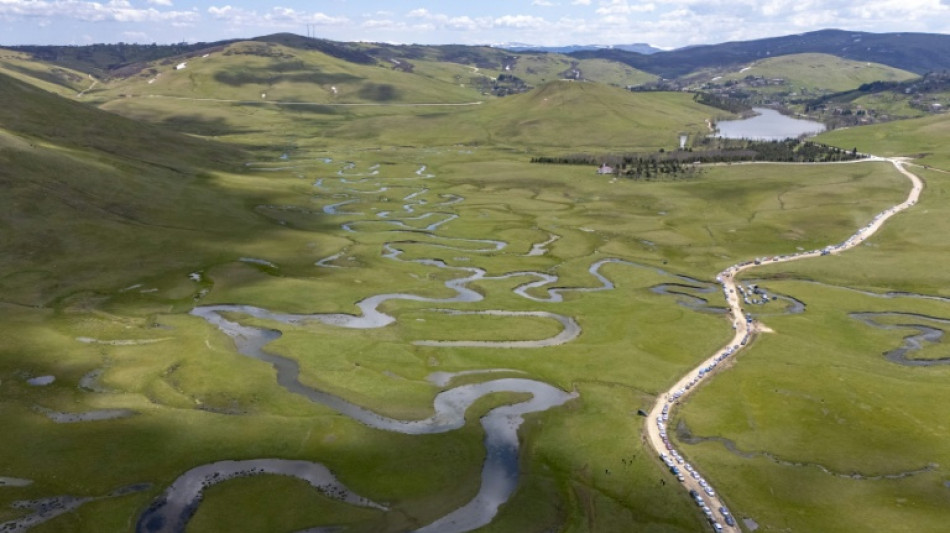
Mines 'draining Turkey's water sources', environmentalists warn / Photo: Yasin AKGUL - AFP

Guney was once a water-rich village fed by 50 springs in Turkey's western Usak province, but since a gold mine opened 20 years ago, they have all dried up.
"Before, you only had to drill 60 metres to find water," said Ugur Sumer, environmental activist and resident of Guney, which is about 170 kilometres (100 miles) east of the resort city of Izmir.
"Today, even drilling 400 metres yields nothing. The mine has used all our water."
With Turkey hosting COP31 in November, its own environmental record is being scrutinised, and activists have warned about the growing number of water-intensive mining projects as resources dry up.
Since 2000, Turkey has rapidly expanded the number of drilling and mining permits granted, notably for gold and coal. The number reached 410,000 last year after the procedures were streamlined by a new law adopted in July.
"I am convinced this law will speed up the arrival of foreign investment in Turkey," Energy Minister Alparslan Bayraktar said in March while visiting Canada.
While there, he met officials from the Tuprag gold mine in Usak, which is owned by Vancouver-based Eldorado Gold.
Turkey is hoping to hike its gold production from 28 tonnes to 100 tonnes per year "without compromising human health and the environment", Bayraktar said. It also wants to be a major player in global rare earths.
But experts and environmentalists warn this explosion in mining permits is endangering water resources and the economies of rural areas.
Not only does the extraction of metals like gold involve large amounts of water, but it also uses cyanide and releases other pollutants, posing major environmental and health risks.
According to official data, in 2024 mining used 5.8 percent of Turkey's 20.3 billion cubic metres of water consumption -- four times the amount used in 2016.
- Farmers' protest -
On the Aybasti plateau in the northeastern Ordu province, villagers turned out en masse earlier this month to protest plans to mine an area they use for farming.
"Our pastures have been closed off because of an exploratory drilling plan for a gold mine," said Nuriye Dilek, a 48-year-old livestock farmer.
"What are we supposed to do if we can no longer raise livestock? Are we supposed to abandon our land and leave?"
Farming and animal husbandry are the main sources of income for locals in this region known for its hazelnuts, which are exported across the world.
"Once the gold mine opens, we won't be able to grow hazelnuts here any more," says Omer Aydin, a nut producer and exporter.
"What's above ground here is more valuable than what's underground. The real gold is the hazelnuts this country produces," he said.
"We are hearing that 80 percent of Ordu's land has been declared a mining site," he told AFP.
"We're extremely concerned."
Last month, the government's anti-disinformation unit Centre for Combating Disinformation denied claims "a large portion of land" was being actively used for mining.
It said the total area corresponded to "only 0.18 percent of Turkey's surface area", denouncing efforts to "tarnish the mining sector".
- 'Excessive use of water, chemicals' -
But the increase in mining permits has infuriated environmentalists, including Ozer Akdemir, who says investment in the sector is being prioritised at the expense of pollution risks and harm to local economies.
"Mining uses excessive water and chemicals. The water isn't just used, it's also polluted," explained hydrologist Erol Kesici.
"The whole world is experiencing a prolonged drought but Turkey is also facing a severe hydrological drought," he said of a phenomenon where rainfall shortages hit the wider water system, depleting water bodies and groundwater.
"Our lakes, rivers and groundwater reserves have dried up as a direct consequence of poor water management," said Kesici.
He recently resigned from Turkey's National Water Council over its "inaction".
"When mountains are levelled to dig mines, the ecosystem is destroyed. Heat islands form, reducing rainfall and consequently groundwater levels," he explained.
"How is it possible to grant so many mining permits? Turkey is suffering from overexploitation," he said.
For lawyer and activist Arif Ali Cangi, the legislation approved in July, which allows companies to expropriate or rezone agricultural land for mining, will only aggravate the situation.
"Environmental impact assessments and oversight mechanisms are now completely ineffective," he told AFP.
"There are now no longer any obstacles to mining operations being set up anywhere."
- 'Pollution is killing farming' -
Using emergency procedures, mining permit requests can be fast-tracked so companies can immediately seize land, a move that seeks to hobble the growing protest movement across Turkey, Cangi said.
Among them are villagers from Ikizkoy in the Mugla region, who have mobilised to protect their olive groves from plans to expand a nearby brown coal lignite mine.
Back in Guney, local resident Sumer said the issue of protecting water sources from overexploitation or pollution was ultimately a matter of survival.
"In 2006, nearly 2,000 residents suffered from vertigo, sight problems and nausea after it rained in Guney, with blood tests showing cyanide in their blood," he said.
"Pollution is killing livestock farming and grape harvests, once the backbone of the local economy," he said.
"We wonder how we're going to survive."
K.Abe--JT