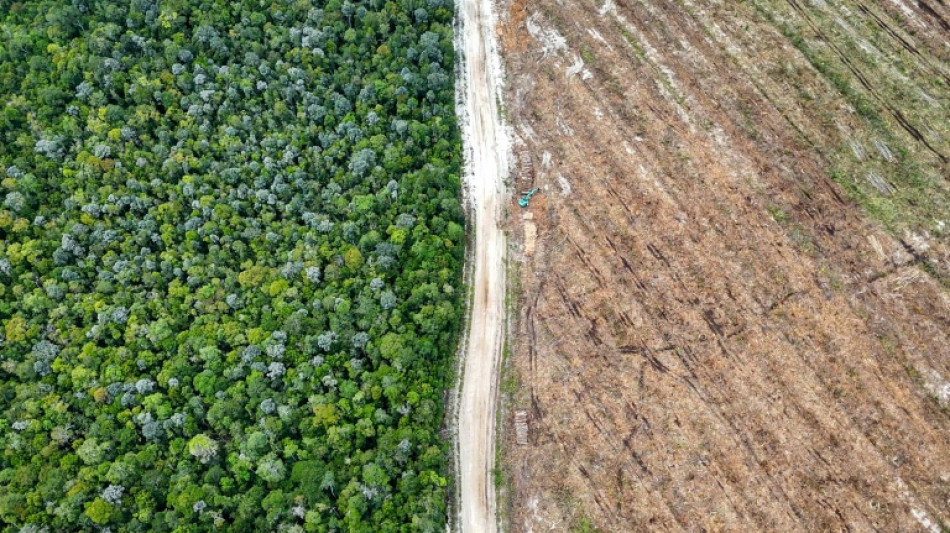
Indonesia orangutan forest cleared for 'carbon-neutral' packaging firm / Photo: SATYA ADHI - AFP

Vast tracts of Indonesian rainforest home to endangered orangutans have been cleared for plantations supplying a maker of "carbon-neutral" packaging, an investigation by AFP and The Gecko Project has found.
Pulp and paper firm Asia Symbol has a no-deforestation policy and supplied major companies like Haleon, the British pharmaceutical giant behind household brands Panadol and Sensodyne.
But wood from plantations where tens of thousands of hectares of forest were felled -- including orangutan habitat -- was processed at an Indonesian mill supplying Asia Symbol.
Haleon said it was cutting ties with Asia Symbol after the investigation, which used satellite data, audit documents, trade records and ship-tracking to trace wood grown on cleared rainforest in Borneo to Asia Symbol's supply chain.
Experts and locals blame the plantations that supplied Asia Symbol for destroying their livelihoods and causing flooding, wildlife loss and land disputes.
"My eyes well up remembering how it was," local village leader Agau told AFP, describing the devastation in Central Kalimantan, one of the most biodiverse places on the planet.
The investigation also raises questions about Asia Symbol's parent company, Singapore-headquartered conglomerate Royal Golden Eagle (RGE).
It committed to a deforestation-free supply chain in 2015 and secured a $1 billion "sustainability-linked loan" in 2024.
It is currently trying to win back Forest Stewardship Council certification designating its products as responsibly sourced.
But the investigation found that its Asia Symbol affiliate received pulp from a mill fed by plantations that cleared nearly 30,000 hectares of forest between 2016 and 2024 -- an area almost three times the size of Paris.
"The findings of this investigation indicate that RGE is still very much in the business of deforestation," said Robin Averbeck, forest programme director at Rainforest Action Network.
- Carbon-neutral packaging -
Asia Symbol had previously pledged to stop using wood from the Industrial Forest Plantation (IFP) "indefinitely".
But the investigation traced timber from IFP and other plantations to the Phoenix Resources International (PRI) mill, which sent pulp to Asia Symbol in China.
Asia Symbol makes "carbon-neutral" packaging there that Haleon used for ibuprofen boxes.
Asia Symbol told AFP it is committed to its no-deforestation policy, which vows not to use wood from natural forests or from those converted to plantations.
It said it is working to strengthen oversight but that its supply chain's complexity "creates real due diligence challenges".
The deforestation is not illegal -- the plantations supplying the PRI mill have Indonesian government permits.
But the consequences for locals and the environment have been grave.
Much of the forest that once grew across the more than 100,000 hectares of IFP's concession has been cleared to plant fast-growing acacia and eucalyptus.
"It's hard to find anything like it used to be," said Agau, 69, the secretary of Humbang Raya village, which is inside the IFP plantation.
Like many people in Indonesia, he uses only one name.
He said animals and birds had disappeared and locals who relied on the forest have been forced to leave to find work.
When AFP reporters visited, felling was underway. On one side of a road was a biodiverse thicket of trees strung with vines. On the other, a ravaged landscape of ashy brown mud strewn with branches.
- 'It breaks our hearts' -
Some 30 kilometres away in Sei Gawing, also inside the concession, locals said they fear drinking water from the nearby river, worried about run-off from the plantation.
Floods are more frequent and severe because tree cover that absorbed rainwater is gone.
"In the last few years there has been flooding that, unlike before, has reached people's homes," village head Dodie Kristiawan said.
Indonesia's government has acknowledged that deforestation worsened floods and landslides that killed over 1,000 people in Sumatra last year, but it has done little to halt forest loss elsewhere.
Ika Magdalena, a pregnant mother-of-three, said the land she once farmed was now off-limits inside IFP's concession.
Promised compensation never arrived, and she now runs a small snack stall to make ends meet.
"They've already damaged our crops, and they don't want to take responsibility," she said.
"It breaks our hearts, but they just stay silent."
IFP did not respond to requests for comment sent by email and post.
Agustan Saining, head of Central Kalimantan's forestry agency, said IFP "has never committed any violations in the forestry sector" and contributes taxes and reforestation funds.
Locals and campaigners say few benefits from the concessions trickle down, with jobs going mostly to outsiders.
Communities lose "sources of livelihood, both food and income, and there are no alternative options," said Bayu Herinata of Central Kalimantan WALHI environmental group.
- 'Ceremonial cannons' -
Asia Symbol confirmed that the PRI mill had supplied it since January 2025 and that it has "commenced a focused review of PRI-related sourcing."
That includes "immediate adoption of global no-deforestation commitments, including potential corrective and remedy actions."
The PRI mill did not respond to requests for comment.
Asia Symbol's parent company RGE has been linked to deforestation and land conflict before.
Last year its attempts to regain Forest Stewardship Council certification stalled over allegations that staff from one of its affiliates attacked an Indigenous community.
And in 2023 Asia Symbol acknowledged deforestation in two concessions in its supply chain and pledged to stop using their products.
But that did not happen.
AFP and investigative newsroom The Gecko Project focused on the PRI mill to trace Asia Symbol's sourcing.
Government audit reports showed the mill received timber from 12 concessions, and satellite imagery analysis showed significant deforestation in at least four.
Records from trade data aggregator Import Genius showed PRI was sending much of its pulp to two ports in China, Rugao and Rizhao, where Asia Symbol's Jiangsu and Shandong facilities are located.
Ship-tracking and trade data showed the cargo ship MV Sailboard arrived in Rugao from Tarakan in Borneo last June, carrying pulp.
It was received with fanfare as Rugao's first "direct shipside pick-up" -- an expedited customs process -- meriting a welcome committee and "ceremonial cannons", local reports said.
A video posted on Chinese TikTok Douyin shows the ship's name and the initials "PRI" stamped on its cargo as officials welcomed the cargo in front of a banner bearing Asia Symbol's logo.
- 'Greenwashing' -
RGE makes much of its sustainability commitments.
"We're proud to say that our whole supply chain is 100 percent deforestation free," its managing director Anderson Tanoto said in 2024.
"The power of integration is that you have accountability of the value chain all the way to where the growers are," he added.
While making paper requires timber, FSC certification includes commitments to protect old-growth forests and respect the rights of local communities.
FSC said its suspension of RGE remains in place.
"There have been numerous breaches," said Grant Rosoman, senior forest campaign advisor for Greenpeace International, who has followed RGE's operations.
"Their commitments are nothing more than greenwashing to convince their buyers that they are cleaning up their act."
- 'Our only hope' -
Sustainability pledges can be lucrative for companies like RGE.
"RGE has managed to access billions of dollars in green credit from banks including Mitsubishi UFJ by its public commitments to eliminate deforestation from its supply chains," Rainforest Action Network's Averbeck said.
Asia Symbol said its "carbon-neutral" products for Haleon did not use pulp from the PRI mill, but failed to explain how it separates pulp from different sources.
UK-based Haleon said its own investigations found no evidence deforestation-linked material entered its supply chain, but that it was "nevertheless very concerned by the allegations raised against Asia Symbol and upstream plantation companies."
"We have therefore asked our suppliers to ensure that any material supplied to Haleon is not sourced from Asia Symbol" or plantation companies "associated with risk of deforestation", it said.
Indonesia has some of the world's highest tree cover loss, according to Global Forest Watch, increasing the risk of natural disasters as well as threatening endangered species and climate goals.
But the perceived short-term economic benefits of clearing forests often outweigh those concerns.
In Humbang Raya, Agau wants the government to stop issuing permits to companies that cut down forests, insisting safeguards and promises to restore them are worthless.
"You plant one tree, a million are lost. It's not balanced," he said.
"Our lives, our livelihood here, depend on the forest that we have. That is our only hope."
K.Yamaguchi--JT