The Japan Times - First major chunk breaks off world's biggest iceberg

EUR -
AED 4.315152
AFN 77.708509
ALL 96.852138
AMD 448.491142
ANG 2.103707
AOA 1077.46608
ARS 1692.867744
AUD 1.766731
AWG 2.114983
AZN 1.996065
BAM 1.958827
BBD 2.365606
BDT 143.531799
BGN 1.957646
BHD 0.442923
BIF 3471.553207
BMD 1.174991
BND 1.516883
BOB 8.115541
BRL 6.345419
BSD 1.17454
BTN 106.215586
BWP 15.56238
BYN 3.462451
BYR 23029.817846
BZD 2.36217
CAD 1.617428
CDF 2631.978985
CHF 0.93526
CLF 0.027299
CLP 1070.885484
CNY 8.288974
CNH 8.27372
COP 4466.84467
CRC 587.522896
CUC 1.174991
CUP 31.137254
CVE 110.435656
CZK 24.285177
DJF 209.15766
DKK 7.470444
DOP 74.667289
DZD 152.34334
EGP 55.789738
ERN 17.624861
ETB 183.52108
FJD 2.648192
FKP 0.879185
GBP 0.877671
GEL 3.168367
GGP 0.879185
GHS 13.482835
GIP 0.879185
GMD 85.774311
GNF 10213.261358
GTQ 8.995863
GYD 245.719709
HKD 9.144171
HNL 30.922442
HRK 7.532747
HTG 153.951832
HUF 385.151393
IDR 19592.088787
ILS 3.766621
IMP 0.879185
INR 106.613135
IQD 1538.577555
IRR 49493.544354
ISK 148.41283
JEP 0.879185
JMD 188.054601
JOD 0.833059
JPY 182.086549
KES 151.515079
KGS 102.752804
KHR 4702.386633
KMF 492.911492
KPW 1057.491268
KRW 1720.480396
KWD 0.36051
KYD 0.978813
KZT 612.546565
LAK 25462.346819
LBP 105176.728999
LKR 362.920819
LRD 207.301224
LSL 19.815521
LTL 3.469442
LVL 0.710741
LYD 6.379995
MAD 10.805297
MDL 19.854766
MGA 5203.151106
MKD 61.58937
MMK 2466.617904
MNT 4166.358748
MOP 9.418054
MRU 47.004836
MUR 53.990968
MVR 18.088629
MWK 2036.690621
MXN 21.126092
MYR 4.808648
MZN 75.093803
NAD 19.815521
NGN 1705.53442
NIO 43.227904
NOK 11.911281
NPR 169.94896
NZD 2.027652
OMR 0.451782
PAB 1.174515
PEN 3.954311
PGK 5.062068
PHP 69.231624
PKR 329.162758
PLN 4.221642
PYG 7889.359242
QAR 4.280496
RON 5.094291
RSD 117.388641
RUB 92.967943
RWF 1709.478019
SAR 4.40866
SBD 9.607607
SCR 17.223335
SDG 706.756952
SEK 10.910905
SGD 1.51451
SHP 0.881547
SLE 28.346692
SLL 24638.971924
SOS 670.04968
SRD 45.293589
STD 24319.935326
STN 24.534259
SVC 10.276881
SYP 12991.498391
SZL 19.808863
THB 36.931722
TJS 10.793679
TMT 4.124217
TND 3.433491
TOP 2.829096
TRY 50.173396
TTD 7.970316
TWD 36.798371
TZS 2916.912694
UAH 49.627044
UGX 4174.450755
USD 1.174991
UYU 46.090635
UZS 14149.865707
VES 314.239221
VND 30925.755393
VUV 142.323844
WST 3.261166
XAF 656.986216
XAG 0.018396
XAU 0.000271
XCD 3.175471
XCG 2.116771
XDR 0.81708
XOF 656.986216
XPF 119.331742
YER 280.241445
ZAR 19.712468
ZMK 10576.317779
ZMW 27.102111
ZWL 378.346528
  • RBGPF

    -3.4900

    77.68

    -4.49%

  • RYCEF

    0.2200

    14.82

    +1.48%

  • NGG

    0.8200

    75.75

    +1.08%

  • RELX

    0.9550

    41.335

    +2.31%

  • CMSC

    0.0100

    23.31

    +0.04%

  • RIO

    -0.1950

    75.465

    -0.26%

  • JRI

    0.0235

    13.59

    +0.17%

  • BCC

    -0.6650

    75.845

    -0.88%

  • CMSD

    0.0300

    23.28

    +0.13%

  • GSK

    0.3700

    49.18

    +0.75%

  • BP

    0.0050

    35.265

    +0.01%

  • BTI

    0.5200

    57.62

    +0.9%

  • VOD

    0.1800

    12.77

    +1.41%

  • BCE

    0.2161

    23.61

    +0.92%

  • AZN

    1.1700

    91

    +1.29%

  • SCS

    0.0200

    16.14

    +0.12%

First major chunk breaks off world's biggest iceberg
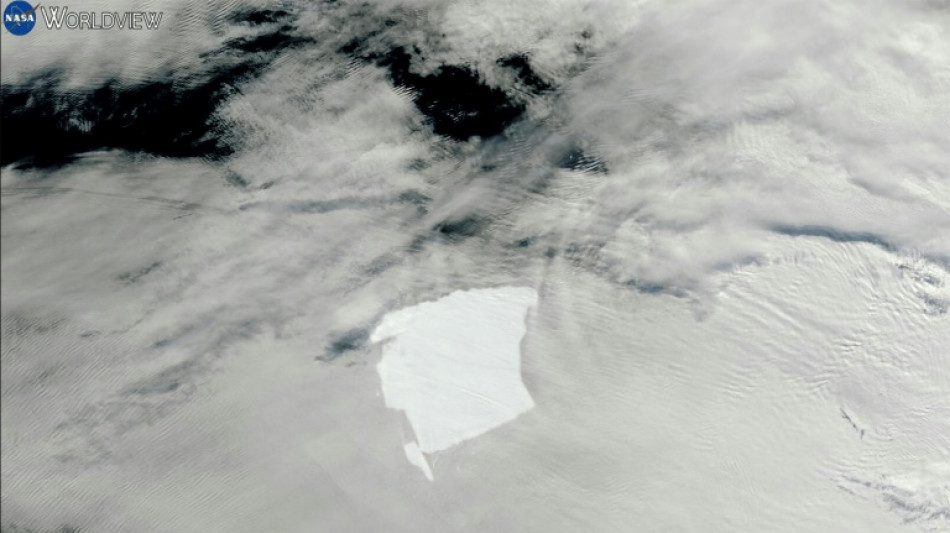
First major chunk breaks off world's biggest iceberg / Photo: Handout - NASA/AFP

First major chunk breaks off world's biggest iceberg

An enormous chunk has broken off the world's largest iceberg, in a possible first sign the behemoth from Antarctica could be crumbling, scientists told AFP on Friday.

Text size:

The colossal iceberg -- which is more than twice the size of Greater London and weighs nearly one trillion tonnes -- had largely stayed intact since it started slowly moving north in 2020.

It has been drifting toward the remote island of South Georgia in the South Atlantic, raising the prospect it could run aground in shallower water and disrupt feeding for baby penguins and seals.

But a chunk about 19 kilometres (12 miles) long has cleaved off, said Andrew Meijers from the British Antarctic Survey, who encountered the iceberg in late 2023 and has tracked its fate via satellite ever since.

"This is definitely the first significant clear slice of the iceberg that's appeared," the physical oceanographer told AFP.

Soledad Tiranti, a glaciologist currently on an Argentinian exploration voyage in the Antarctic, also told AFP that a section had "broken" away.

The jagged piece has an area of roughly 80 square kilometres (31 square miles) -- huge in its own right, but just a fraction of the approximately 3360 square kilometres that remained.

Meijers said icebergs were full of deep fractures, and although this monumental specimen had shrunk over time and lost a much smaller piece, it had "held together pretty nicely".

"This is a sign that those rifts in it are starting to break up," he said.

In the past, other mega-icebergs had fallen apart "relatively quickly over the course of several weeks" once they started losing big pieces, he said.

It was hard to say if this was "a loose tooth just waiting to come out" or evidence of a much bigger change underway.

"I'm sorry to say but it's not really an exact science how these things fall apart... it's really hard to say if this is going to blow apart now, or it's going to hang together for longer," Meijers said.

Known as A23a, the world's biggest and oldest iceberg calved from the Antarctic shelf in 1986.

It remained stuck for over 30 years before finally breaking free in 2020, its lumbering journey north sometimes delayed by ocean forces that kept it spinning in place.

This monster block of freshwater was being whisked along by the world's most powerful ocean "jet stream" -- the Antarctic Circumpolar Current.

Meijers said its trajectory toward South Georgia, a crucial feeding ground for seals and penguins, would unlikely change because it had lost this chunk.

But should it collapse further it would pose "much less of a threat for wildlife" because foraging animals could manoeuvre unimpeded between the smaller chunks to find food, he added.

Icebergs had grounded there in the past and caused significant mortality to penguin chicks and seal pups.

Tiranti said the iceberg was expected to keep plodding its way north but its exact course depended greatly on how local currents influenced its movements.

burs-np/yad

T.Ikeda--JT