Warming Baltic Sea: a red flag for global oceans / Photo: Alessandro RAMPAZZO - AFP

Climate change combined with pollution from farming and forestry could flip northern Europe's Baltic Sea from being a sponge for CO2 to a source of the planet-warming gas, scientists studying told AFP.
This should be a red flag, they warned, noting that other coastal marine zones around the world are trending in the same direction.
"We are at the forefront of these changes," said University of Helsinki professor Alf Norkko.
The Baltic Sea –- connected to the Atlantic by the straights of Denmark, and surrounded by Germany, Poland, Finland, Sweden and the Baltic states –- has warmed at twice the pace of global oceans generally.
Its relatively shallow waters are extremely sensitive to changes in the environment and climate.
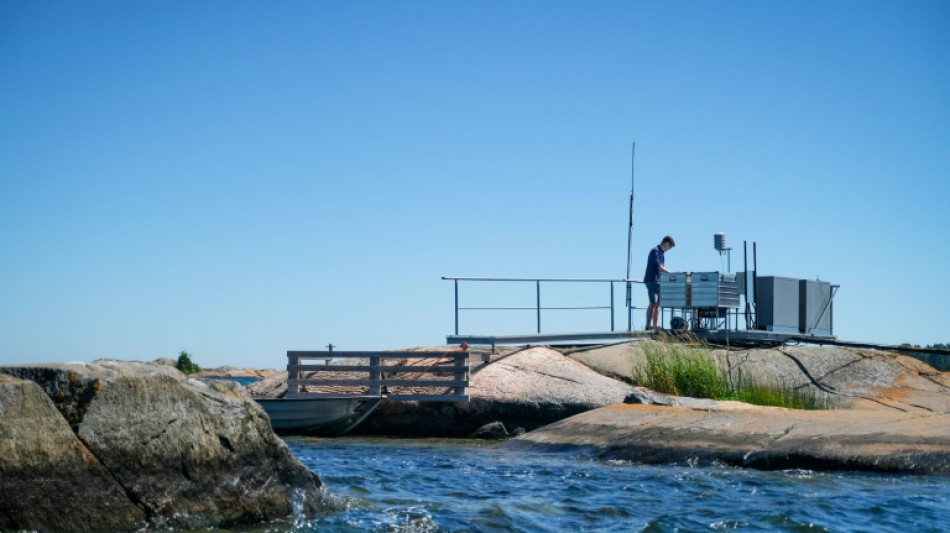
AFP recently accompanied Norkko, who leads the largest marine research station in the Baltic Sea, and some of his colleagues on a research excursion to the Finnish waterfront town of Hanko.
Slender terns dart above the lush marsh-like landscape surrounding the over 120-year-old field station, a common sight along Finland's 1,100-kilometre (680-mile) coastline, which is dotted by more than 81,000 islands.
Measurements conducted since 1926 show that average sea temperature have spiked by two degrees Celsius over the last 30 years.
"The Baltic Sea is basically a small bathtub compared to the global oceans," said doctoral researcher Norman Gobeler, an expert on marine heatwaves.
"We are seeing the first effects of the temperature increase."
- Linking marine ecosystems to climate change -
During one foray into the field, coastal ecologist and doctoral researcher Margaret Williamson –- sporting waist-high waders and sunglasses –- moved through a swaying, green reedbed collecting stems, roots and soil to measure CO2 levels.
"The Baltic Sea is really important for understanding what climate change is doing worldwide," said Williamson, who is part of a joint research project with Helsinki and Stockholm universities.
Many coastal areas across the globe -- coral reefs, estuaries, and mangrove forests –- are among the planet's richest biodiversity hotspots, providing vital nurseries and habitats for hundreds of marine species.
They are also the most vulnerable to the kind of changes observed in the Baltic.
Up to now, oceans have been our most important natural ally in coping with global warming.
Over decades, they have consistently absorbed 90 percent of the heat generated by human-induced climate change, and about a quarter of the carbon dioxide humanity injects into the atmosphere.
But scientists say there is a lot we do not know about the capacity of oceans to continue serving as "sinks", or sponges, for our carbon pollution, Norkko noted.
"There has been a lot of emphasis on terrestrial forests' role as carbon sinks," he said. "Our coasts and oceans have been ignored. The question is, how much further the oceans can take of all these stressors?"
- From carbon sink to carbon source? -
Recent findings from the Finnish research station suggest coastal ecosystems in the Baltic Sea could start emitting greenhouse gases –- CO2 and methane –- instead of absorbing them, driven by both rising temperatures and environmental pollution.
The ecological condition of many coastal areas has deteriorated due to the runoff from forestry and nitrogen and phosphorus-rich fertiliser used in agriculture, as well as untreated waste water.
The overabundance of chemical nutrients leads to harmful algae blooms, and vast "dead zones" depleted of oxygen, a process known as eutrophication.
"A degraded ecosystem will be a net carbon source," Norkko said. "Our biggest concern is that what should be an efficient carbon sink could become a carbon source."
Norkko said the changes already witnessed in the Baltic Sea should sound the alarm for coastal regions across the world.
"Many of the world's densely populated coastal areas are affected by eutrophication and this has a huge effect on the ability of coastal ecosystems to mitigate climate change," he said.
While measures to protect and restore healthy marine ecosystems had been taken in the Baltic Sea and elsewhere, ramped up efforts are required to ensure their role as carbon absorbers.
Pointing to the dark green, bubbly bladderwrack -- a threatened seaweed that anchors coastal marine ecosystems –- Norkko compared the algae with an "old growth forest", noting it lives up to 30 years in a robust coastal ecosystem.
"Once the bladderwrack sucks up carbon it stores it for a long time," he said. "That's why a healthy system is a buffer against change and is important to maintain."
S.Yamada--JT