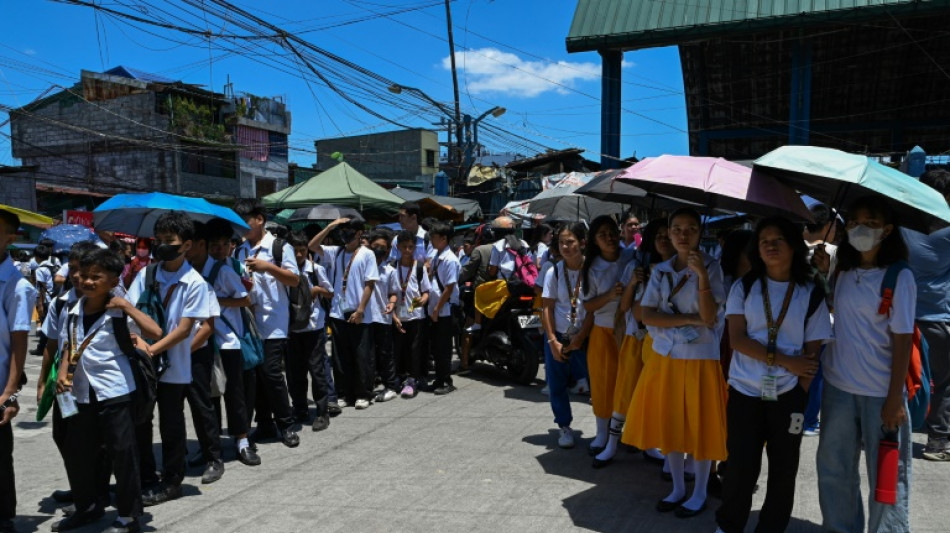
School's out: how climate change threatens education / Photo: JAM STA ROSA - AFP/File

Record-breaking heat last month that prompted governments in Asia to close schools offers fresh evidence of how climate change is threatening the education of millions of children.
The arrival of seasonal rains has now brought relief to some parts of the region, but experts warn the broader problem remains, and many countries are poorly prepared to handle the impacts of climate change on schooling.
Asia is warming faster than the global average, and climate change is producing more frequent, longer, and more intense heatwaves.
But heat is not the only challenge.
A warmer atmosphere holds more moisture, which can result in heavy rains and flooding.
This can damage schools or put them out of commission while they are used as shelters.
Hot weather can also drive wildfires and spikes in air pollution, which have caused school closures everywhere from India to Australia.
"The climate crisis is already a reality for children in East Asia and Pacific," the UN children's agency UNICEF warned last year.
Mohua Akter Nur, 13, is living proof of that claim, sweltering in a one-room home in Bangladesh's capital Dhaka after her school closed.
Intermittent electricity means she cannot even rely on a fan to cool the cramped dwelling.
"The heat is intolerable," she told AFP last month.
"Our school is shut, but I can't study at home."
- Poorest hit hardest -
April marked the 11th straight month of record global heat, and the pattern is clear in Bangladesh, said Shumon Sengupta, country director for NGO Save the Children.
"Not only are the temperatures higher, the duration of the high temperatures is much longer," he told AFP.
"Previously, few areas used to have these heatwaves, now the coverage of the country is much higher," he added.
Schools across much of Asia are simply not equipped to deal with the growing consequences of climate change.
Bangladesh's urban schools can be sturdy, but are often overcrowded, with little ventilation, said Sengupta.
In rural areas, corrugated metal roofs can turn classrooms into ovens, and electricity for fans is unreliable.
In Bangladesh and elsewhere, students often walk long distances to and from school, risking heatstroke in the process.
But closing schools comes with serious consequences, "particularly for children from poorer, vulnerable communities who do not have access to resources such as computers, internet and books," said Salwa Aleryani, UNICEF's health specialist for East Asia and the Pacific.
Those children "are also less likely to have better conditions at home to protect them during heatwaves".
They may be left unsupervised by parents who cannot afford to stay home, and school closures put children at higher risk of child labour, child marriage and even trafficking, said Sengupta.
- 'Wake up to this' -
Climate change also threatens schooling indirectly.
UNICEF research in Myanmar found that crop shortages caused by rising temperatures and unpredictable rain caused families to pull children from school to help with work or because they could no longer afford fees.
Some wealthy countries in the region have taken steps to protect children's education in the face of a changing climate.
In Japan, fewer than half of all public schools had air conditioning in 2018, but that figure jumped to over 95 percent by 2022 after a series of heatwaves.
Not all impacts can be mitigated, however, even in developed economies.
Australian authorities have repeatedly closed schools because of wildfires, and research has found long-term impacts on learning among students whose communities were worst affected.
Developing countries in the region need help to invest in upgrading infrastructure, said Sengupta, but the only real solution to the crisis lies in tackling the root cause: climate change.
"It's very important for government and policymakers to really, really wake up on this," he said.
"The climate crisis is a child crisis. Adults are causing the crisis, but it's children who are impacted the most."
S.Yamamoto--JT