The Japan Times - 'A blessing': Rains refill Iraq's drought-hit reservoirs

EUR -
AED 4.269899
AFN 72.662339
ALL 95.405511
AMD 428.950368
ANG 2.081712
AOA 1067.330384
ARS 1621.356113
AUD 1.625758
AWG 2.095711
AZN 1.980527
BAM 1.952809
BBD 2.342712
BDT 142.77316
BGN 1.941564
BHD 0.438736
BIF 3463.255005
BMD 1.162669
BND 1.486948
BOB 8.037827
BRL 5.923818
BSD 1.163118
BTN 111.565038
BWP 16.453082
BYN 3.236898
BYR 22788.315786
BZD 2.339357
CAD 1.600001
CDF 2610.191988
CHF 0.914404
CLF 0.026737
CLP 1052.20463
CNY 7.888827
CNH 7.922689
COP 4416.608133
CRC 527.637215
CUC 1.162669
CUP 30.810733
CVE 110.096369
CZK 24.325073
DJF 207.126313
DKK 7.473236
DOP 69.494752
DZD 154.501333
EGP 61.501196
ERN 17.440038
ETB 181.618544
FJD 2.561012
FKP 0.862572
GBP 0.871508
GEL 3.115639
GGP 0.862572
GHS 13.300856
GIP 0.862572
GMD 84.292821
GNF 10199.377903
GTQ 8.873523
GYD 243.351452
HKD 9.103781
HNL 30.934151
HRK 7.533282
HTG 152.299826
HUF 360.805293
IDR 20469.953455
ILS 3.394343
IMP 0.862572
INR 111.557996
IQD 1523.792263
IRR 1528909.962123
ISK 143.577646
JEP 0.862572
JMD 183.788496
JOD 0.82435
JPY 184.449292
KES 150.525696
KGS 101.675279
KHR 4666.932073
KMF 490.646704
KPW 1046.404385
KRW 1742.538579
KWD 0.358789
KYD 0.969332
KZT 546.063004
LAK 25509.366836
LBP 104161.250939
LKR 382.099678
LRD 212.857634
LSL 19.267337
LTL 3.433059
LVL 0.703287
LYD 7.385814
MAD 10.721878
MDL 20.122525
MGA 4841.667441
MKD 61.623296
MMK 2441.186696
MNT 4161.744004
MOP 9.381492
MRU 46.688489
MUR 54.842444
MVR 17.903675
MWK 2016.945397
MXN 20.182309
MYR 4.59372
MZN 74.305846
NAD 19.267089
NGN 1594.089176
NIO 42.805173
NOK 10.825322
NPR 178.503662
NZD 1.989595
OMR 0.447045
PAB 1.163138
PEN 3.987661
PGK 5.067239
PHP 71.634949
PKR 323.968666
PLN 4.244964
PYG 7088.143293
QAR 4.240006
RON 5.210505
RSD 117.405232
RUB 84.637916
RWF 1701.523095
SAR 4.380063
SBD 9.320115
SCR 15.845149
SDG 698.171038
SEK 10.967087
SGD 1.488321
SHP 0.86805
SLE 28.659693
SLL 24380.593665
SOS 664.793191
SRD 43.259365
STD 24064.904456
STN 24.462531
SVC 10.177412
SYP 128.512671
SZL 19.270732
THB 37.944894
TJS 10.852364
TMT 4.069342
TND 3.404286
TOP 2.799428
TRY 52.953804
TTD 7.895586
TWD 36.672333
TZS 3022.939585
UAH 51.358635
UGX 4367.310715
USD 1.162669
UYU 46.588642
UZS 13928.905095
VES 593.134301
VND 30642.146048
VUV 137.102475
WST 3.145716
XAF 654.965075
XAG 0.015168
XAU 0.000255
XCD 3.142171
XCG 2.096325
XDR 0.813791
XOF 654.953826
XPF 119.331742
YER 277.471017
ZAR 19.394775
ZMK 10465.424388
ZMW 21.896838
ZWL 374.378999
  • CMSC

    -0.0900

    23.05

    -0.39%

  • AZN

    -3.0350

    181.925

    -1.67%

  • RIO

    -5.8500

    103.74

    -5.64%

  • BCC

    -2.9700

    66.43

    -4.47%

  • BCE

    -0.2050

    23.985

    -0.85%

  • GSK

    -0.8864

    49.6125

    -1.79%

  • RYCEF

    -0.8300

    15.1

    -5.5%

  • BTI

    -1.2250

    65.475

    -1.87%

  • RBGPF

    0.8900

    61.68

    +1.44%

  • VOD

    -0.7350

    14.745

    -4.98%

  • RELX

    0.9400

    32.4

    +2.9%

  • NGG

    -7.0500

    80.38

    -8.77%

  • BP

    0.4342

    44.055

    +0.99%

  • JRI

    -0.4765

    12.53

    -3.8%

  • CMSD

    -0.1062

    23.1266

    -0.46%

'A blessing': Rains refill Iraq's drought-hit reservoirs
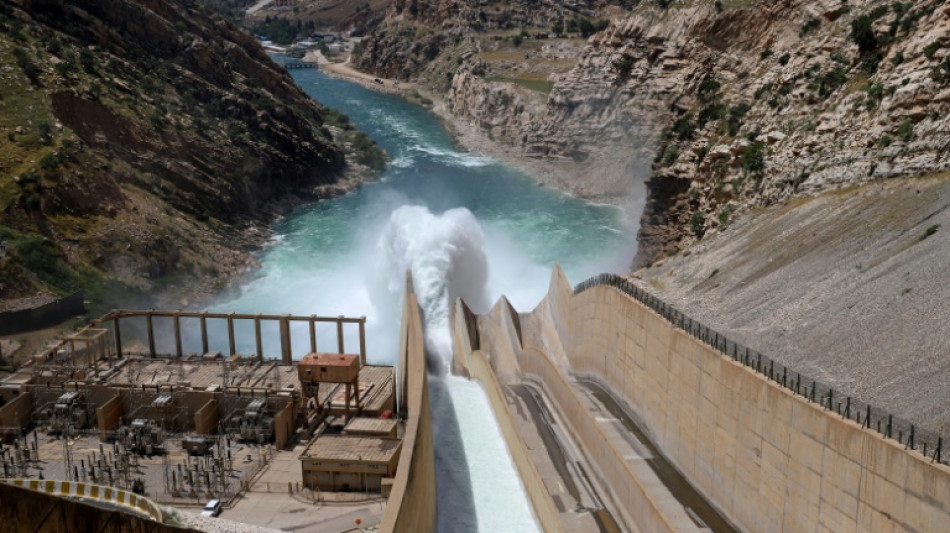
'A blessing': Rains refill Iraq's drought-hit reservoirs / Photo: Shwan MOHAMMED - AFP

'A blessing': Rains refill Iraq's drought-hit reservoirs

The reservoir behind the massive Darbandikhan dam, tucked between the rolling mountains of northeastern Iraq, is almost full again after four successive years of drought and severe water shortages.

Text size:

Iraqi officials say recent rainfall has refilled some of the water-scarce country's main reservoirs, taking levels to a record since 2019.

"The dam's storage capacity is three million cubic metres (106 million cubic feet). Today, with the available reserves, the dam is only missing 25 centimetres (10 inches) of water to be considered full," Saman Ismail, director of the Darbandikhan facility, told AFP on Sunday.

Built on the River Sirwan, the dam is located south of the city of Sulaimaniyah in Iraq's autonomous Kurdistan region.

"In the coming days, we will be able to say that it's full," said Ismail, with the water just a few metres below the road running along the edge of the basin.

The last time Darbandikhan was full was in 2019, and since then "we've only had years of drought and shortages," said Ismail.

He cited "climate change in the region" as a reason, "but also dam construction beyond Kurdistan's borders".

The central government in Baghdad says upstream dams built in neighbouring Iran and Turkey have heavily reduced water flow in Iraq's rivers, on top of rising temperatures and irregular rainfall.

This winter, however, bountiful rains have helped to ease shortages in Iraq, considered by the United Nations to be one of the five countries most vulnerable to some impacts of climate change.

In Iraq, rich in oil but where infrastructure is often run-down, torrential rains have also flooded the streets of Kurdistan's regional capital Arbil.

Four hikers died last week in floods in Kurdistan, and in Diyala, a rural province in central Iraq, houses were destroyed.

- 'Positive effects' -

Ali Radi Thamer, director of the dam authority at Iraq's water resources ministry, said that most of the country's six biggest dams have experienced a rise in water levels.

At the Mosul dam, the largest reservoir with a capacity of about 11 billion cubic metres, "the storage level is very good, we have benefitted from the rains and the floods," said Thamer.

Last summer, he added, Iraq's "water reserves... reached a historic low".

"The reserves available today will have positive effects for all sectors", Thamer said, including agriculture and treatment plants that produce potable water, as well as watering southern Iraq's fabled marshes that have dried up in recent years.

He cautioned that while 2019 saw "a sharp increase in water reserves", it was followed by "four successive dry seasons".

Water has been a major issue in Iraq, a country of 43 million people that faces a serious environmental crisis from worsening climate change, with temperatures frequently hitting 50 degrees Celsius (122 degrees Fahrenheit) in summer.

About five kilometres (three miles) south of Darbandikhan, terraces near a small riverside tourist establishment are submerged in water.

But owner Aland Salah prefers to see the glass half full.

"The water of the Sirwan river is a blessing," he told AFP.

"When the flow increases, the area grows in beauty.

"We have some damage, but we will keep working."

Y.Kato--JT