The Japan Times - Queen bumblebees surprise scientists by surviving underwater

EUR -
AED 4.261686
AFN 72.518126
ALL 96.160795
AMD 437.916051
ANG 2.076902
AOA 1063.92807
ARS 1620.894064
AUD 1.65476
AWG 2.088408
AZN 1.970846
BAM 1.960559
BBD 2.333294
BDT 142.143832
BGN 1.983186
BHD 0.438036
BIF 3440.071491
BMD 1.160226
BND 1.482153
BOB 8.005606
BRL 6.107314
BSD 1.158512
BTN 108.276243
BWP 15.830087
BYN 3.449425
BYR 22740.438859
BZD 2.329825
CAD 1.592922
CDF 2637.194957
CHF 0.913069
CLF 0.026782
CLP 1057.500432
CNY 7.982935
CNH 7.992499
COP 4304.857894
CRC 540.299947
CUC 1.160226
CUP 30.746002
CVE 110.511356
CZK 24.46604
DJF 206.195291
DKK 7.470861
DOP 69.468586
DZD 153.532302
EGP 60.725563
ERN 17.403397
ETB 182.590661
FJD 2.570366
FKP 0.869614
GBP 0.864444
GEL 3.150049
GGP 0.869614
GHS 12.652281
GIP 0.869614
GMD 84.69697
GNF 10186.788649
GTQ 8.873541
GYD 242.374636
HKD 9.089
HNL 30.769327
HRK 7.532537
HTG 151.73507
HUF 387.533623
IDR 19593.904666
ILS 3.61486
IMP 0.869614
INR 108.143086
IQD 1519.896679
IRR 1525755.822399
ISK 143.5661
JEP 0.869614
JMD 182.474533
JOD 0.822673
JPY 183.805982
KES 150.249669
KGS 101.462002
KHR 4658.309039
KMF 493.095954
KPW 1044.208436
KRW 1724.026537
KWD 0.355575
KYD 0.96546
KZT 558.403878
LAK 25002.880951
LBP 103898.280487
LKR 363.7774
LRD 213.013821
LSL 19.64241
LTL 3.425847
LVL 0.701809
LYD 7.419668
MAD 10.862015
MDL 20.262537
MGA 4832.343022
MKD 61.659959
MMK 2435.840288
MNT 4138.470064
MOP 9.347333
MRU 46.536872
MUR 54.286865
MVR 17.925481
MWK 2015.313859
MXN 20.626976
MYR 4.570713
MZN 74.149944
NAD 19.514851
NGN 1598.061442
NIO 42.603704
NOK 11.306181
NPR 173.227569
NZD 1.978238
OMR 0.446111
PAB 1.158457
PEN 4.029485
PGK 4.995357
PHP 68.941816
PKR 323.992893
PLN 4.256674
PYG 7570.409943
QAR 4.227895
RON 5.094786
RSD 117.392846
RUB 95.0483
RWF 1693.93065
SAR 4.355637
SBD 9.341816
SCR 17.754023
SDG 697.295937
SEK 10.810097
SGD 1.479793
SHP 0.87047
SLE 28.483818
SLL 24329.381573
SOS 663.067502
SRD 43.318793
STD 24014.345491
STN 24.559088
SVC 10.136169
SYP 128.279334
SZL 19.549569
THB 37.48982
TJS 11.068989
TMT 4.060793
TND 3.37041
TOP 2.793546
TRY 51.40987
TTD 7.864889
TWD 36.94854
TZS 3010.787548
UAH 50.865882
UGX 4373.522573
USD 1.160226
UYU 47.204794
UZS 14160.564212
VES 529.648437
VND 30561.525509
VUV 138.329272
WST 3.164856
XAF 657.53334
XAG 0.016773
XAU 0.000263
XCD 3.13557
XCG 2.087778
XDR 0.819211
XOF 659.593761
XPF 119.331742
YER 276.888123
ZAR 19.463841
ZMK 10443.420318
ZMW 22.445875
ZWL 373.592451
  • RBGPF

    -13.5000

    69

    -19.57%

  • CMSC

    0.2300

    22.88

    +1.01%

  • RYCEF

    0.7500

    16.05

    +4.67%

  • CMSD

    0.0816

    22.74

    +0.36%

  • NGG

    0.0700

    82.06

    +0.09%

  • BCC

    3.5800

    71.88

    +4.98%

  • RELX

    0.4500

    33.81

    +1.33%

  • BCE

    -0.0300

    25.76

    -0.12%

  • JRI

    -0.0900

    11.68

    -0.77%

  • RIO

    2.6900

    85.84

    +3.13%

  • VOD

    0.1500

    14.48

    +1.04%

  • GSK

    0.1500

    51.99

    +0.29%

  • AZN

    0.4700

    184.07

    +0.26%

  • BTI

    0.5500

    57.92

    +0.95%

  • BP

    -1.2100

    43.57

    -2.78%

Queen bumblebees surprise scientists by surviving underwater
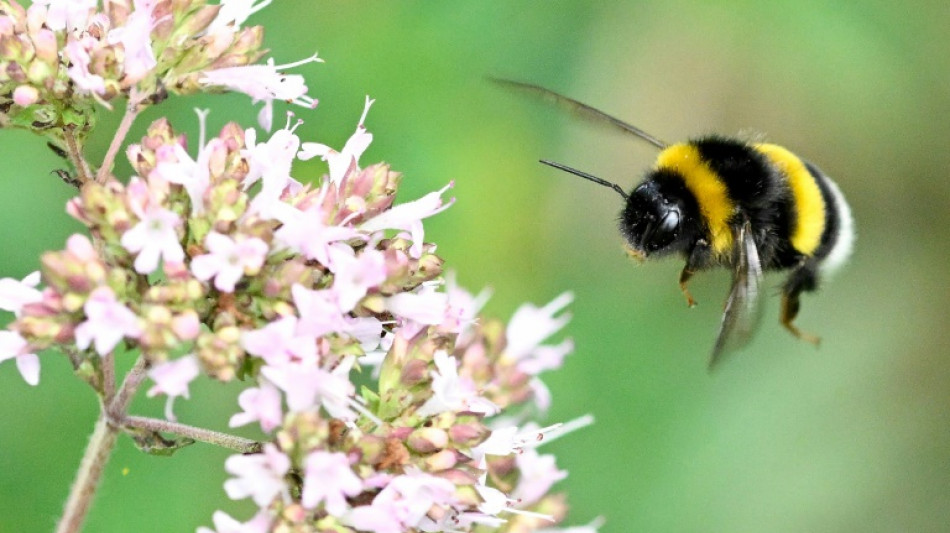
Queen bumblebees surprise scientists by surviving underwater / Photo: Damien MEYER - AFP

Queen bumblebees surprise scientists by surviving underwater

Bumblebees can surprisingly withstand days underwater, according to a study published Wednesday, suggesting they could withstand increased floods brought on by climate change that threaten their winter hibernation burrows.

Text size:

The survival of these pollinators that are crucial to ecosystems is "encouraging" amid worrying global trends of their declining populations, the study's lead author Sabrina Rondeau told AFP.

With global warming prompting more frequent and extreme floods in regions around the world, it poses "an unpredictable challenge for soil-dwelling species, particularly bees nesting or overwintering underground", co-author Nigel Raine of the University of Guelph said in a statement.

Rondeau said she first discovered queen bumblebees could withstand drowning by accident.

She had been studying the effect of pesticide residues in soil on queen bumblebees that burrow underground for the winter when water accidentally entered the tubes housing a few of the bees.

"I freaked out," said Rondeau, who had been conducting the experiment for her doctoral studies. "It was only a small proportion... so it was not that big of a deal, but I didn't want to lose those bees."

To her "shock", she said, they survived.

"I've been studying bumblebees for a very long time. I've talked about it to a lot of people and no one knew that this was a possibility," she said.

She launched another experiment to better understand what happened.

Researchers placed 143 hibernating queen bumblebees in tubes -- some with no water as a comparative group, some floating in water and some fully submerged using a plunger for a period ranging from eight hours to seven days, according to the study published in the journal Biology Letters.

Remarkably, 81 percent of the hibernating queens that were submerged not only survived seven days, but once returned to dry conditions remained alive eight weeks later.

The long-term impact on the bees' health and the effects it could have on a colony still needs further research, Rondeau noted.

The common eastern bumblebees used in the study are found in North America and are particularly hardy, not showing the same degree of population declines as other bee species, she said.

"So we are also wondering whether this resistance to flooding can be part of why they're doing so well," said Rondeau, now a postdoctoral fellow at the University of Ottawa.

The study would have to be replicated on other species of bumblebees to determine how common the trait is.

"But it's encouraging to know that at least (flooding) is not another big threat that we have to consider," she said.

S.Yamamoto--JT