Australia battles to save last 11 wild 'earless dragons' / Photo: DAVID GRAY - AFP

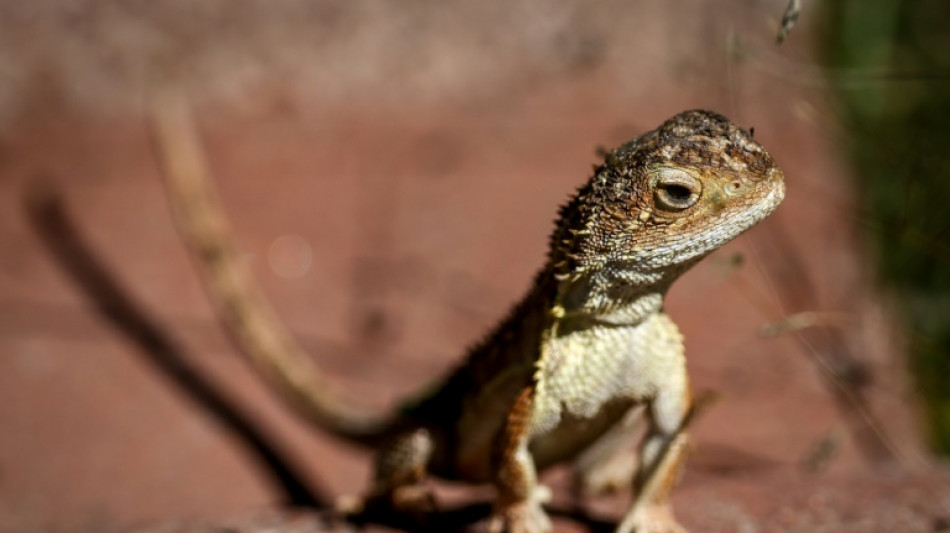
Australia's grassland earless dragon is no bigger than a pinkie when it emerges from its shell, but the little lizard faces an enormous challenge in the years ahead: avoiding extinction.
As recently as 2019, scientists in Canberra counted hundreds of grassland earless dragons in the wild. This year, they found 11.
In other areas of the country, the lizard has not been seen for three decades.
The earless dragon -- which is light brown and has long white stripes down its body -- measures about 15 centimetres (the size of a US$1 bill) when fully grown.
It lacks an external ear opening and functional eardrum, hence the name.
Australia has four species of earless dragons. Three are critically endangered, the highest level of risk, while the fourth is endangered.
The critically endangered dragons will likely be extinct in the next 20 years without conservation efforts.
"If we properly manage their conservation, we can bring them back," said University of Canberra Professor Bernd Gruber, who is working to do just that.
- Breeding programmes -
Australia is home to thousands of unique animals, including 1,130 species of reptiles that are found nowhere else in the world.
Climate change, invasive plants and animals, and habitat destruction -- such as the 2019 bushfires, which burned more than 19 million hectares (46 million acres) -- have pushed Australia's native species to the brink.
In the past 300 years, about 100 of Australia's unique flora and fauna species have been wiped off the planet.
To save the earless dragons there are several breeding programmes under way across Australia, including a bio-secure facility in Canberra's bushlands, which Gruber is overseeing.
On shelves are dozens of tanks that house the lizards –- one to each container –- with a burrow, grass and heat lamps to keep them warm.
The biggest problem is matchmaking, with the territorial female lizards preferring to choose their mates.
This means that scientists must introduce different male lizards to the female until she approves.
If that was not hard enough, scientists must also use genetic analysis to determine which lizards are compatible together and ensure genetic diversity in their offspring.
At any one time, the breeding programmes around Australia can have up to 90 earless dragons, which will eventually be released back into the wild.
At the moment, Gruber is looking after more than 20 small lizards that have just hatched. Scientists almost missed the tiny eggs until three weeks ago.
"There is a sense of hope looking over them," he told AFP.
- Habitat destruction -
Despite the efforts of scientists, the lizards are contending with a shrinking habitat and a changing climate.
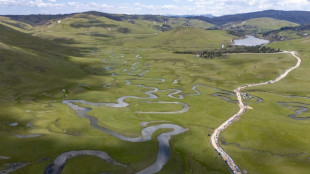
Australian Conservation Foundation campaigner Peta Bulling said the lizards only live in temperate grasslands, most of which have been destroyed by urban development.
Only 0.5 percent of grasslands present at the time of European colonisation still exist.
Without the lizards, Australia's alpine grasslands could look vastly different.
"We don't understand everything the grassland earless dragons do in the ecosystem, but we can make guesses they play an important role in managing invertebrate populations. They live in burrows in the soil, so they are probably aerating the soil in different ways too," she told AFP.
Bulling said that while it was important to bring the lizard back, it was also vital to protect their habitats, without which the newly saved lizards would have nowhere to live.
"They are highly specialised to live in their habitat but they will not adapt quickly to change," she said.
Last year, scientists rediscovered a small number of another kind of earless dragons after 50 years in an area that is being kept secret for conservation reasons.
Resources are being poured into understanding just how big that population is and what can be done to protect it.
T.Sasaki--JT