The Japan Times - Florida coral reef still struggling after 2023 heat wave

EUR -
AED 4.260787
AFN 72.50444
ALL 96.181978
AMD 437.900577
ANG 2.076831
AOA 1063.891421
ARS 1620.797192
AUD 1.658085
AWG 2.088336
AZN 1.970026
BAM 1.960492
BBD 2.333215
BDT 142.138981
BGN 1.983118
BHD 0.437933
BIF 3439.954083
BMD 1.160187
BND 1.482103
BOB 8.005333
BRL 6.074626
BSD 1.158473
BTN 108.272547
BWP 15.829546
BYN 3.449307
BYR 22739.662744
BZD 2.329746
CAD 1.593499
CDF 2637.105366
CHF 0.913137
CLF 0.026773
CLP 1057.138921
CNY 7.982668
CNH 7.990491
COP 4305.824752
CRC 540.281506
CUC 1.160187
CUP 30.744952
CVE 110.507645
CZK 24.446704
DJF 206.188037
DKK 7.47187
DOP 69.466132
DZD 153.8229
EGP 60.730676
ERN 17.402803
ETB 182.584407
FJD 2.57144
FKP 0.869584
GBP 0.864519
GEL 3.149927
GGP 0.869584
GHS 12.65186
GIP 0.869584
GMD 84.694191
GNF 10186.440898
GTQ 8.873238
GYD 242.366364
HKD 9.089078
HNL 30.768235
HRK 7.535064
HTG 151.729892
HUF 387.927623
IDR 19571.192389
ILS 3.614736
IMP 0.869584
INR 108.276354
IQD 1519.844806
IRR 1525703.749098
ISK 143.596065
JEP 0.869584
JMD 182.468306
JOD 0.822596
JPY 183.95401
KES 150.227716
KGS 101.458707
KHR 4658.150428
KMF 493.079859
KPW 1044.172798
KRW 1733.818235
KWD 0.355516
KYD 0.965427
KZT 558.38482
LAK 25002.026821
LBP 103894.734936
LKR 363.764984
LRD 213.007367
LSL 19.642187
LTL 3.42573
LVL 0.701786
LYD 7.419431
MAD 10.861648
MDL 20.261845
MGA 4832.178169
MKD 61.598908
MMK 2435.757154
MNT 4138.328821
MOP 9.347014
MRU 46.53515
MUR 54.029674
MVR 17.924774
MWK 2015.24491
MXN 20.658637
MYR 4.553723
MZN 74.147926
NAD 19.514377
NGN 1601.232315
NIO 42.601697
NOK 11.302947
NPR 173.221657
NZD 1.983548
OMR 0.446116
PAB 1.158418
PEN 4.029285
PGK 4.995188
PHP 69.436894
PKR 323.98207
PLN 4.260299
PYG 7570.15157
QAR 4.227745
RON 5.095425
RSD 117.501369
RUB 95.04465
RWF 1693.872837
SAR 4.355741
SBD 9.341497
SCR 16.846394
SDG 697.271915
SEK 10.829979
SGD 1.480219
SHP 0.870441
SLE 28.482483
SLL 24328.551228
SOS 663.046126
SRD 43.317318
STD 24013.525898
STN 24.55825
SVC 10.135823
SYP 128.274956
SZL 19.549855
THB 37.671069
TJS 11.068611
TMT 4.060654
TND 3.370309
TOP 2.793451
TRY 51.447094
TTD 7.86462
TWD 36.983051
TZS 3010.684749
UAH 50.864146
UGX 4373.373308
USD 1.160187
UYU 47.203183
UZS 14160.080286
VES 529.630361
VND 30560.482466
VUV 138.324551
WST 3.164748
XAF 657.510898
XAG 0.016717
XAU 0.000262
XCD 3.135463
XCG 2.087707
XDR 0.819183
XOF 659.568219
XPF 119.331742
YER 276.878852
ZAR 19.574964
ZMK 10443.064834
ZMW 22.445109
ZWL 373.5797
  • CMSD

    0.0816

    22.74

    +0.36%

  • CMSC

    0.2300

    22.88

    +1.01%

  • BCC

    3.5800

    71.88

    +4.98%

  • GSK

    0.1500

    51.99

    +0.29%

  • NGG

    0.0700

    82.06

    +0.09%

  • BCE

    -0.0300

    25.76

    -0.12%

  • RBGPF

    -13.5000

    69

    -19.57%

  • AZN

    0.4700

    184.07

    +0.26%

  • BTI

    0.5500

    57.92

    +0.95%

  • RIO

    2.6900

    85.84

    +3.13%

  • BP

    -1.2100

    43.57

    -2.78%

  • JRI

    -0.0900

    11.68

    -0.77%

  • RYCEF

    0.7500

    16.05

    +4.67%

  • VOD

    0.1500

    14.48

    +1.04%

  • RELX

    0.4500

    33.81

    +1.33%

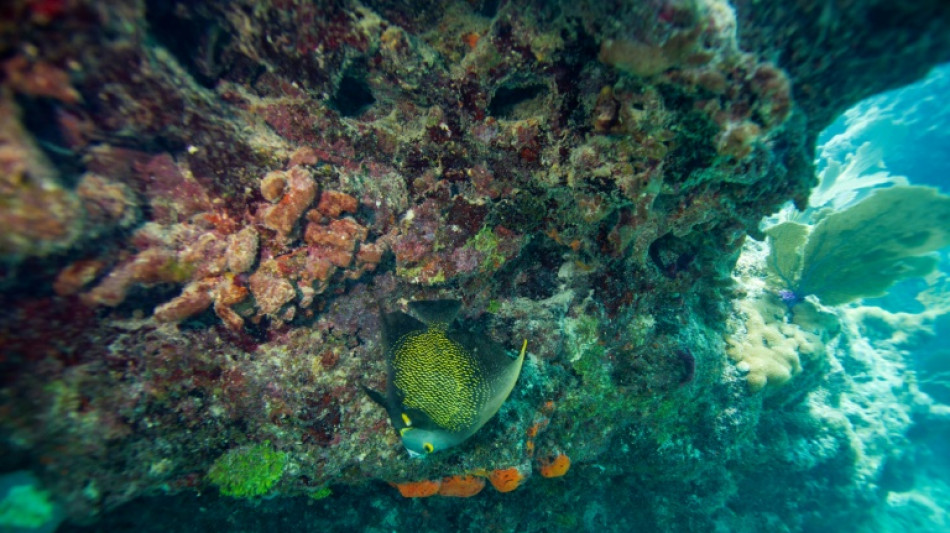
Florida coral reef still struggling after 2023 heat wave
Florida coral reef still struggling after 2023 heat wave / Photo: Joseph Prezioso - AFP/File

Florida coral reef still struggling after 2023 heat wave

Coral reefs off the Florida Keys islands are struggling to recover from last summer's record-breaking heat wave, new data showed Thursday, in another sign of the devastating impacts of human-caused climate change.

Text size:

The state's southern waters experienced hot tub-like conditions with temperatures in July briefly topping 100 degrees Fahrenheit (37.8C) in Manatee Bay.

Coral, marine invertebrates made up of individual animals called polyps, have a symbiotic relationship with the algae that live inside their tissue and provide their primary source of food.

When the water is too warm, coral expel their algae and turn white, an effect called "bleaching" that leaves them exposed to disease and at risk of dying off.

A team of National Oceanic and Atmospheric Administration (NOAA) researchers carried out a scientific mission to assess the heat wave's impacts, surveying 64 locations at five of the major reefs that make up most of the state's 255-mile- (410 kilometer-) long barrier reef, which is home to sea turtles, stingrays, sharks, dolphins, grouper and many more species of fish.

They found less than 22 percent of approximately 1,500 staghorn coral (Acropora cervicornis) -- a species that is listed as a candidate for endangered species protections -- remained alive.

Among the five reefs surveyed, living elkhorn coral (Acropora palmata), which is listed as threatened throughout its range, was found only at three sites.

"The findings from this assessment are critical to understanding the impacts to corals throughout the Florida Keys following the unprecedented marine heat wave," said NOAA's Sarah Fangman.

"They also offer a glimpse into coral's future in a warming world," she continued, adding the work would inform ongoing restoration efforts.

NOAA is leading an initiative to restore nearly 3 million square feet (280,000 square meters) of coral reef, the equivalent of more than 50 American football fields -- through growing and transplanating corals.

Florida's coral reefs are vital not just to their wider ecosystem but also for the state's tourism and recreation industries. But their health has been declining since the 1970s due to the impact of human activities, hurricanes, heat-induced bleaching and disease.

K.Abe--JT