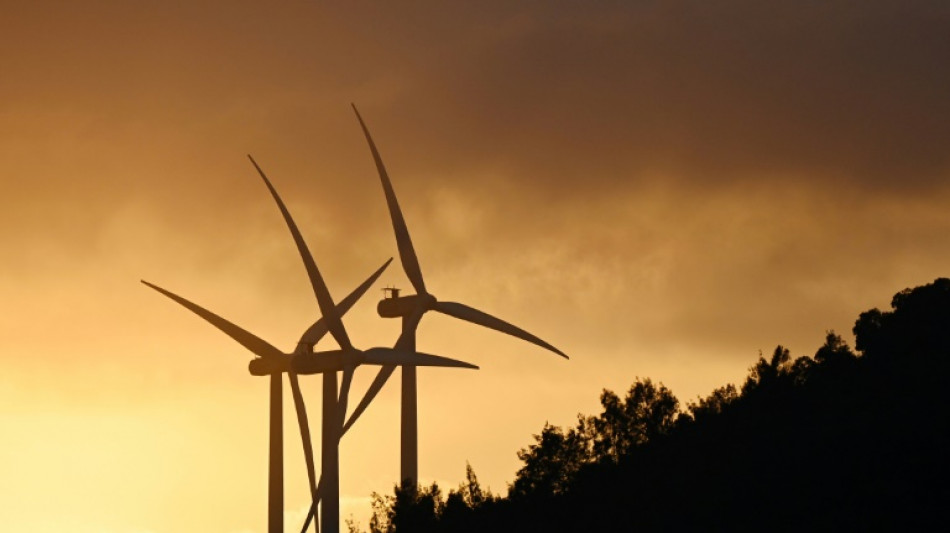
Clean energy largest driver of Chinese GDP growth in 2023: report / Photo: GREG BAKER - AFP/File

Clean-energy projects were the largest driver of China's economic growth in 2023, with Beijing investing nearly as much in decarbonisation infrastructure as total global investment in fossil fuels, according to a report released Thursday.
China is the world's biggest emitter of greenhouse gases driving climate change, but it is also the top producer of wind and solar energy.
Faced with soaring energy consumption, the country has turbocharged its use of renewables -- but also in 2022 approved its largest expansion of coal-fired power plants since 2015, despite President Xi Jinping pledging to peak CO2 emissions between 2026 and 2030.
Investment in "clean-energy" sectors accounted for 40 percent of China's GDP expansion last year, researchers at the Finland-based Centre for Research on Energy and Clean Air (CREA) said in a new report on Thursday.
"With Chinese investment growing by just 1.5 trillion yuan in 2023 overall, the analysis shows that clean energy accounted for all of the growth, while investment in sectors such as real estate shrank," the researchers said.
The researchers examined investment in solar power, electric vehicles (EVs), energy efficiency, railways, energy storage, electricity grids, wind, nuclear and hydropower.
These sectors received $890 billion in investment, almost as much as the total global investment in fossil fuels last year, CREA researchers said.
"Without the growth from clean-energy sectors, China's GDP would have missed the government's growth target of 'around 5 percent', rising by only 3.0 percent instead of 5.2 percent," the researchers found.
"China's reliance on the clean technology sectors to drive growth and achieve key economic targets boosts their economic and political importance," the researchers said. "It could also support an accelerated energy transition."
- EV glut -
They warned, however, that China could soon have excess capacity in the sector, and that "there is a limit to how much solar power, batteries and other clean technology can be absorbed".
"In order to keep driving growth in investment, clean technology manufacturing would need to not only absorb as much capital as it did in 2023, but keep increasing investment year after year," the researchers said.
The threat of overcapacity is beginning to trouble Chinese policymakers, with Vice Minister of Industry Xin Guobin saying that some businesses had been "blindly rushing in, and building redundant new energy vehicle projects".
Xin said at a press conference last week that the government would take measures to crack down on unnecessary EV projects.
Buoyed by years of government subsidies, China's electric car industry has exploded in the past decade, with homegrown BYD overtaking US carmaker Tesla in electric vehicle sales last quarter.
Between 2014 and the end of 2022, the Chinese government said it had spent more than 200 billion yuan ($28 billion) on subsidies and tax breaks for EV purchases alone.
Companies in other industries are looking to grab a share of the pie, including consumer electronics giant Xiaomi, which unveiled its first electric car model last month.
Chinese EV firms now face problems, however, including "insufficient consumer demand" and trade barriers in other markets, with many businesses still struggling to make a profit, Xin warned at a press conference on Friday.
International Energy Agency chief Fatih Birol warned last week that trade barriers in the clean energy sector could slow down the global energy transition.
Both the United States and European countries have signalled they might adopt more protectionist policies to buttress their own green sectors.
Washington is considering raising tariffs on Chinese EVs, as well as other goods like solar cells, media reports said in December.
EVs are already subjected to a 25 percent import fee introduced on Chinese automobiles during Donald Trump's administration.
In October, the EU announced a probe into China's EV subsidies after accusations that the resulting products undercut European competitors.
The bloc is also mulling a separate investigation into Chinese support for its manufacturers of wind turbines.
K.Abe--JT