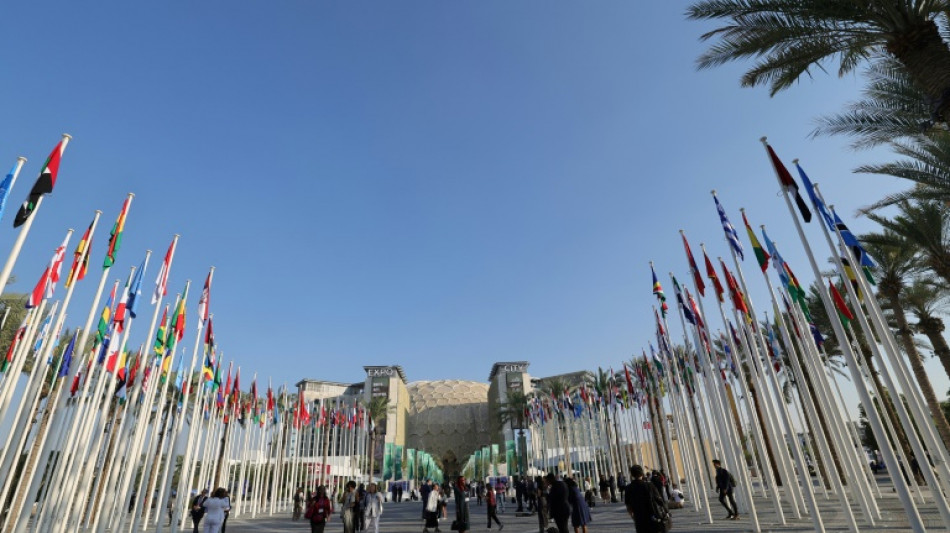
COP28's Emirati host narrows fossil fuel ambition, drawing fire / Photo: Giuseppe CACACE - AFP

The Emirati head of COP28 climate talks on Monday stopped short of pushing for a phase-out of fossil fuels, in a first bid for consensus that drew immediate fire from Western powers and environmentalists who had hoped for a historic turning point.
With hours to go before the official end to the 13-day UN summit in Dubai, COP28 president Sultan Al Jaber released a new draft agreement aimed at bringing onboard the nearly 200 countries, which include Saudi Arabia and other producers seeking to preserve their economic lifeblood.
After an earlier draft listed the landmark option of a "phase-out" of oil, gas and coal, the new text draft focuses on "reducing" their production and consumption in order to achieve net-zero emissions by 2050.
Jaber -- whose role as president of the UAE national oil company has drawn suspicion from environmentalists -- called his text a step forward and said he still sought "high ambition" on the fossil-fuel language.
"We have made progress but we still have a lot to do," Jaber said in a plenary session.
Small island states that fear that climate change threatens their very existence accused the Emiratis of ignoring their interests.
"The Republic of the Marshall Islands did not come here to sign our death warrant," said its negotiator John Silk, demanding an end to fossil fuels.
Environmentalists said the text was woefully inefficient in checking warming at 1.5 degrees Celsius above pre-industrial levels -- the goal blessed by the 2015 Paris accord to avoid the worst ravages of climate change including worsening storms and droughts and rising sea levels.
"If this race-to-the-bottom monstrosity gets enshrined as the final word, this crucial COP will be a failure," said Jean Su of the Center for Biological Diversity.
Former US vice president Al Gore, who won a Nobel peace prize for his work on climate change, said that "COP28 is now on the verge of complete failure."
The draft, he said, "reads as if OPEC dictated it word for word."
The text does not go so far as to demand actions on fossil fuels, only presenting measures that nations "could" take.
"A list of crucial actions has become a menu to pick and choose from," said analyst Dave Jones of Ember's Global Insights Lead.
"And the main course doesn't even include a fossil-fuel phase-out."
- Western powers disappointed -
If the text aimed to win over the Saudis, it disappointed Western powers with the European Union, the United States, Germany and France all calling for stronger language.
"This text is insufficient. There are elements that are not acceptable as they are," French negotiator Agnes Pannier-Runacher said.
The United States, while voicing appreciation for Emirati efforts, called for fossil fuel language to be "substantially strengthened".
But a person familiar with the COP28 presidency's thinking called the text "an opening gambit" that can be built upon.
Negotiators who have spent 12 days in the glitzy metropolis built on petrodollars were expected to work through the night, with few expecting an agreement in time by the official close on Tuesday.
"We will talk as long as necessary and we will do our utmost as the European Union to arrive at what the world needs," said EU climate chief Wopke Hoekstra.
The draft agreement says countries can take action that includes "reducing both consumption and production of fossil fuels, in a just, orderly and equitable manner so as to achieve net zero by, before, or around 2050 in keeping with the science".
On coal, the dirtiest major form of energy, the text lists limitations on "new and unabated coal power" -- meaning going ahead with potential projects that use new carbon capture and storage (CCS) technologies.
The text does list an option of "phasing out" of "inefficient fossil fuel subsidies" that encourage "wasteful consumption".
COP28 is taking place at the end of the hottest year on record with scientists believing it may be the warmest in more than 100,000 years.
Climate-related disasters in 2023 have included drought in the Horn of Africa and severe wildfires in Canada, Greece and Hawaii.
- US-China unity -
In a rare display of unity between rival powers, China and the United States, the world's two largest emitters, have largely been cooperating, with veteran US negotiator John Kerry pushing for a success as he celebrated his 80th birthday.
The latest draft deal includes language similar to a joint US-China statement released last month.
The COP28 deal calls for accelerating the deployment of zero and low-emissions technologies, including renewables, nuclear power and CCS "so as to enhance efforts towards substitution of unabated fossil fuels in energy systems".
Critics say carbon capture technology remains too expensive and would never be enough on its own to meaningfully reduce emissions.
K.Yamaguchi--JT