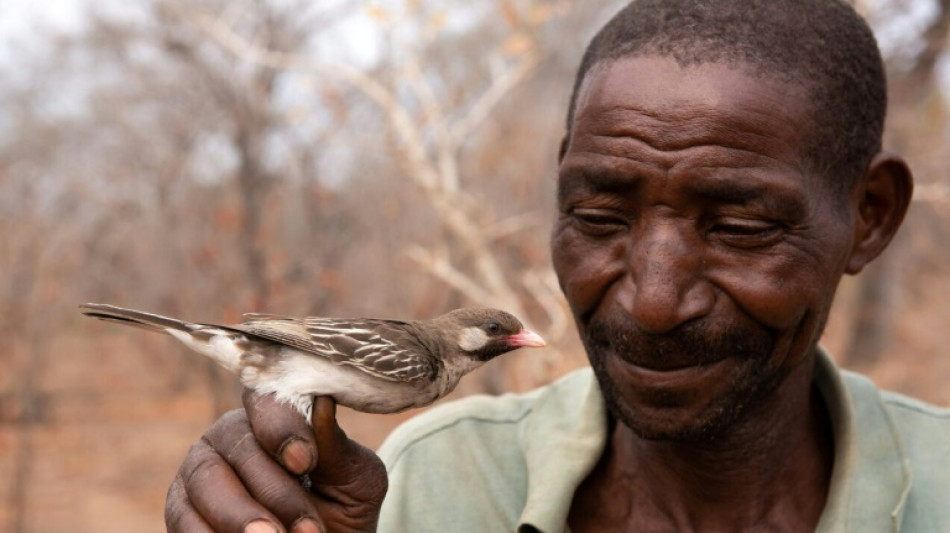
Wild birds analyze grunts, whistles made by human honey-hunters / Photo: Claire Spottiswoode - University of Cambridge/AFP

In parts of Africa, expert honey-hunters call out to a species of bird known as the greater honeyguide, which leads them to wild bee nests -- a mutually beneficial practice.
In a new study published Thursday in Science, researchers have found that honeyguide birds in Tanzania and Mozambique distinguish between honey-hunters' calls, responding more readily to signals used in their local area.
"The assignment of meaning to arbitrary or semi-arbitrary sounds is one of the features that characterizes human language," joint lead author Claire Spottiswoode, an evolutionary biologist at the University of Cambridge, told AFP.
The new research shows this phenomenon "extends to our interactions with other species, showing how continuous we really are with the rest of the natural world."
The Hadza, a group of hunter-gatherers in northern Tanzania, use a melodic whistle to initiate a partnership with honeyguides, while the Yao people of Mozambique use a trill followed by a grunt that sounds like "brrr-hmm!"
Once a nest is found, the humans crack it open, harvesting the honey and bee larvae, while the birds feast on the exposed beeswax.
Using mathematical models and audio playback, Spottiswoode and her co-author Brian Wood, a UCLA anthropologist, studied these signals, how helpful they were for people, and their effects on the birds.
They found the honeyguide birds of Tanzania were more than three times more likely to cooperate after hearing local Hadza whistles compared to "foreign" Yao calls.
Conversely, the honeyguides of Mozambique were almost twice as likely to seek a partnership after hearing a Yao trill-grunt than a foreign Hadza whistle.
The authors called this an example of "cultural coevolution," with humans of an area more likely to be successful if they stick to the local tradition, just as the birds of that region keep their ears out for the specific local call.
As for why such stark differences arose between the communities, practical considerations may be at play.
The Hadza hunt mammals using bows and arrows, and using a bird-like whistle reduces the chances of frightening away the other prey they are also after.
The Yao, meanwhile, don't hunt mammals and their trill-grunt might be a good way of scaring off elephants or buffaloes whom they don't wish to startle in a close encounter.
"Not just among the Hadza, but in hunting cultures around the world, people use whistles as a form of encrypted communication -- to share information while avoiding detection by prey," Wood said.
- A dying practice -
How exactly honeyguides learn localized human calls is an area for future study.
Perhaps they watch and copy the behavior of older birds, or perhaps they form positive associations between the human signal and a reward.
Nor is it known just how far this partnership goes back.
Our pre-Homo sapien ancestors acquired mastery of fire and stone tools between 1.5 - 3 million years ago, respectively, and so "it's plausible that this relationship could be really ancient," said Spottiswoode.
It wasn't until a seminal study published in 1989 that the scientific world was convinced the honeyguide-honey hunter relationship was real, not just a folktale or superstition.
But the practice is slowly dying out, partly as a result of changes in the way people obtain sweet food, and partly because people are prevented from interacting with honeyguides in protected nature parks.
"The birds still call to us, but we don't necessarily follow them," said Spottiswoode.
"We should really treasure these remaining places where the relationship still thrives and where this rich interspecies culture still exists."
Y.Ishikawa--JT