The Japan Times - UN report warns of catastrophic risks to Earth systems

EUR -
AED 4.30605
AFN 77.455431
ALL 96.368843
AMD 446.825609
ANG 2.098861
AOA 1075.194297
ARS 1684.256833
AUD 1.75871
AWG 2.113454
AZN 1.990675
BAM 1.954163
BBD 2.357215
BDT 143.020165
BGN 1.955393
BHD 0.442026
BIF 3459.001738
BMD 1.172513
BND 1.513838
BOB 8.087224
BRL 6.349745
BSD 1.170314
BTN 105.638487
BWP 16.520088
BYN 3.433823
BYR 22981.246248
BZD 2.353818
CAD 1.612973
CDF 2620.565058
CHF 0.932962
CLF 0.027339
CLP 1072.493319
CNY 8.275653
CNH 8.268371
COP 4459.358408
CRC 582.814151
CUC 1.172513
CUP 31.071583
CVE 110.172687
CZK 24.225634
DJF 208.404491
DKK 7.470031
DOP 74.947522
DZD 152.069003
EGP 55.74336
ERN 17.587688
ETB 182.244576
FJD 2.663717
FKP 0.873318
GBP 0.876851
GEL 3.168164
GGP 0.873318
GHS 13.435742
GIP 0.873318
GMD 85.593444
GNF 10179.470725
GTQ 8.96349
GYD 244.814872
HKD 9.128872
HNL 30.812314
HRK 7.533513
HTG 153.270269
HUF 383.949754
IDR 19529.662388
ILS 3.757716
IMP 0.873318
INR 106.095444
IQD 1533.115418
IRR 49374.504122
ISK 148.206273
JEP 0.873318
JMD 187.502094
JOD 0.831307
JPY 182.852189
KES 150.926355
KGS 102.536535
KHR 4685.054462
KMF 492.45513
KPW 1055.256887
KRW 1731.578572
KWD 0.359668
KYD 0.975283
KZT 609.39939
LAK 25383.73123
LBP 104804.385472
LKR 361.926745
LRD 206.56692
LSL 19.820193
LTL 3.462125
LVL 0.709241
LYD 6.356647
MAD 10.76548
MDL 19.9313
MGA 5190.62869
MKD 61.534638
MMK 2462.590834
MNT 4159.343647
MOP 9.38044
MRU 46.393325
MUR 53.841242
MVR 18.068604
MWK 2029.39094
MXN 21.161231
MYR 4.807886
MZN 74.924535
NAD 19.820193
NGN 1700.342027
NIO 43.063917
NOK 11.861178
NPR 169.022099
NZD 2.017765
OMR 0.450856
PAB 1.170319
PEN 3.944495
PGK 4.965818
PHP 69.261539
PKR 329.157998
PLN 4.223168
PYG 7998.264228
QAR 4.265426
RON 5.089523
RSD 117.366736
RUB 93.397389
RWF 1703.465419
SAR 4.399723
SBD 9.650473
SCR 15.979173
SDG 705.269084
SEK 10.892648
SGD 1.514641
SHP 0.879688
SLE 28.264217
SLL 24587.000022
SOS 667.637746
SRD 45.244327
STD 24268.642774
STN 24.479385
SVC 10.24042
SYP 12966.090323
SZL 19.814313
THB 36.957449
TJS 10.790559
TMT 4.103794
TND 3.431525
TOP 2.823129
TRY 50.060647
TTD 7.942345
TWD 36.573601
TZS 2884.366813
UAH 49.399998
UGX 4161.513111
USD 1.172513
UYU 46.081389
UZS 14068.212388
VES 310.404955
VND 30844.1155
VUV 142.444053
WST 3.264212
XAF 655.405048
XAG 0.01819
XAU 0.000271
XCD 3.168774
XCG 2.109233
XDR 0.815114
XOF 655.405048
XPF 119.331742
YER 279.49766
ZAR 19.7712
ZMK 10554.022157
ZMW 26.830405
ZWL 377.548567
  • SCS

    0.0200

    16.14

    +0.12%

  • CMSC

    0.1300

    23.43

    +0.55%

  • BCC

    -0.7500

    76.26

    -0.98%

  • CMSD

    0.1200

    23.4

    +0.51%

  • JRI

    0.0000

    13.72

    0%

  • RBGPF

    0.0000

    81.17

    0%

  • BCE

    0.2100

    23.4

    +0.9%

  • RIO

    0.5000

    76.74

    +0.65%

  • NGG

    0.0500

    74.69

    +0.07%

  • GSK

    0.4700

    48.88

    +0.96%

  • AZN

    -1.2200

    90.29

    -1.35%

  • RYCEF

    -0.1000

    14.64

    -0.68%

  • BP

    -0.3500

    35.53

    -0.99%

  • BTI

    -0.3900

    58.37

    -0.67%

  • VOD

    -0.0200

    12.54

    -0.16%

  • RELX

    0.2000

    40.28

    +0.5%

UN report warns of catastrophic risks to Earth systems
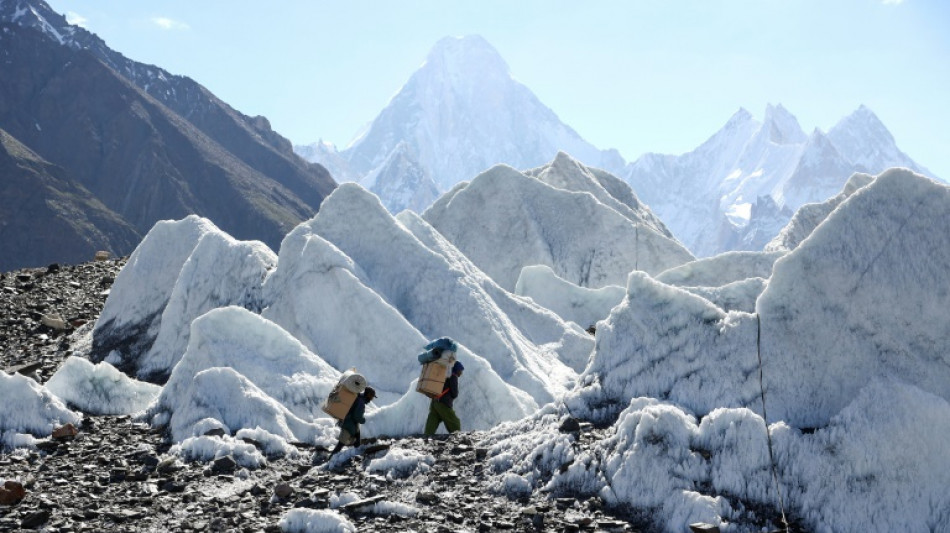
UN report warns of catastrophic risks to Earth systems / Photo: Joe STENSON - AFP

UN report warns of catastrophic risks to Earth systems

Melting glaciers, unbearable heat and space junk: a month before crunch climate talks in the United Arab Emirates, a UN report published Wednesday warns about irreversible impacts to the planet without drastic changes to connected social and physical systems.

Text size:

The Interconnected Disaster Risks Report identifies thresholds it calls "risk tipping points," defined as "the moment at which a given socioecological system is no longer able to buffer risks and provide its expected function" -- after which the risk of catastrophe increases significantly.

It focuses on six areas that connect the physical and natural world with human society: accelerating extinctions, groundwater depletion, mountain glacial melt, space debris, unbearable heat and an "uninsurable" future.

"As we indiscriminately extract our water resources, damage nature and biodiversity, and pollute both Earth and space, we are moving dangerously close to the brink of multiple risk tipping points that could destroy the very systems that our life depends on," said Zita Sebesvari, the report's lead author.

For example: underground water reservoirs represent an essential freshwater resource around the world and today mitigate half of the losses of agriculture caused by droughts, which are being exacerbated by climate change.

But aquifers themselves are now depleting faster than they can be naturally replenished: Saudi Arabia has already crossed the groundwater risk tipping point while India isn't far behind.

In the case of accelerating extinctions, the report highlights the cascading effects of extinctions throughout food chains.

"The gopher tortoise, which is threatened with extinction, digs burrows that are used by more than 350 other species for breeding, feeding, protection from predators and avoiding extreme temperatures," the report said.

If the gopher tortoise goes extinct, the gopher frog that helps control insect populations will likely follow, triggering effects throughout the entire forest ecosystem of the southeastern United States.

Mountain glaciers that store vast amounts of freshwater meanwhile are melting twice as fast as they did in the past two decades.

"Peak water" -- the point when a glacier produces its maximum amount of water runoff due to melting -- has been reached or is expected to be reached within the next ten years across small glaciers in Central Europe, Western Canada and South America.

"The 90,000+ glaciers of the Himalayas, Karakoram and Hindu Kush mountains are at risk, and so are the nearly 870 million people that rely on them," the report said.

In the case of space junk, the report warns Earth's orbit is in danger of becoming so full of debris that a collision triggers a chain reaction that threatens humanity's ability to operate satellites -- including those that provide vital early warning monitoring against disasters.

The report finds most solutions currently being implemented focus on delaying problems rather than genuinely addressing the root causes.

"We need to understand the difference between adapting to risk tipping points and avoiding them, and between actions that delay looming risks and those that move us towards transformation," it said.

T.Shimizu--JT