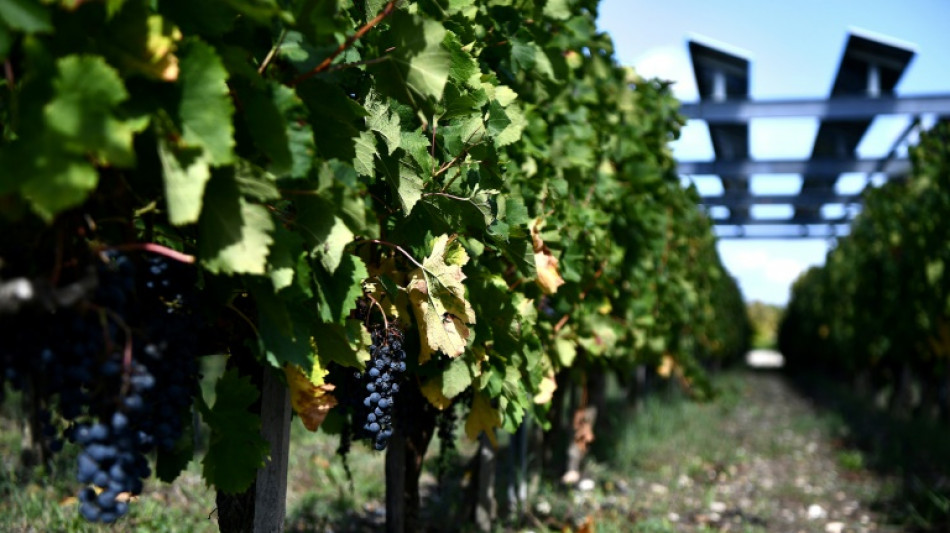
Climate change is improving French wine -- for now / Photo: Christophe ARCHAMBAULT - AFP/File

What makes a good or bad year for wine? It's a question that vexes not only vintners but also scientists, who've long looked to weather conditions to provide the answer.
A new study published Wednesday in the journal iScience now argues that climate change could contribute to superior vintages -- at least up to a point.
By analyzing decades worth of wine critic scores from Bordeaux, the research shows that good years are characterized by warmer temperatures, greater differences between winter and summer, and earlier, shorter growing seasons.
All conditions that are becoming more frequent as a result of human-caused planetary warming.
"I don't think that climate change is a good thing," Andrew Wood, lead author of the study told AFP.
Even though it appears to be improving wine growing conditions, climate change also exposes vineyards to more extreme events, Wood said, from heightened risk of fires in summer to more frost and hail storms in spring.
And even if good years are characterized by a dry and hot summer, too severe a drought can be devastating.
When a certain threshold is reached, quality drops dramatically "and you can even get the situation in which grapes are dropped from the vine," said Wood.
"We could be very close to the point at which it stops becoming better, and it starts being a lot worse," added the University of Oxford scientist. "We just don't know."
- Stronger wines -
Wood and colleagues paired detailed climate data with annual wine critic scores from the Bordeaux wine region in southwest France from 1950 to 2020, finding that, for the time being, the trend is positive.
They focused on Bordeaux because its wine region relies exclusively on rainfall for irrigation and because of the long term records of wine scores.
Of course, wine judging is subjective and unblinded, meaning the critics know what they are tasting.
But the paper argues that because there is broad consensus about what makes good versus bad wine, the taste scores offer a reliable means to monitor how crops are changing over time -- and they attempted to statistically control for the effects of improving winemaking technology.
"People generally prefer stronger wines which age for longer and give you richer, more intense flavors, higher sweetness, and lower acidity," said Wood.
"And with climate change -- generally, we are seeing a trend across the world that with greater warming, wines are getting stronger."
Higher temperatures lead to more photosynthesis, which in turn produces more sugar and a higher alcohol content.
Previous studies identified the beneficial effect of rainy winters and high temperatures in summer.
But the researchers in the current study showed that the other seasons also play an important role: wet and warm springtimes, and dry and cool autumns, are also linked with better rated wines.
They achieved this by matching highly localized, year-round weather data, with critics' ratings of individual "appellation d'origine controlee" (AOCs) in Bordeaux.
According to Wood, the same trends could hold true of other wine-growing regions of the world.
But, he stresses, it's not something to toast.
"The problem in scenarios where it gets really hot is water: if plants don't have enough, they eventually fail, and when they fail, you lose everything," he said.
T.Ikeda--JT