The Japan Times - Brazil high court resumes key Indigenous lands case

EUR -
AED 4.31146
AFN 77.552815
ALL 96.490006
AMD 447.387397
ANG 2.1015
AOA 1076.545647
ARS 1686.460724
AUD 1.760602
AWG 2.116111
AZN 1.99315
BAM 1.95662
BBD 2.360179
BDT 143.199982
BGN 1.956637
BHD 0.442544
BIF 3463.35069
BMD 1.173987
BND 1.515741
BOB 8.097392
BRL 6.345873
BSD 1.171786
BTN 105.771304
BWP 16.540858
BYN 3.43814
BYR 23010.14023
BZD 2.356777
CAD 1.616715
CDF 2623.86079
CHF 0.932964
CLF 0.02736
CLP 1073.317806
CNY 8.286057
CNH 8.278702
COP 4464.965093
CRC 583.546915
CUC 1.173987
CUP 31.110649
CVE 110.311206
CZK 24.201973
DJF 208.666515
DKK 7.469115
DOP 75.041752
DZD 152.174529
EGP 55.805107
ERN 17.609801
ETB 182.47371
FJD 2.66706
FKP 0.874416
GBP 0.876262
GEL 3.169235
GGP 0.874416
GHS 13.452635
GIP 0.874416
GMD 85.700954
GNF 10192.269224
GTQ 8.974759
GYD 245.122674
HKD 9.137837
HNL 30.851054
HRK 7.535468
HTG 153.462974
HUF 382.616951
IDR 19524.690979
ILS 3.759816
IMP 0.874416
INR 106.058551
IQD 1535.042982
IRR 49436.581934
ISK 148.204435
JEP 0.874416
JMD 187.737838
JOD 0.832368
JPY 182.800889
KES 151.11573
KGS 102.665441
KHR 4690.944912
KMF 493.074524
KPW 1056.583646
KRW 1729.94575
KWD 0.360027
KYD 0.976509
KZT 610.165579
LAK 25415.645822
LBP 104936.154484
LKR 362.38179
LRD 206.826633
LSL 19.845112
LTL 3.466477
LVL 0.710133
LYD 6.364639
MAD 10.779015
MDL 19.956359
MGA 5197.154791
MKD 61.561122
MMK 2465.687013
MNT 4164.573128
MOP 9.392234
MRU 46.451655
MUR 53.909635
MVR 18.090815
MWK 2031.942463
MXN 21.162074
MYR 4.804542
MZN 75.011046
NAD 19.845112
NGN 1701.552826
NIO 43.118061
NOK 11.81033
NPR 169.234608
NZD 2.018902
OMR 0.451397
PAB 1.171791
PEN 3.949454
PGK 4.972061
PHP 69.293982
PKR 329.571844
PLN 4.22215
PYG 8008.320328
QAR 4.270789
RON 5.091231
RSD 117.392861
RUB 93.000534
RWF 1705.607162
SAR 4.405546
SBD 9.662606
SCR 16.594891
SDG 706.148212
SEK 10.862781
SGD 1.515406
SHP 0.880794
SLE 28.293557
SLL 24617.912895
SOS 668.477157
SRD 45.301212
STD 24299.155382
STN 24.510162
SVC 10.253295
SYP 12982.392397
SZL 19.839226
THB 37.168443
TJS 10.804126
TMT 4.108954
TND 3.435839
TOP 2.826678
TRY 50.121365
TTD 7.952331
TWD 36.617932
TZS 2887.993286
UAH 49.462107
UGX 4166.74532
USD 1.173987
UYU 46.139326
UZS 14085.900144
VES 310.795223
VND 30885.243326
VUV 142.623146
WST 3.268316
XAF 656.229079
XAG 0.018394
XAU 0.000274
XCD 3.172758
XCG 2.111885
XDR 0.816138
XOF 656.229079
XPF 119.331742
YER 279.84908
ZAR 19.778131
ZMK 10567.290561
ZMW 26.864138
ZWL 378.023253
  • SCS

    0.0200

    16.14

    +0.12%

  • RBGPF

    0.0000

    81.17

    0%

  • BCC

    -0.7500

    76.26

    -0.98%

  • CMSD

    0.1200

    23.4

    +0.51%

  • CMSC

    0.1300

    23.43

    +0.55%

  • NGG

    0.0500

    74.69

    +0.07%

  • GSK

    0.4700

    48.88

    +0.96%

  • BCE

    0.2100

    23.4

    +0.9%

  • BTI

    -0.3900

    58.37

    -0.67%

  • RIO

    0.5000

    76.74

    +0.65%

  • RYCEF

    -0.1000

    14.64

    -0.68%

  • JRI

    0.0000

    13.72

    0%

  • VOD

    -0.0200

    12.54

    -0.16%

  • RELX

    0.2000

    40.28

    +0.5%

  • AZN

    -1.2200

    90.29

    -1.35%

  • BP

    -0.3500

    35.53

    -0.99%

Brazil high court resumes key Indigenous lands case
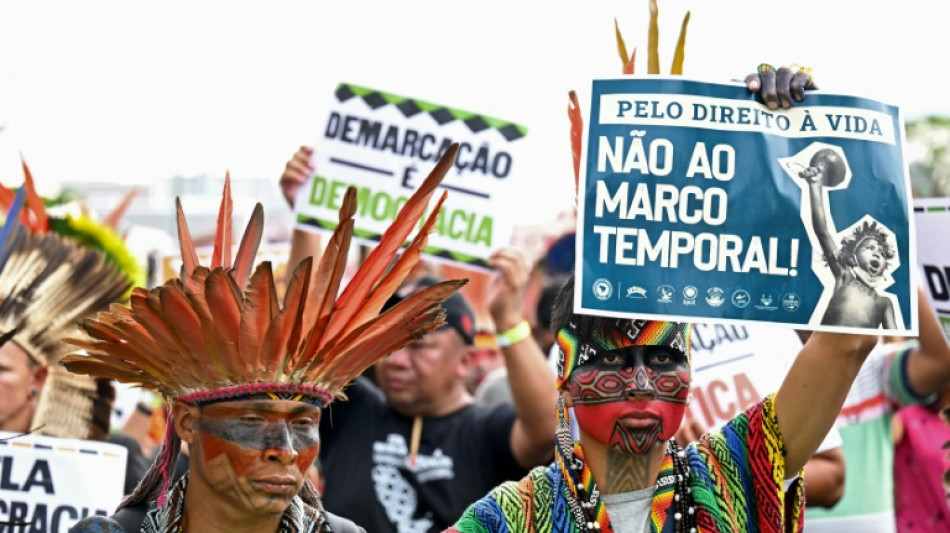
Brazil high court resumes key Indigenous lands case / Photo: Evaristo SA - AFP

Brazil high court resumes key Indigenous lands case

Brazil's Supreme Court resumed hearings Wednesday in a closely watched case on whether to restrict native peoples' rights to claim their ancestral lands, a key buffer against climate change.

Text size:

Hundreds of Indigenous protesters, many in traditional feather headdresses, rallied in the capital Brasilia as the court weighed the legality of the so-called "time-frame argument," which holds that native peoples should not have the right to lands where they were not present in 1988, when the current constitution was ratified.

Indigenous groups say that violates their rights, given that many were forced from their ancestral lands, including during the military dictatorship that ruled Brazil from the 1960s to 1980s.

The Supreme Court began hearing the case in 2021, but has adjourned the proceedings several times.

So far, two of the court's 11 justices have sided with the Indigenous plaintiffs, and two against them, one of these a judge who announced his stance on Wednesday.

The proceedings were to resume on Thursday with the remaining seven judges due to state their opinion.

Climate campaigners have joined Indigenous activists in pressing for the court to reject the time-frame argument, given that numerous studies have found that protected Indigenous reservations are one of the best ways to fight deforestation and, with it, global warming.

"The argument ignores our constitutional rights to our ancestral lands, puts existing Indigenous reservations at risk and makes creating new ones unviable," Dinamam Tuxa, coordinator of the Association of Brazil's Indigenous Peoples (APIB), told AFP ahead of the trial.

Indigenous rights groups have dubbed the case the "trial of the century."

The UN High Commissioner for Human Rights said in a statement that a win for the time-frame limitation argument would be "a big setback" for the rights of Indigenous people in Brazil and go against international human rights norms.

The limitation is backed by Brazil's powerful agribusiness lobby, which scored a victory in May when the lower house of Congress passed a bill enshrining the 1988 cutoff in law.

The bill is now working its way through the Senate.

Leftist President Luiz Inacio Lula da Silva, a self-described ally of Indigenous peoples, is expected to veto the bill if it passes. But Congress, where the agribusiness coalition is a major player, could override a veto.

The case could enter murky legal territory if that happens before the Supreme Court's justices finish delivering their rulings.

The constitution makes no mention of a cutoff date in relation to Indigenous reservations.

Indigenous reservations cover 11.6 percent of Brazil's territory, notably in the Amazon rainforest.

Brazil has around 1.7 million Indigenous inhabitants -- 0.8 percent of the population.

M.Saito--JT