The Japan Times - Vaquitas still exist, but barely: sea 'panda' survey

EUR -
AED 4.298532
AFN 77.113669
ALL 96.629783
AMD 443.666316
ANG 2.095199
AOA 1073.317589
ARS 1682.80214
AUD 1.752877
AWG 2.10684
AZN 1.989453
BAM 1.957835
BBD 2.345437
BDT 142.327914
BGN 1.958061
BHD 0.441223
BIF 3443.343016
BMD 1.170466
BND 1.509546
BOB 8.048364
BRL 6.406312
BSD 1.164461
BTN 104.691439
BWP 15.511807
BYN 3.382793
BYR 22941.141486
BZD 2.342034
CAD 1.613593
CDF 2611.310761
CHF 0.935083
CLF 0.027564
CLP 1081.311798
CNY 8.26888
CNH 8.26069
COP 4496.674415
CRC 573.373409
CUC 1.170466
CUP 31.01736
CVE 110.379712
CZK 24.242937
DJF 207.361209
DKK 7.468618
DOP 75.001926
DZD 152.058053
EGP 55.663166
ERN 17.556996
ETB 181.387864
FJD 2.659062
FKP 0.878911
GBP 0.874022
GEL 3.148521
GGP 0.878911
GHS 13.370896
GIP 0.878911
GMD 86.036408
GNF 10129.363367
GTQ 8.91436
GYD 243.683247
HKD 9.105263
HNL 30.671324
HRK 7.536685
HTG 152.485901
HUF 382.827946
IDR 19483.583733
ILS 3.789098
IMP 0.878911
INR 105.100216
IQD 1525.459504
IRR 49305.897501
ISK 148.6023
JEP 0.878911
JMD 186.734178
JOD 0.829875
JPY 182.092379
KES 150.568638
KGS 102.35772
KHR 4665.852388
KMF 493.936673
KPW 1053.415883
KRW 1714.780166
KWD 0.359029
KYD 0.970401
KZT 603.728472
LAK 25253.850988
LBP 104279.799218
LKR 359.596903
LRD 205.529697
LSL 19.793743
LTL 3.456083
LVL 0.708003
LYD 6.337232
MAD 10.765188
MDL 19.825369
MGA 5199.292826
MKD 61.562431
MMK 2458.620816
MNT 4154.401858
MOP 9.333606
MRU 46.439343
MUR 54.134085
MVR 18.02238
MWK 2019.26722
MXN 21.254593
MYR 4.802452
MZN 74.804474
NAD 19.793743
NGN 1695.900278
NIO 42.855384
NOK 11.801233
NPR 167.506303
NZD 2.010955
OMR 0.450047
PAB 1.16471
PEN 3.915032
PGK 4.94108
PHP 69.121896
PKR 329.171182
PLN 4.22464
PYG 7934.551208
QAR 4.245812
RON 5.09165
RSD 117.405916
RUB 91.587501
RWF 1694.899403
SAR 4.392276
SBD 9.633631
SCR 17.704013
SDG 704.034591
SEK 10.844511
SGD 1.512342
SHP 0.878153
SLE 28.21055
SLL 24544.093046
SOS 664.348523
SRD 45.19989
STD 24226.291366
STN 24.520245
SVC 10.189413
SYP 12941.658243
SZL 19.786337
THB 37.138671
TJS 10.771494
TMT 4.108337
TND 3.423558
TOP 2.818202
TRY 49.87861
TTD 7.89652
TWD 36.392105
TZS 2864.702455
UAH 49.298504
UGX 4158.321518
USD 1.170466
UYU 45.637681
UZS 13977.540637
VES 301.519502
VND 30849.982966
VUV 142.704116
WST 3.263037
XAF 656.499042
XAG 0.018901
XAU 0.000276
XCD 3.163244
XCG 2.098733
XDR 0.816474
XOF 656.499042
XPF 119.331742
YER 279.185474
ZAR 19.820175
ZMK 10535.603643
ZMW 27.080359
ZWL 376.889704
  • RYCEF

    -0.1300

    14.62

    -0.89%

  • VOD

    0.0600

    12.56

    +0.48%

  • NGG

    -0.2500

    74.64

    -0.33%

  • BTI

    1.4700

    58.76

    +2.5%

  • RELX

    0.5400

    40.08

    +1.35%

  • AZN

    1.6900

    91.51

    +1.85%

  • RIO

    1.8400

    76.24

    +2.41%

  • SCS

    0.0200

    16.14

    +0.12%

  • RBGPF

    -1.5200

    77.68

    -1.96%

  • CMSC

    0.0600

    23.3

    +0.26%

  • GSK

    1.1400

    48.41

    +2.35%

  • CMSD

    0.0600

    23.28

    +0.26%

  • BCC

    5.0100

    77.01

    +6.51%

  • JRI

    0.0190

    13.72

    +0.14%

  • BCE

    0.0400

    23.19

    +0.17%

  • BP

    0.3300

    35.88

    +0.92%

Vaquitas still exist, but barely: sea 'panda' survey
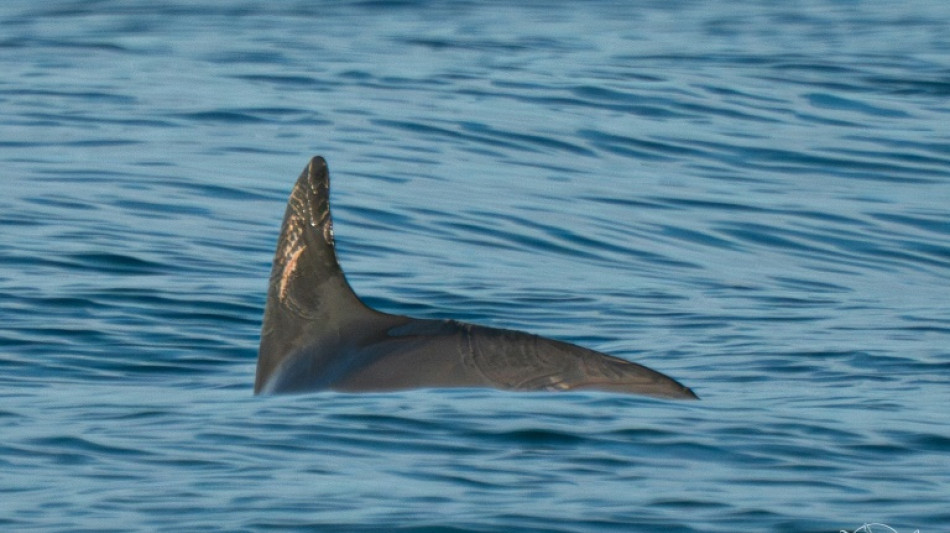
Vaquitas still exist, but barely: sea 'panda' survey / Photo: Handout - Sea Shepherd Conservation Society/AFP

Vaquitas still exist, but barely: sea 'panda' survey

The vaquita, a small porpoise on the verge of extinction, is still hanging in there, said scientists Wednesday who had spotted about a dozen specimens of Mexico's "panda of the sea" on an expedition in May.

Text size:

The vaquita is the smallest of all porpoises, similar to dolphins but with shorter beaks and more rounded bodies.

They perish in nets used to illegally catch totoaba, large fish whose swim bladders -- organs used to control buoyancy -- are believed in China to hold medicinal powers.

Scientists conducting a survey of the vaquita's endemic range in the Gulf of California off Mexico's north coast -- spotted between 10 and 13 of the porpoises last month, they reported Wednesday.

"We estimated that the sightings included 1-2 calves and there was a 76 percent probability that the total number seen, including calves, was between 10 and 13 individuals," said a report issued by the NGO Sea Shepherd spearheading vaquita conservation efforts.

"Since the search was in a small portion of the vaquita's historical range, 10-13 is considered a minimum estimate of the number of vaquitas left," it added.

This was about the same number estimated in October 2021.

According to the latest report, all vaquitas sighted in May "appeared to be healthy."

The vaquita is considered the world's most threatened cetacean -- the group of whales, dolphins and porpoises.

Grey-colored porpoises, vaquitas are called "pandas of the sea" for the rings around their eyes.

They grow to about 55 kilograms (120 pounds) and 1.5 metres (five feet) in length.

Elusive by nature, the vaquita is difficult to observe, and little is known about their reproductive life and longevity.

Females are believed to have a single calf every two years or more, according to conservation group WWF.

Vaquitas drown when they get entangled in gillnets -- vertical sheets of netting used to catch fish -- and cannot surface to breathe.

First discovered as a species only in 1958, vaquita numbers plummeted by 92 percent from 1997 to 2005, according to scientists.

The vaquita is listed as "critically endangered" on the International Union for Conservation of Nature's Red List of threatened species -- the last category before extinction in the wild.

In 2019, UNESCO added the Gulf of California to its list of World Heritage in Danger due to fears of imminent vaquita extinction.

H.Takahashi--JT