The Japan Times - Global warming made Horn of Africa drought possible: report

EUR -
AED 4.276813
AFN 76.973456
ALL 96.541792
AMD 443.66228
ANG 2.08461
AOA 1067.892825
ARS 1669.966546
AUD 1.754987
AWG 2.096192
AZN 1.983027
BAM 1.955634
BBD 2.345501
BDT 142.477887
BGN 1.956448
BHD 0.439063
BIF 3440.807467
BMD 1.164551
BND 1.508572
BOB 8.047316
BRL 6.334693
BSD 1.164501
BTN 104.703098
BWP 15.471685
BYN 3.348015
BYR 22825.199431
BZD 2.342101
CAD 1.610603
CDF 2599.277862
CHF 0.936214
CLF 0.027366
CLP 1073.576028
CNY 8.233487
CNH 8.233644
COP 4424.32385
CRC 568.851637
CUC 1.164551
CUP 30.860601
CVE 110.255626
CZK 24.203441
DJF 207.372369
DKK 7.470483
DOP 74.533663
DZD 151.069156
EGP 55.295299
ERN 17.468265
ETB 180.630743
FJD 2.632409
FKP 0.873058
GBP 0.872682
GEL 3.138427
GGP 0.873058
GHS 13.246874
GIP 0.873058
GMD 85.012011
GNF 10119.139684
GTQ 8.920242
GYD 243.639286
HKD 9.06591
HNL 30.671392
HRK 7.535456
HTG 152.447039
HUF 381.79862
IDR 19435.831998
ILS 3.768149
IMP 0.873058
INR 104.761263
IQD 1525.570298
IRR 49042.15781
ISK 149.038664
JEP 0.873058
JMD 186.394153
JOD 0.825682
JPY 180.924386
KES 150.637193
KGS 101.839763
KHR 4662.603591
KMF 491.440116
KPW 1048.095309
KRW 1716.311508
KWD 0.357482
KYD 0.970517
KZT 588.92993
LAK 25252.853035
LBP 104284.433872
LKR 359.199461
LRD 204.962574
LSL 19.736622
LTL 3.438616
LVL 0.704426
LYD 6.330462
MAD 10.755786
MDL 19.814315
MGA 5194.558365
MKD 61.63476
MMK 2445.088292
MNT 4131.097496
MOP 9.338406
MRU 46.439052
MUR 53.65147
MVR 17.938025
MWK 2019.328319
MXN 21.214047
MYR 4.78745
MZN 74.42642
NAD 19.736622
NGN 1688.691781
NIO 42.856356
NOK 11.767822
NPR 167.524757
NZD 2.017953
OMR 0.446942
PAB 1.164601
PEN 3.914467
PGK 4.94158
PHP 68.667692
PKR 326.478343
PLN 4.230371
PYG 8009.319058
QAR 4.244739
RON 5.092114
RSD 117.39002
RUB 89.442396
RWF 1694.355948
SAR 4.370528
SBD 9.584944
SCR 15.747661
SDG 700.479911
SEK 10.957056
SGD 1.508674
SHP 0.873715
SLE 27.602715
SLL 24420.049847
SOS 664.343518
SRD 44.985434
STD 24103.854302
STN 24.497917
SVC 10.190134
SYP 12876.251041
SZL 19.721323
THB 37.120026
TJS 10.684692
TMT 4.087574
TND 3.41611
TOP 2.803959
TRY 49.523723
TTD 7.894329
TWD 36.43764
TZS 2841.658406
UAH 48.889044
UGX 4119.649753
USD 1.164551
UYU 45.546128
UZS 13931.815535
VES 296.438708
VND 30697.564133
VUV 141.331197
WST 3.24748
XAF 655.901236
XAG 0.019964
XAU 0.000277
XCD 3.147257
XCG 2.098822
XDR 0.815731
XOF 655.901236
XPF 119.331742
YER 277.803961
ZAR 19.724584
ZMK 10482.36295
ZMW 26.923711
ZWL 374.984944
  • RBGPF

    0.0000

    78.35

    0%

  • CMSD

    -0.0700

    23.25

    -0.3%

  • JRI

    0.0400

    13.79

    +0.29%

  • BCC

    -1.2100

    73.05

    -1.66%

  • SCS

    -0.0900

    16.14

    -0.56%

  • NGG

    -0.5000

    75.41

    -0.66%

  • BCE

    0.3300

    23.55

    +1.4%

  • CMSC

    -0.0500

    23.43

    -0.21%

  • RELX

    -0.2200

    40.32

    -0.55%

  • GSK

    -0.1600

    48.41

    -0.33%

  • RIO

    -0.6700

    73.06

    -0.92%

  • BP

    -1.4000

    35.83

    -3.91%

  • BTI

    -1.0300

    57.01

    -1.81%

  • AZN

    0.1500

    90.18

    +0.17%

  • VOD

    -0.1630

    12.47

    -1.31%

  • RYCEF

    -0.0500

    14.62

    -0.34%

Global warming made Horn of Africa drought possible: report
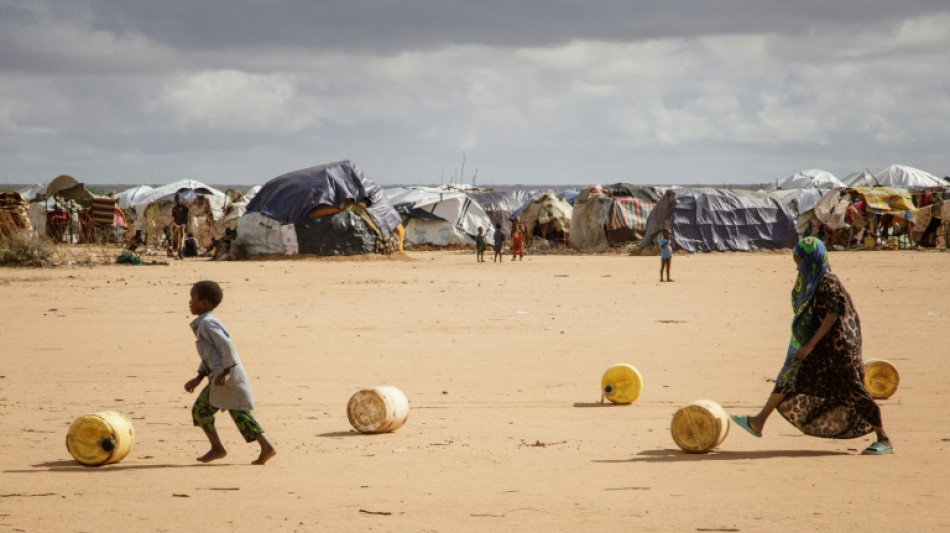
Global warming made Horn of Africa drought possible: report / Photo: Bobb Muriithi - AFP

Global warming made Horn of Africa drought possible: report

A devastating drought that has struck the Horn of Africa could not have occurred without global warming, according to a new report released Thursday from an international team of climate scientists.

Text size:

"Human-caused climate change has made agricultural drought in the Horn of Africa about 100 times more likely," said a summary of the report by the World Weather Attribution (WWA) group.

"The ongoing devastating drought would not have happened at all without the effect of greenhouse gas emissions," it added.

Since late 2020, countries on the Horn of Africa -- Djibouti, Ethiopia, Eritrea, Kenya, Somalia, South Sudan and Sudan -- have been suffering the worst drought in 40 years. The extended drought has led to the deaths of millions of heads of cattle and wiped out crops.

The WWA study concentrated on the three areas worst hit by the drought: southern Ethiopia, Somalia and eastern Kenya.

While climate change had little effect on total annual rainfall in the region, "higher temperatures have significantly increased evaporation from soil and plants, which has made dry soils much more likely", according to the 19 scientists who contributed to the WWA report.

"Without this effect, the region would not have experienced agricultural drought -- when crops and pastures are affected by dry conditions -- over the last two years," the summary added.

"Instead, widespread crop failures and livestock deaths have left more than 20 million people at risk of acute food insecurity."

The WWA said that, for its rapid analysis, "scientists looked at changes in rainfall in 2021 and 2022 in the affected region, covering southern Ethiopia, southern Somalia and eastern Kenya".

"They found that climate change is affecting the rainfall periods in opposite ways. The long rains are becoming drier, with low rainfall now about twice as likely, while the short rains are becoming wetter due to climate change," it added.

"This wettening trend in the short rains has been masked recently by the La Nina weather pattern, which reduces rainfall in the short rains."

Joyce Kimutai, a Kenyan climatologist who contributed to the report, told AFP: "It is time we act and engage differently. Central to this process is to transform and enhance resilience of our systems.

"We need to innovate across and throughout food systems, improve collaboration, involve vulnerable groups, make the best use of data and information, as well as incorporating new technologies and traditional knowledge."

The WWA network, set up by leading climate scientists, has built a reputation in recent years for its capacity to evaluate the extent to which climate change has contributed to extreme weather events.

Its results are published as a matter of urgency, without passing through the long peer-review process required by scientific journals, but employ approved methodological approaches.

K.Okada--JT