India population to surpass China mid-year: UN / Photo: Manjunath KIRAN - AFP/File

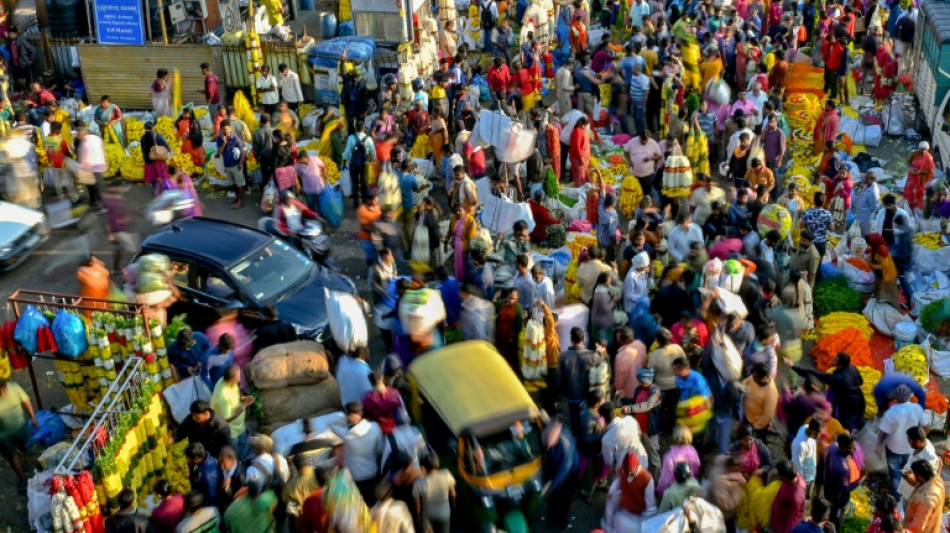
India is set to overtake China as the world's most populous country by the end of June, UN estimates showed Wednesday, posing huge challenges to a nation with creaking infrastructure and insufficient jobs for millions of young people.
The seismic shift will see India's population hit 1.4286 billion -- almost three million more than China's 1.4257 billion -- at mid-year, the United Nations Population Fund's State of World Population report forecast.
China has generally been regarded as the world's most populous country since the fall of the Roman Empire but last year its population shrank for the first time since 1960, while India's has continued to rise.
The South Asian giant spreads from the Himalayas to the beaches of Kerala, with 22 official languages, and nearly half its inhabitants are under 25.
The country faces huge challenges providing electricity, food and housing for its growing population, with many of its massive cities already struggling with water shortages, air and water pollution, and packed slums.
According to the Pew Research Centre, the number of people in India has grown by more than one billion since 1950, the year the UN began gathering population data.
China ended its strict "one-child policy", imposed in the 1980s amid overpopulation fears, in 2016 and started letting couples have three children in 2021.
Many blame its falling birth rates on the soaring cost of living, as well as the growing number of women going into the workforce and seeking higher education.
China said on Wednesday that it "implements a national strategy to actively respond to population ageing, promotes the three-child birth policy and supporting measures, and actively responds to changes in population development".
"China's demographic dividend has not disappeared, the talent dividend is taking shape, and development momentum remains strong," said foreign ministry spokesman Wang Wenbin.
- 8 billion -
India has no recent official population data because it has not conducted a census since 2011, with a follow-up in 2021 delayed by the Covid pandemic.
The initiative is now bogged down by logistical hurdles, making it unlikely the massive exercise will begin anytime soon. Some accuse the government of deliberately delaying the count until after national elections next year.
The census will shine a spotlight on how the Indian economy under Prime Minister Narendra Modi is struggling to provide jobs for the millions of young people entering the job market every year.
The new UN report also estimated that the global population will have hit 8.045 billion by mid-2023, by which time almost one in five people on the planet will be Indian.
Other countries, mostly in Europe and Asia, can expect a demographic slump over the coming decades, according to other UN figures published last July.
In Africa, the continent's population is expected to rise from 1.4 to 3.9 billion inhabitants by 2100, with about 38 percent of Earth dwellers living there, compared to around 18 percent today.
The population of the entire planet, meanwhile, is only expected to decline in the 2090s, after peaking at 10.4 billion, according to the UN.
- Sleeping giant -
India is on the frontlines of the effects of climate change, but generates most of its electricity from coal and its efforts will be vital in the global fight to reduce carbon emissions.
The nuclear-armed nation has started to become more assertive on the world stage, pushing for a permanent seat on the UN Security Council.
Many Western countries are banking on the world's largest democracy, already a member of the US-led Quad alliance, becoming more of a geopolitical counterweight to China.
But it also co-founded the BRICS grouping with Brazil, Russia, China and South Africa to challenge the dominant US- and European-led global governance structures, and is a member of the Shanghai Co-operation Organization alongside Moscow and Beijing.
New Delhi has resisted Western pressure to freeze out Moscow, opting instead to strengthen trade ties with its long-standing ally and ramping up imports of Russian oil.
Y.Watanabe--JT