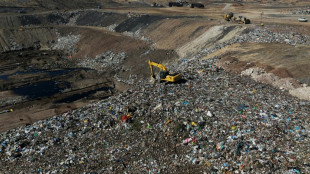
Global food system emissions imperil Paris climate goals / Photo: Luis ROBAYO - AFP/File

The global food system's greenhouse gas emissions will add nearly one degree Celsius to Earth's surface temperatures by 2100 on current trends, obliterating Paris Agreement climate goals, scientists warned Monday.
A major overhaul of the sector -- from production to distribution to consumption -- could reduce those emissions by more than half even as global population increases, they reported in Nature Climate Change.
Earth's surface has warmed 1.2C since the late 1800s, leaving only a narrow margin for staying under the 2015 treaty's core goal of capping warming at "well under" 2C.
Even further out of reach is the aspirational limit of 1.5C, which science subsequently showed to be a much safer threshold to avoid devastating and possibly irreversible climate impacts, including coastal flooding, heatwaves and drought.
"Mitigating emissions from the food sector is essential to working toward a secure climate future," the study's lead author Catherine Ivanovich, a doctoral student at Columbia University in New York, told AFP.
The global food system accounts for about 15 percent of current warming levels, but only a third of national emissions reductions plans under the Paris pact include any measure to cut carbon pollution from agriculture or livestock.
To improve on previous estimates of how much feeding the world adds to global warming, Ivanovich and her colleagues looked separately at the three main greenhouse gases, which vary in potency and staying power in the atmosphere.
Once emitted, carbon dioxide remains in the atmosphere for centuries. Methane only lingers for about a decade but, on that timescale, is almost 100 times more efficient in retaining the Sun's heat.
- Changing diets -
Methane from belching livestock, rice paddies and rotting food accounts for about 60 percent of food-related emissions, they found, with CO2 from machinery and transport, along with nitrous oxide from excess use of chemical fertilisers, responsible for 20 percent each.
The researchers also gathered data on the carbon emissions for nearly 100 individual food items.
Without a sharp change in production and diet, the study concluded, global food consumption will boost Earth's average surface temperature 0.7C and 0.9C by century's end.
"This additional warming alone is enough to surpass the 1.5C global warming target and approach the 2C threshold," the authors noted.
Methane, the study showed, is clearly the key to curbing food-related carbon pollution.
"The majority of future warming from the food sector comes from the emissions of methane," said Ivanovich.
"Because it is a short-lived pollutant, immediate reductions in its emissions can result in climate benefits in the near future."
Improving production methods for meat, dairy and rice alone could reduce the additional warming forecast from the food sector by a quarter, she said.
Adopting a diet optimal for human health across the globe, using renewables rather than fossil fuels for power, and slashing food waste would cut another 25 percent, the study found.
To date, however, trend lines for many of these measures are stagnant or -- in the case of meat consumption -- moving in the wrong direction, other research has shown.
K.Inoue--JT