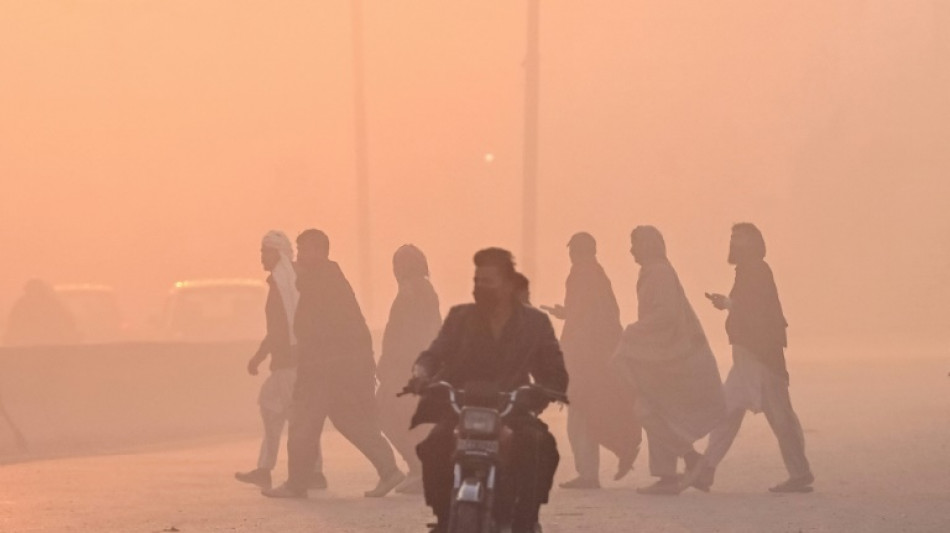
'Really suffocating': Pakistan emerges from record smog season / Photo: Arif ALI - AFP/File

Tens of millions of Pakistanis spent at least four months breathing toxic air pollution 20 times above safe levels, in the worst winter smog season for several years, according to data analysed by AFP.
Pakistan regularly ranks among the world's most polluted countries, with Lahore often the most polluted megacity between November and February.
AFP's analysis of data recorded since 2018 by independent air monitoring project AQICN shows the 2024-2025 winter smog season started a month earlier in October and persisted at higher levels, including in cities normally less affected by pollution.
Lahore's 14 million residents spent six months breathing concentrations of PM2.5 -- tiny particles that can penetrate the lungs and bloodstream -- at levels 20 times or more than recommended by the World Health Organization.
Those in Karachi, Pakistan's biggest city, and the capital Islamabad were subjected to 120 days of the same choking pollution levels.
"The smog is just getting worse every year," admitted a factory owner in Lahore, who wished to remain anonymous after openly criticising government policies.
"If I was rich, my first decision would be to leave Pakistan for Dubai, to protect my children and raise them in a smog-free environment," he told AFP.
- Legal action -
Experts say the pollution is primarily caused by factory and traffic emissions. It worsens in winter as farmers burn crop stubble and cooler temperatures and slow-moving winds trap the deadly pollutants.
This year, winter rains that typically bring relief did not arrive until late February, as climate change renders Pakistan's weather patterns increasingly unpredictable.
The smog was so thick it could be seen from space and prompted authorities to close schools serving millions of students across the largest province Punjab, including its capital Lahore.
Young climate activist Risha Rashid said Islamabad is fast becoming "another Lahore" and has launched legal action against the government.
"It's really suffocating," the 21-year-old, who has asthma, told AFP.
"I cannot go out, even if I have exams. It's not just affecting our physical health but our mental health as well."
An Ipsos poll in November found four out of five Pakistanis said they were affected by the smog.
It can cause sore throats, stinging eyes and respiratory illnesses, while prolonged exposure can trigger strokes, heart disease and lung cancer.
Its effects are worse for children, who breathe more rapidly and have weaker immune systems.
- 'At war' -
This smog season, Punjab's provincial government declared a "war on smog", increasing public air quality monitoring devices tenfold to around 30 and offering farmers subsidised rentals of machinery to clear crop stubble and avoid burning.
It also pledged to increasingly enforce emissions regulations on tens of thousands of factories and more than 8,000 brick kilns, a major source of black carbon emissions.
But environmentalists and experts say action has been piecemeal and sometimes counterproductive, including restrictions on private air quality monitoring devices that the government claims give "misleading results that spread panic."
And anti-smog machines, including a tower in Lahore shut down two months after installation, are effectively useless, experts say.
"It is like putting an air conditioner out in the open," said one who spoke on condition of anonymity.
- Pledges for clean air -
Efforts that tackle pollution's effects, rather than its source, miss the point, said Ahmad Ali Gul at Lahore's University of Management and Technology.
"It's like when you have a bathtub and it's overflowing and it's creating a huge mess, do you first grab a towel or you first close the tap?" he said.
"First, we need to focus on reducing the emissions and then we talk about how to protect ourselves from smog."
The government has blamed rival India, which borders Punjab province, for pollution blowing over into Lahore.
But Pakistan has limited vehicle emissions standards, and officials admit 83 percent of Lahore's carbon emissions are from transport.
"Switching to a cleaner fuel would give immediate results, we've seen it in other countries," said Frank Hammes, the global CEO of the Switzerland-based AQI air quality project.
But that "needs a pretty strong central effort to push down sometimes the painful changes that need to be made in order to reduce air pollution," he added.
Pakistan's government wants electric vehicles (EVs) to account for a third of new sales by 2030.
Cheaper Chinese models launched in Pakistan in 2024, but currently make up just a fraction of overallcar sales in a country where 40 percent of the 240 million population lives in poverty, according to the World Bank.
Pakistan had a taste of clean air during the pandemic, when a lockdown forced vhicles off the streets and factories to close in March 2020, but it was short-lived as the economic impact was too great for many to bear.
"Air quality improved so much that we could even see the stars in Lahore in the evening," saidOmar Masud a director of Urban Unit, which analyses pollution data for the government.
While climate change can make air pollution worse, few Pakistanis worry about global warming, explained Abdul Sattar Babar, Ipsos director for Pakistan.
"Most Pakistanis are overwhelmed by the economic challenges that they are facing," he said.
"When you can barely survive, climate issues are obviously not your primary concern".
M.Yamazaki--JT