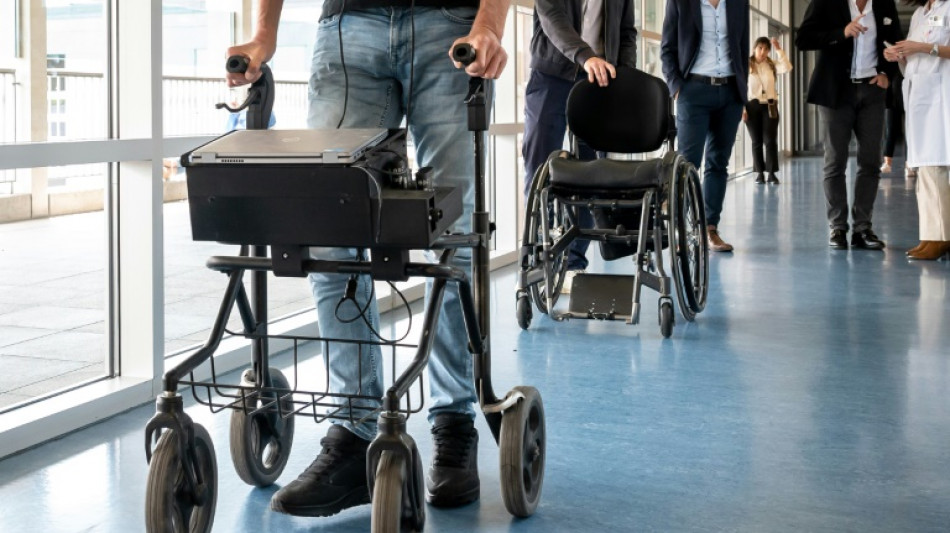
Brain stimulation can help injured people walk: study / Photo: Fabrice COFFRINI - AFP/File

Scientists said Monday that electrically stimulating a particular region in the brain could help people with injured spinal cords walk more easily, with one patient describing how the technique allowed him to conquer his fear of stairs.
The new technique is intended for people with spinal cord injuries where the connection between their brain and spinal cord has not been totally severed, and who still have some movement in their legs.
Wolfgang Jaeger, one of two patients who took part in an early trial, said that it immediately made a "big difference" to his mobility.
"Now when I see a staircase with just a few steps, I know I can handle it on my own," the 54-year-old said in a video released alongside a new study in the journal Nature Medicine.
The research was conducted by a Swiss team that has pioneered several recent advances, including using electrical stimulation of the spinal cord to let several paralysed patients walk again.
This time around, the researchers wanted to figure out which region of the brain was most responsible for people recovering from spinal cord injuries.
- 'I feel the urge to walk' -
Using 3D imaging techniques to map out the brain activity of mice with these injuries, the team created what they called a "brain-wide atlas".
They were surprised to find that the brain region they were looking for was in the lateral hypothalamus, which is otherwise known as a regulator for arousal, feeding and motivation.
A particular group of neurons in this region "appears to be involved in the recovery of walking after spinal cord injury," neuroscientist Gregoire Courtine at Switzerland's Ecole Polytechnique Federale de Lausanne told AFP.
Next, the team sought to amplify the signal from these neurons using a procedure called deep brain stimulation, which is commonly used to treat movement problems in people with Parkinson's disease.
It involves a surgeon implanting electrodes in the brain region, which are connected to a device implanted in the patient's chest. When switched on, the device sends electrical pulses up to the brain.
First, the team tested their theory on rats and mice, finding that it "immediately" improved walking, the study said.
The first human participant of the 2022 Swiss trial was a woman who, like Jaeger, has an incomplete spinal cord injury.
Neurosurgeon Jocelyne Bloch told AFP that when the women's device was turned on for the first time, she said: "I feel my legs."
When they turned up the electrical current, the women said, "I feel the urge to walk," according to Bloch.
The patients could turn on their device whenever they needed, and also went through months of rehab and strength training.
The woman's goal was to walk independently without a walker, while Jaeger's was to climb stairs by himself.
"Both of them reached their goal," Bloch said.
- 'No problem' -
Jaeger, who is from the Swiss municipality of Kappel, spoke about facing eight steps down to the sea during a holiday last year.
With the device turned on, "walking up and down the stairs was no problem," he said.
"It's a great feeling when you don't have to rely on others all the time."
Over time, he "became faster and could walk longer" even when the device was switched off, he added.
More research is still needed -- and this technique will not be effective for all patients, Courtine emphasised.
Because it depends on boosting the brain's signal to the spinal cord, it depends how much signal was getting through in the first place.
And while deep brain stimulation is now fairly common, some people are not so "comfortable with someone operating on their brain," Courtine added.
The researchers believe that in the future, the best option for recovering from these kinds of injuries could be stimulating both their spinal cord and lateral hypothalamus.
H.Takahashi--JT