China records nearly 3,400 daily virus cases in worst outbreak in two years

Chinese health authorities reported nearly 3,400 Covid-19 cases on Sunday, double the previous day, forcing lockdowns on virus hotspots as the country contends with its gravest outbreak in two years.
A nationwide surge in cases has seen authorities close schools in Shanghai and lock down several northeastern cities, as almost 19 provinces battle clusters of the Omicron and Delta variants.
The city of Jilin has been partially locked down, with hundreds of neighbourhoods sealed up, an official announced Sunday, while Yanji, an urban area of nearly 700,000 bordering North Korea, was fully closed off.
China, where the virus was first detected in late 2019, has maintained a strict 'zero-Covid' policy enforced by swift lockdowns, travel restrictions and mass testing when clusters have emerged.
But the latest flare-up, driven by the highly transmissible Omicron variant and a spike in asymptomatic cases, is challenging that approach.
Zhang Yan, an official with the Jilin provincial health commission, admitted Sunday that local authorities' virus response so far had been lacking.
"The emergency response mechanism in some areas is not robust enough, there is insufficient understanding of the characteristics of the Omicron variant... and judgment has been inaccurate," he said at a government press briefing.
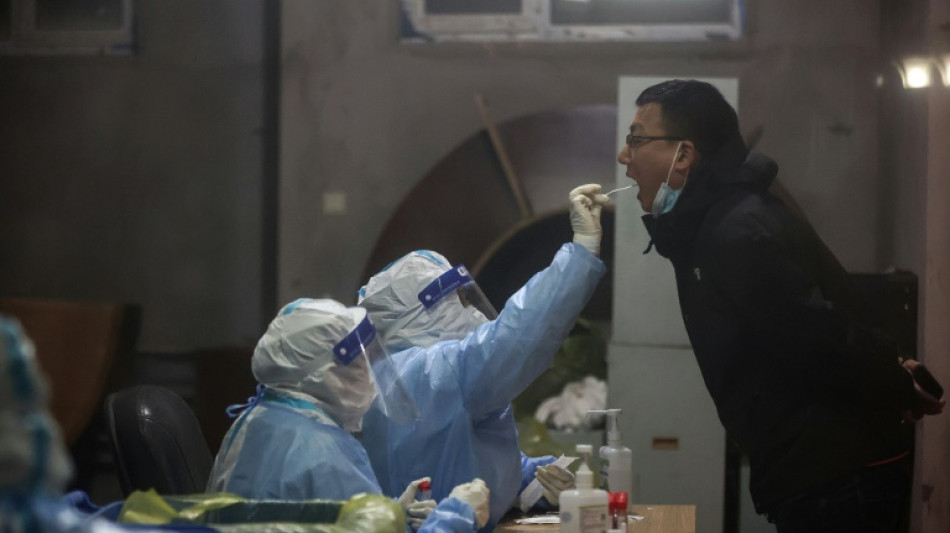
Residents of Jilin have completed six rounds of mass testing, local officials said. On Sunday the city reported over 500 cases of the Omicron variant.
The neighbouring city of Changchun -- an industrial base of nine million people -- was locked down Friday.
The smaller cities of Siping and Dunhua, both in Jilin province, were locked down Thursday and Friday, according to official announcements.
The mayor of Jilin and the head of the Changchun health commission were dismissed from their jobs Saturday, state media reported, in a sign of the political imperative placed on local authorities to squash virus clusters.
- Covid-zero? -
But fatigue with the strict approach has been showing in China, with officials increasingly urging softer and more targeted measures to contain the virus, while economists warn that tough clampdowns are hurting the economy.
As cases have climbed since late February, the response in different parts of the country has been generally softer and more targeted compared to December, when the city of Xi’an and its 13 million people were locked down for two weeks.
In China’s biggest city Shanghai, authorities have increasingly moved to temporarily lock down individual schools, businesses, restaurants and malls over close-contact fears rather than mass quarantines.
Long lines have been seen outside hospitals in the city as people rush to obtain a negative Covid test.
As cases rise, the country's National Health Commission announced Friday that they would introduce the use of rapid antigen tests.
The kits will now be available online or at pharmacies for clinics and ordinary citizens to buy for "self-testing", the health commission said.
Although nucleic acid tests will continue to be the main method of testing, the move suggests China may be anticipating that official efforts will not be able to contain the virus.
Last week, a top Chinese scientist said the country should aim to co-exist with the virus, like other nations, where Omicron has spread like wildfire.
But the government has also made clear that mass lockdowns remain an option.
Chinese Vice Premier Sun Chunlan, who frequently telegraphs top-level thinking on the pandemic response, on Saturday urged regions to quickly pounce on and clear outbreaks.
burs-lxc/apj/reb
M.Sugiyama--JT