The Japan Times - Seals sing 'otherworldly' songs structured like nursery rhymes

EUR -
AED 4.042864
AFN 71.555478
ALL 90.626386
AMD 396.789587
ANG 1.970962
AOA 1010.579203
ARS 1699.438636
AUD 1.630164
AWG 1.981527
AZN 1.870698
BAM 1.953118
BBD 2.223267
BDT 137.291487
BGN 1.952322
BHD 0.416432
BIF 3314.708844
BMD 1.100848
BND 1.421342
BOB 12.887305
BRL 6.26559
BSD 1.103794
BTN 103.970712
BWP 15.428045
BYN 3.306989
BYR 21576.629451
BZD 2.220072
CAD 1.572551
CDF 2548.464071
CHF 0.925048
CLF 0.027971
CLP 1100.859145
CNY 7.344586
CNH 7.340182
COP 3651.084949
CRC 494.62533
CUC 1.100848
CUP 26.491625
CVE 110.114304
CZK 24.43114
DJF 196.561889
DKK 7.475795
DOP 67.148409
DZD 150.83203
EGP 59.060739
ERN 16.512727
ETB 181.173679
FJD 2.510041
FKP 0.832855
GBP 0.834498
GEL 2.851402
GGP 0.832855
GHS 12.942288
GIP 0.832855
GMD 81.462736
GNF 9779.749248
GTQ 8.438452
GYD 230.933957
HKD 8.637758
HNL 29.682648
HRK 7.520958
HTG 144.75387
HUF 364.714942
IDR 20106.996782
ILS 3.546823
IMP 0.832855
INR 103.392071
IQD 1673.402276
IRR 2106734.940616
ISK 136.592545
JEP 0.832855
JMD 174.412893
JOD 0.780549
JPY 175.638717
KES 143.164967
KGS 96.268533
KHR 4534.855646
KMF 492.079488
KPW 990.763983
KRW 1469.115521
KWD 0.342925
KYD 0.919837
KZT 492.014422
LAK 24846.995814
LBP 98848.170975
LKR 367.135891
LRD 187.651486
LSL 18.660862
LTL 3.25052
LVL 0.665892
LYD 7.115295
MAD 10.93888
MDL 20.05056
MGA 5015.159317
MKD 61.538484
MMK 2311.306937
MNT 3967.489416
MOP 8.920851
MRU 44.642108
MUR 52.631293
MVR 16.955842
MWK 1914.08918
MXN 20.449047
MYR 4.506766
MZN 70.331926
NAD 18.660777
NGN 1481.49971
NIO 40.624957
NOK 10.571002
NPR 166.354093
NZD 1.995937
OMR 0.423285
PAB 1.103784
PEN 3.755843
PGK 5.037152
PHP 70.412485
PKR 305.237156
PLN 4.404374
PYG 6850.655697
QAR 4.023893
RON 5.349685
RSD 117.601459
RUB 90.875482
RWF 1633.079894
SAR 4.142649
SBD 8.914337
SCR 15.159395
SDG 662.159924
SEK 11.09986
SGD 1.419164
SHP 0.828921
SLE 25.374813
SLL 23084.245426
SOS 630.842395
SRD 41.27043
STD 22785.340133
STN 24.466738
SVC 9.658738
SYP 14313.231806
SZL 18.654454
THB 37.34085
TJS 10.182672
TMT 3.85297
TND 3.327346
TOP 2.650579
TRY 55.4744
TTD 7.492712
TWD 36.254133
TZS 2918.874306
UAH 50.186545
UGX 4558.761139
USD 1.100848
UYU 44.738367
UZS 13273.773979
VES 1004.941699
VND 28362.259244
VUV 132.893978
WST 3.094027
XAF 655.957
XAG 0.023115
XAU 0.000284473133
XCD 2.975098
XCG 1.989368
XDR 0.778357
XOF 655.957
XPF 119.331742
YER 260.406273
ZAR 18.663884
ZMK 9908.960466
ZMW 22.568217
ZWL 354.472749
SSP 6544.963616
MXV 2.294661
  • RYCEF

    0.1000

    19.81

    +0.5%

  • VOD

    -0.2500

    16.33

    -1.53%

  • CMSC

    -0.2800

    20.12

    -1.39%

  • RBGPF

    -2.0000

    65

    -3.08%

  • RIO

    -0.2500

    94.16

    -0.27%

  • BTI

    -1.2000

    54.85

    -2.19%

  • NGG

    -0.3000

    74.94

    -0.4%

  • GSK

    -0.3500

    49.35

    -0.71%

  • BCE

    -0.4200

    20.14

    -2.09%

  • CMSD

    -0.3400

    19.93

    -1.71%

  • BP

    -0.9100

    43.52

    -2.09%

  • RELX

    0.1700

    33.24

    +0.51%

  • BCC

    -0.6200

    75.97

    -0.82%

  • AZN

    -1.9400

    164.21

    -1.18%

  • JRI

    0.0000

    10.77

    0%

Seals sing 'otherworldly' songs structured like nursery rhymes
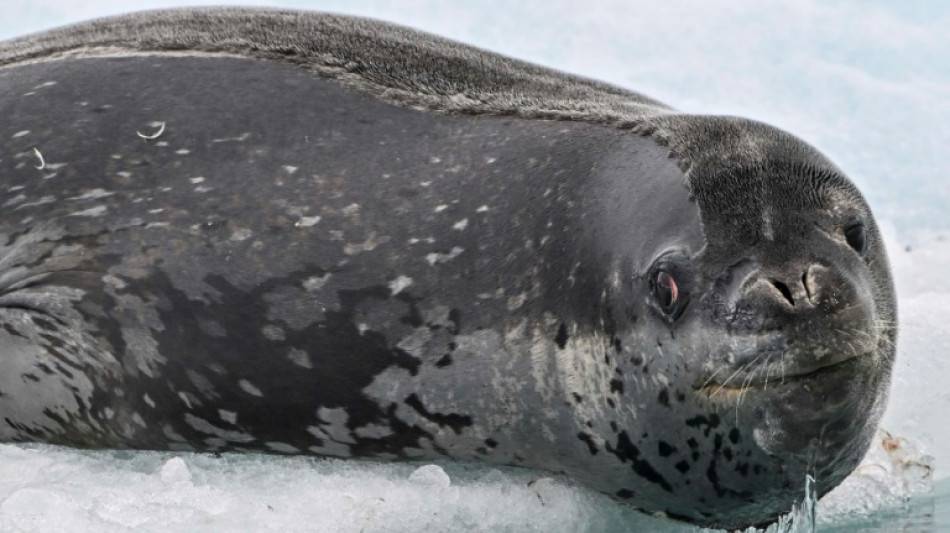
Seals sing 'otherworldly' songs structured like nursery rhymes / Photo: Juan BARRETO - AFP/File

Seals sing 'otherworldly' songs structured like nursery rhymes

When male leopard seals dive down into icy Antarctic waters, they sing songs structured like nursery rhymes in performances that can last up to 13 hours, scientists said Thursday.

Text size:

The Australian-led team of researchers compared the complexity of the songs composed by the big blubbery mammals to those of other animals -- as well as human musicians like the Beatles and Mozart.

Lucinda Chambers, a bioacoustics PhD student at Australia's University of New South Wales, told AFP that people are often surprised when they hear the "otherworldly" hoots and trills sung by leopard seals.

"It kind of sounds like sound effects from an '80s sci-fi" movie, said the lead author of a new study in the journal Scientific Reports.

During the spring breeding season, male leopard seals dive underwater and perform their songs for two minutes before returning to the surface for air. They then repeat this performance for up to 13 hours a day, according to the study.

The researchers determined that all leopard seals share the same set of five "notes" which are impossible to distinguish between individuals.

However each seal arranges these notes in a unique way to compose their own personal song.

"We theorise that they're using that structure as a way to broadcast their individual identity, kind of like shouting their name out into the void," Chambers said.

The researchers believe the males use these songs to woo potential female mates -- and ward off rivals.

- 'Songbirds of the ocean' -

The team studied recordings of 26 seals captured by study co-author Tracey Rogers off the coast of Eastern Antarctica throughout the 1990s.

"They're like the songbirds of the Southern Ocean," Rogers, who is also from the University of New South Wales, said in a statement.

"During the breeding season, if you drop a hydrophone into the water anywhere in the region, you'll hear them singing."

The team analysed how random the seals' sequences of notes were, finding that their songs were less predictable than the calls of humpback whales or the whistles of dolphins.

But they were still more predictable than the more complex music of the Beatles or Mozart.

"They fall into the ballpark of human nursery rhymes," Chambers said.

This made sense, because the songs need to be simple enough so that each seal can remember their composition to perform it every day, she explained.

She compared it to how "nursery rhymes have to be predictable enough that a child can memorise them".

But each seal song also needs to be unpredictable enough to stand out from those of the other males.

Leopard seals, which are the apex predator in Antarctic waters, swim alone and cover vast distances. They likely evolved their particular kind of song so that their message travels long distances, the researchers theorised.

Varying pitch or frequency might not travel as far in their environment, Chambers said.

Female seals also sing sometimes, though the scientists do not know why.

Chambers suggested it could be to teach their pups how to sing -- exactly how this talent is passed down is also a mystery. But she added that this behaviour has never been observed in the wild.

The females could also just be communicating with each other, she said.

K.Inoue--JT