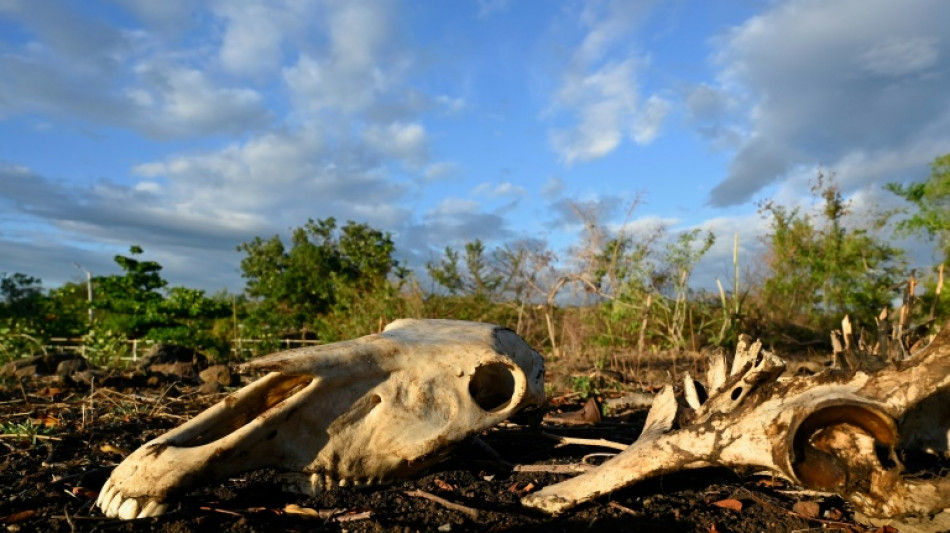
UN issues call to arms to combat off-the-charts El Nino / Photo: Orlando SIERRA - AFP/File

The El Nino weather phenomenon gripping the planet is heading off the charts, the United Nations warned Wednesday, saying countries should take urgent action to prepare for the worst.
El Nino is set to peak in December, but the human impact of its associated extreme temperatures, floods and droughts is set to last into 2027 and beyond.
The UN called for international preventative measures to protect the millions of people most exposed -- before disaster strikes.
"The current El Nino event could be unprecedented in strength: literally off the monitoring charts that we have used for the past four decades," said Celeste Saulo, head of the UN's weather and climate agency.
"We are already witnessing extreme weather events and expect this to multiply and cascade as El Nino intensifies," the World Meteorological Organization chief told a press conference in Geneva, alongside the UN aid chief Tom Fletcher.
They issued a joint call for "urgent and coordinated anticipatory action" to protect the most vulnerable communities already living on the edge.
"We cannot stop El Nino, but we can prevent many of its worst human consequences," said Saulo.
- 'Wrecking ball' -
Fletcher said El Nino was a "wrecking ball" that would bring havoc to Latin America, eastern and southern Africa, Asia and the Pacific.
He said the long-term impact "will be felt for months and potentially years to come... because it's this overlaying of crisis on crisis and crisis".
He cited widespread conflict and displacement, soaring fuel and fertiliser and food prices, and swingeing aid cuts.
"The risk is you have tens of millions of people pushed into humanitarian need," he explained, warning that 50 million people could face increased hunger.
Fletcher said the next two weeks were "the critical window to act".
Somalia, Ethiopia, Kenya need supplies ahead of heavy rains; southern Africa needs seeds and livestock; Central America needs livelihood assistance, while Asia and the Pacific must prepare for droughts, floods and cyclones, he said.
However, Fletcher warned that the damage from El Nino would not be limited to countries on the front line.
"It will create economic shocks for the global economy and drive further conflict, displacement, migration," he said.
"I am sounding the alarm that the humanitarian system... cannot alone cope with a threat on this scale."
He called on countries, development banks and international financial institutions to get money moving "before that damage is done".
Fletcher said he had released $50 million to help 11 countries on the frontline, including Chad, El Salvador, Ethiopia, Somalia and South Sudan.
- 'Far-reaching consequences' -
El Nino warms surface temperatures in the central and eastern equatorial Pacific Ocean, bringing worldwide changes in winds, pressure and rainfall patterns.
It typically takes place every two to seven years and lasts around nine to 12 months.
Conditions oscillate between El Nino and its opposite La Nina, with neutral conditions in between.
The naturally occurring weather phenomenon is set to bring higher temperatures to much of the planet, with its impact compounding the effects of man-made climate change.
The WMO's latest global seasonal climate update out Wednesday forecasted that sea surface temperatures in the tropical Pacific Ocean -- the epicentre of El Nino -- may rise to 3.8C above average during November to January: way above typical El Nino figures.
This would be the highest three-month measurement since observations began, eclipsing the previous record of 2.6C set in 2015-2016.
"This will have far-reaching consequences for weather patterns across the world," said Saulo.
While El Nino usually peaks between November and February, the resulting spike in temperatures typically comes later.
The last El Nino contributed to making 2023 the second-hottest year on record and 2024 the all-time high.
This El Nino is already hitting some regions hard, including in Central America, where animals and crops are dying from drought.
H.Nakamura--JT