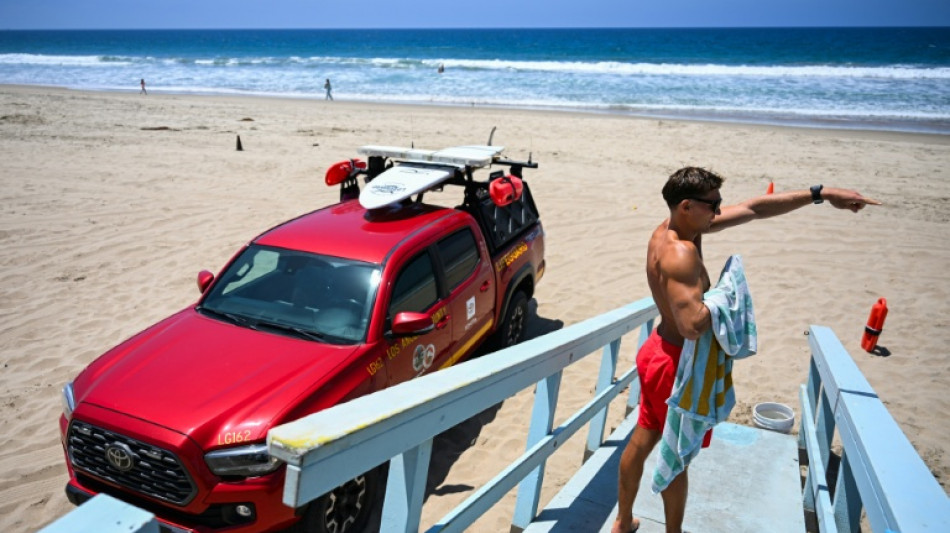
California lifeguards wiped out from extreme weather / Photo: Patrick T. Fallon - AFP

In California, repeated heat waves have sent Americans running to the beaches to seek relief, but more and more swimmers are finding themselves in troubled waters as strong waves whip the coast and fuel powerful rip currents.
Last weekend, lifeguards in Los Angeles County performed a record 1,950 ocean rescues -- numbers that lifeguard captain Pono Barnes called "staggering."
"To kind of put that in perspective, a busy summer weekend is usually in the 300 rescue range, 500 on the high end," Barnes told AFP on Manhattan Beach.
Since the start of July, California has been at the mercy of successive searing heat waves, with the mercury sitting at 86-95 degrees Fahrenheit (30-35C), and even hotter inland.
They may not be record-breaking temperatures, but the heat is abnormally humid because of the months-long marine heat wave in the Pacific -- and residents are suffering.
The solution for many is a quick trip to the beach for a dip in the ocean, but the timing could not be worse.
Tropical swells generated by Hurricanes Elida, Fausto and Genevieve off Mexico have been slamming the shore for two weeks.
On several beaches, waves are at times six feet (1.8 meters) high. It's a dream for surfers, but can quickly become a nightmare for inexperienced swimmers thrashed by strong currents.
- 'Pretty hectic' -
Last Saturday, Maximus Oberto said he did 30 ocean rescues himself.
"I've got to say it was probably the busiest day of my whole career," Oberto told AFP. "It was pretty hectic."
"It was pretty much nonstop from sunrise to sunset," said the lifeguard, sporting the red trunks made famous on the TV show "Baywatch."
"Physically, it was a lot. I was a little tired, but I kept pushing through it."
This coming weekend, a new heat dome is expected to leave millions sweating in the American West, from Utah and Arizona to Nevada and California.
With heavy surf forecast until Saturday night, lifeguards say they expect another dangerous and busy weekend.
But they won't keep swimmers out of the water.
"Come to the beach. This is what LA is about," said Barnes.
"But when you come down, come and be safe. Swim near an open lifeguard tower, check in with that lifeguard for current ocean conditions and what's going on in that area as far as hazards."
- Fire warning -
After weeks of scorching temperatures, this weekend's heat wave also brings with it fears of a jump in the number of wildfires.
Governor Gavin Newsom said Friday that firefighters have been prepositioned in several counties in central and southern California as a precaution.
"I would expect a significant uptick in fire activity in California," Daniel Swain, a climate scientist focused on extreme weather at the University of California, Los Angeles, told AFP.
"During this heat wave, we are going to see much more flammable landscape in the Northern Sierra (Nevada), northern Mountains, and in the mountains of Southern California too."
Should those fears be realized, it would compound an already worrying situation in the American West.
Thousands of firefighters have been deployed to more than 40 major fires in Washington and Oregon.
The situation is especially grim in Oregon, which is on track to record its worst-ever fire season.
The flames, often sparked by lightning strikes, have incinerated one million acres (405,000 hectares) in the last two weeks, forcing thousands of residents to leave their homes in rural areas.
So far, no major city has been threatened by the US wildfires, and the blazes are generating fewer headlines as a result, unlike the megafires in France and Spain.
But on the Warm Springs Indian Reservation in Oregon, where six homes have been destroyed this week, the flames are a real disaster, says top official Edward Henderson.
"We're short as it is, and so every home is a big loss," Henderson, the secretary-treasurer and CEO of the Confederated Tribes of Warm Springs, told local network KOIN.
"Some of these homes hold a couple generations' worth of people...you're talking about the family, the children, and the grandchildren."
H.Hayashi--JT