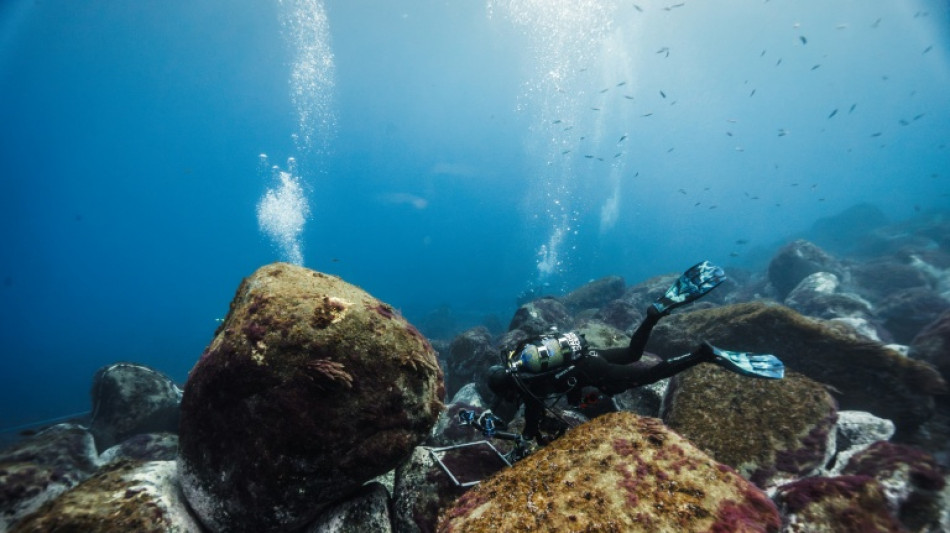
On the front line of ocean conservation off Portugal's Madeira / Photo: HENRIQUE CASINHAS - AFP

Juan Mayorga smiled as a stingray glided across his computer screen, moving gracefully over the seabed near Portugal's Desertas Islands, part of the Madeira archipelago in the Atlantic Ocean.
"It's a good day when we see animals like this," said the Colombian environmental engineer, who is analysing underwater footage to measure the effects of marine protection.
"This is conservation in action," said Mayorga, 36, who works for Pristine Seas, a marine conservation initiative run by the National Geographic Society.
"As we protect the place, year after year, fish get bigger and bigger and bigger, produce more and more babies, and that is protection working right there."
Mayorga is among nearly 200 scientists taking part in a month-long expedition in October to study the marine environment around Madeira, the birthplace of football superstar Cristiano Ronaldo.
Researchers aboard around 15 vessels are investigating the archipelago's marine life, assessing the health of its ecosystems and exploring how they can better withstand climate change.
Mayorga is analysing underwater video recorded at depths of 40 to 50 metres (130 to 165 feet) by cameras mounted on metal frames baited to attract fish.
He is particularly interested in comparing waters south of the Desertas Islands, where fishing is completely prohibited, with those to the north, where some fishing is still allowed.
The comparison offers a glimpse of how different levels of protection affect marine life.
- 'Real fight' -
The expedition's flagship is the 70-metre sailing ship Santa Maria Manuela, which has brought researchers to the Desertas Islands, a group of three uninhabited rocky islets about 40 kilometres (25 miles) southeast of Madeira.
Rising steeply from the Atlantic, the islands' rust-coloured cliffs, rocky slopes and windswept ridges form a protected nature reserve where seabirds circle above the waves.
On the largest island, Rui Seabra, a 44-year-old researcher from the University of Porto, attaches temperature sensors to rocks exposed at low tide along a small cove.
He wants to understand how crustaceans and sponges fare in sunny and shaded areas, information that could help scientists predict how marine biodiversity will respond to rising temperatures.
"We need to understand how biodiversity will be redistributed, which species will migrate where, what the conditions are here, how they will change, and which species we expect to find here in the future," he said.
Nearby, a marine biologist aboard an inflatable boat collected environmental DNA samples from the water.
The technique can reveal which fish species are present even when they evade the cameras.
"We are on the front lines of the real fight to find solutions that allow us to address problems on the ground," said expedition leader Emanuel Goncalves.
- 'Best weapon' -
The fieldwork comes as a UN biodiversity summit, known as COP17, gets underway Monday in Armenia to discuss efforts to protect the world's natural ecosystems.
Goncalves, chief scientist at Portugal's Oceano Azul Foundation, a marine conservation non-profit, acknowledges the importance of international meetings in setting political priorities.
But "the urgency to act does not allow us to wait for decisions that sometimes take decades," he said.
Madeira has long been a pioneer in marine conservation.
The archipelago includes the main island of Madeira, the beach destination of Porto Santo, the Desertas Islands and the remote Selvagens Islands, about 280 kilometres farther south toward Spain's Canary Islands.
In 1971, authorities established a reserve around the Selvagens Islands to protect Cory's shearwaters, seabirds found around Madeira and other Atlantic islands.
Expanded in 2022, the reserve now covers about 2,600 square kilometres (1,000 square miles), making it the largest protected marine area in the North Atlantic.
Another reserve established around the Desertas Islands in the early 1990s has helped a colony of Mediterranean monk seals, one of Europe's most endangered marine mammals, grow from just eight animals to 31.
"An ocean in a good state of conservation is the best weapon we have against climate change," said Paulo Oliveira, coordinator of the Madeira Ocean conservation programme launched in May.
T.Sato--JT