Webb observations point to a shorter cosmic dark age / Photo: Handout - ESA, NASA, CSA, STScI/AFP

The first galaxies may have formed far earlier than previously thought, according to observations from the James Webb Space Telescope that are reshaping astronomers' understanding of the early universe.
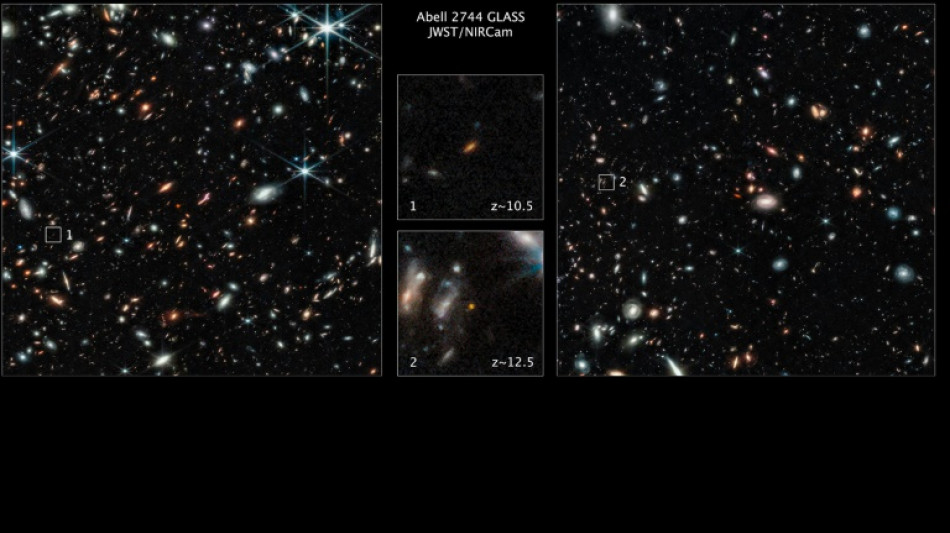
Researchers using the powerful observatory have now published papers in the journal Astrophysical Journal Letters, documenting two exceptionally bright, exceptionally distant galaxies, based on data gathered within the first few days of Webb going operational in July.
Their extreme luminosity points to two intriguing possibilities, astronomers on a NASA press call said Thursday.
The first is that these galaxies are very massive, with lots of low-mass stars like galaxies today, and had to start forming 100 million years after the Big Bang which occurred 13.8 billion years ago.
That is 100 million years earlier than the currently held end of the so-called cosmic dark age, when the universe contained only gas and dark matter.
A second possibility is that they are made up of "Population III" stars, which have never been observed but are theorized to have been made of only helium and hydrogen, before heavier elements existed.
Because these stars burned so brightly at extreme temperatures, galaxies made of them would not need to be as massive to account for the brightness seen by Webb, and could have started forming later.
"We are seeing such bright, such luminous galaxies at this early time, that we're really uncertain about what is happening here," Garth Illingworth of the University of California at Santa Cruz told reporters.
The galaxies' rapid discovery also defied expectations that Webb would need to survey a much larger volume of space to find such galaxies.
"It's sort of a bit of a surprise that there are so many that formed so early," added astrophysicist Jeyhan Kartaltepe of the Rochester Institute of Technology.
- Most distant starlight -
The two galaxies were found to have definitely existed approximately 450 and 350 million years after the Big Bang.
The second of these, called GLASS-z12, now represents the most distant starlight ever seen.
The more distant objects are from us, the longer it takes for their light to reach us, and so to gaze at the distant universe is to see into the deep past.
As these galaxies are so distant from Earth, by the time their light reaches us, it has been stretched by the expansion of the universe and shifted to the infrared region of the light spectrum.
Webb can detect infrared light at a far higher resolution than any instrument before it.
Illingworth, who co-authored the paper on GLASS-z12, told AFP disentangling the two competing hypotheses would be a "real challenge," though the Population III idea was more appealing to him, as it would not require upending existing cosmological models.
Teams are hoping to soon use Webb's powerful spectrograph instruments -- which analyze the light from objects to reveal their detailed properties -- to confirm the galaxies' distance, and better understand their composition.
The Atacama Large Millimeter/submillimeter Array (ALMA), a ground telescope in northern Chile, might also be able to help in weighing the mass of the two galaxies, which would help decide between the two hypotheses.
"JWST has opened up a new frontier, bringing us closer to understanding how it all began," summed up Tommaso Treu of the University of California at Los Angeles, principal investigator on one of the Webb programs.
K.Inoue--JT