The Japan Times - New particle discovered by Large Hadron Collider

EUR -
AED 4.237
AFN 72.67215
ALL 96.439167
AMD 435.408636
ANG 2.0649
AOA 1057.779611
ARS 1611.010422
AUD 1.624564
AWG 2.079223
AZN 1.945534
BAM 1.958758
BBD 2.321285
BDT 141.413535
BGN 1.971725
BHD 0.435689
BIF 3425.959811
BMD 1.153522
BND 1.472724
BOB 7.964268
BRL 5.999239
BSD 1.15253
BTN 106.434947
BWP 15.663195
BYN 3.45692
BYR 22609.027707
BZD 2.31797
CAD 1.580844
CDF 2612.727331
CHF 0.906552
CLF 0.026444
CLP 1044.421282
CNY 8.024186
CNH 7.939869
COP 4265.100795
CRC 540.234489
CUC 1.153522
CUP 30.568328
CVE 111.459011
CZK 24.430415
DJF 205.236134
DKK 7.472503
DOP 70.306427
DZD 152.806808
EGP 60.267824
ERN 17.302827
ETB 181.535552
FJD 2.54761
FKP 0.867251
GBP 0.864011
GEL 3.137768
GGP 0.867251
GHS 12.556073
GIP 0.867251
GMD 84.785822
GNF 10122.15418
GTQ 8.828331
GYD 241.131426
HKD 9.039568
HNL 30.649418
HRK 7.531693
HTG 151.178936
HUF 389.160771
IDR 19557.962488
ILS 3.570237
IMP 0.867251
INR 106.568171
IQD 1511.113587
IRR 1515900.701843
ISK 143.590528
JEP 0.867251
JMD 181.303769
JOD 0.817873
JPY 183.301551
KES 149.263438
KGS 100.875415
KHR 4635.429751
KMF 494.860672
KPW 1038.220285
KRW 1714.894867
KWD 0.353612
KYD 0.960484
KZT 555.347835
LAK 24771.881325
LBP 103297.879013
LKR 358.905059
LRD 211.38284
LSL 19.332716
LTL 3.40605
LVL 0.697754
LYD 7.394447
MAD 10.837363
MDL 20.106057
MGA 4792.883824
MKD 61.627084
MMK 2422.572577
MNT 4123.260971
MOP 9.302989
MRU 46.273525
MUR 53.868606
MVR 17.833708
MWK 2003.667624
MXN 20.417936
MYR 4.526993
MZN 73.708818
NAD 19.332766
NGN 1563.826412
NIO 42.357371
NOK 11.068751
NPR 170.297794
NZD 1.969866
OMR 0.443525
PAB 1.152575
PEN 3.954846
PGK 4.963026
PHP 68.735485
PKR 322.149837
PLN 4.260412
PYG 7471.28166
QAR 4.202568
RON 5.099835
RSD 117.439798
RUB 95.05593
RWF 1682.988338
SAR 4.33112
SBD 9.287766
SCR 15.104453
SDG 693.266837
SEK 10.686618
SGD 1.47243
SHP 0.86544
SLE 28.389514
SLL 24188.788329
SOS 659.241715
SRD 43.339545
STD 23875.572759
STN 24.916071
SVC 10.084227
SYP 127.897764
SZL 19.333216
THB 37.247344
TJS 11.047116
TMT 4.014256
TND 3.369443
TOP 2.777403
TRY 50.996395
TTD 7.819774
TWD 36.731828
TZS 3016.45951
UAH 50.637624
UGX 4350.531602
USD 1.153522
UYU 46.850745
UZS 13963.381974
VES 514.754787
VND 30337.623912
VUV 137.946383
WST 3.177041
XAF 656.974663
XAG 0.014379
XAU 0.00023
XCD 3.117451
XCG 2.077209
XDR 0.818793
XOF 663.848984
XPF 119.331742
YER 275.111989
ZAR 19.198364
ZMK 10383.082638
ZMW 22.480628
ZWL 371.433556
  • CMSC

    -0.0150

    22.975

    -0.07%

  • CMSD

    -0.0420

    22.908

    -0.18%

  • JRI

    -0.0350

    12.505

    -0.28%

  • BCC

    1.2600

    72.98

    +1.73%

  • RYCEF

    0.3800

    16.5

    +2.3%

  • GSK

    -0.1000

    53.67

    -0.19%

  • RBGPF

    0.1000

    82.5

    +0.12%

  • RIO

    0.2850

    90.145

    +0.32%

  • NGG

    0.0100

    90.9

    +0.01%

  • BCE

    0.2500

    26.15

    +0.96%

  • AZN

    -0.2300

    191.78

    -0.12%

  • BTI

    -0.1800

    60.76

    -0.3%

  • VOD

    0.1900

    14.79

    +1.28%

  • RELX

    -0.2900

    34.18

    -0.85%

  • BP

    1.1350

    44.035

    +2.58%

New particle discovered by Large Hadron Collider
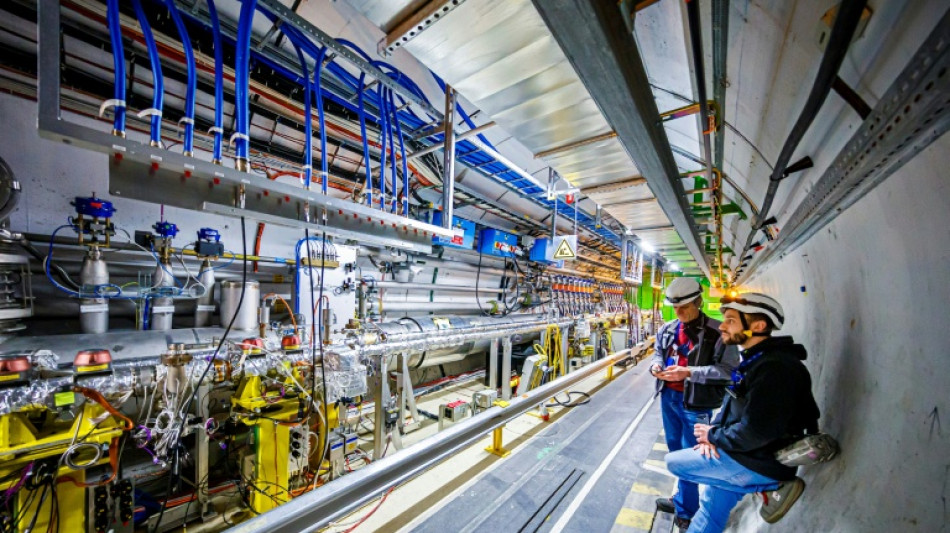
New particle discovered by Large Hadron Collider / Photo: VALENTIN FLAURAUD - AFP/File

New particle discovered by Large Hadron Collider

The Large Hadron Collider has discovered a new particle, the 80th identified so far by the world's most powerful particle smasher, Europe's CERN physics laboratory announced Tuesday.

Text size:

The new particle has been named "Xi-cc-plus". Scientists hope the particle -- which is similar to a proton but four times heavier -- will reveal more about the strange behaviour of quantum mechanics.

All the matter around us -- including the protons and neutrons that make up the nucleus of atoms -- are made of baryons.

These common particles are composed of three quarks, which are fundamental building blocks of matter.

Quarks come in six "flavours": up, down, charm, strange, top and bottom. Each has varying mass, electric charge and quantum properties.

In theory, there could be many different types of baryons that mix these flavours -- however most are extremely difficult to observe.

To chase them down, the Large Hadron Collider sends particles whizzing around an underground ring at phenomenal speeds until they smash into each other.

This gives scientists a brief chance to measure how the more stable elements decay, then deduce the properties of the original particle.

The newly discovered "Xi-cc-plus" contains two "charm" quarks and one "down" quark.

Normal protons have two "up" quarks and one "down" quark. Because the new particle has two heavier "charm" quarks instead of "up" ones, it has a much greater mass.

Vincenzo Vagnoni, spokesman for the Large Hadron Collider beauty (LHCb) experiment, said it was "only the second time a baryon with two heavy quarks has been observed".

It is also "the first new particle identified after the upgrades to the LHCb detector that were completed in 2023," he said in a statement.

"The result will help theorists test models of quantum chromodynamics, the theory of the strong force that binds quarks into not only conventional baryons and mesons but also more exotic hadrons such as tetraquarks and pentaquarks."

In 2017, the LHCb experiment announced that it had discovered a similar particle, made of two "charmed" quarks and one "up" quark.

The new particle has an expected lifetime six times shorter than this earlier one, making it far more tricky to spot, CERN said.

The Large Hadron Collider is a 27-kilometre (17 mile) long proton-smashing ring running about 100 metres below France and Switzerland. Mostly famously, it proved the existence of the Higgs boson -- known as the "God particle" -- in 2012.

The latest discovery comes as CERN plans to build an even bigger particle smasher, the Future Circular Collider, to continue probing the mysteries of the universe.

S.Yamamoto--JT