The Japan Times - Chinese booster rocket makes uncontrolled return to Earth

EUR -
AED 4.307662
AFN 75.65645
ALL 95.455382
AMD 433.035491
ANG 2.099447
AOA 1076.768783
ARS 1636.860327
AUD 1.626298
AWG 2.111312
AZN 1.99669
BAM 1.95591
BBD 2.370113
BDT 144.388141
BGN 1.956602
BHD 0.444402
BIF 3502.307889
BMD 1.172951
BND 1.489746
BOB 8.131389
BRL 5.80165
BSD 1.176766
BTN 110.920564
BWP 15.755888
BYN 3.325559
BYR 22989.842205
BZD 2.366713
CAD 1.602169
CDF 2716.554865
CHF 0.915682
CLF 0.026553
CLP 1045.063663
CNY 7.981991
CNH 7.981616
COP 4385.546991
CRC 539.802822
CUC 1.172951
CUP 31.083205
CVE 110.272157
CZK 24.311053
DJF 209.550028
DKK 7.473452
DOP 69.980366
DZD 155.132327
EGP 61.837278
ERN 17.594267
ETB 183.735061
FJD 2.567297
FKP 0.862672
GBP 0.865245
GEL 3.143253
GGP 0.862672
GHS 13.238746
GIP 0.862672
GMD 85.625652
GNF 10327.318134
GTQ 8.985736
GYD 246.203881
HKD 9.183732
HNL 31.283497
HRK 7.535741
HTG 154.124748
HUF 357.026418
IDR 20376.096548
ILS 3.403148
IMP 0.862672
INR 110.814383
IQD 1541.586917
IRR 1539967.542208
ISK 143.815622
JEP 0.862672
JMD 185.35045
JOD 0.831578
JPY 184.015502
KES 151.920982
KGS 102.539973
KHR 4720.06492
KMF 491.466945
KPW 1055.668813
KRW 1717.505805
KWD 0.361199
KYD 0.980655
KZT 544.970726
LAK 25824.235848
LBP 105018.682784
LKR 378.928134
LRD 215.948619
LSL 19.199619
LTL 3.463419
LVL 0.709507
LYD 7.443356
MAD 10.785516
MDL 20.245969
MGA 4886.004719
MKD 61.666615
MMK 2463.011404
MNT 4199.687323
MOP 9.491735
MRU 47.080447
MUR 54.800109
MVR 18.127941
MWK 2040.401971
MXN 20.276983
MYR 4.596825
MZN 74.956934
NAD 19.199783
NGN 1597.01982
NIO 43.301888
NOK 10.926269
NPR 177.458928
NZD 1.975285
OMR 0.450996
PAB 1.176766
PEN 4.07603
PGK 5.121049
PHP 70.959441
PKR 327.879986
PLN 4.231562
PYG 7202.344676
QAR 4.289452
RON 5.263969
RSD 117.404627
RUB 87.561202
RWF 1725.197269
SAR 4.433959
SBD 9.421446
SCR 16.245024
SDG 704.357949
SEK 10.887686
SGD 1.488639
SHP 0.875726
SLE 28.854149
SLL 24596.194285
SOS 672.537919
SRD 43.904758
STD 24277.720273
STN 24.500233
SVC 10.296581
SYP 129.667759
SZL 19.194082
THB 37.824741
TJS 10.997348
TMT 4.117058
TND 3.41348
TOP 2.824185
TRY 53.175691
TTD 7.960449
TWD 36.83395
TZS 3050.721524
UAH 51.52615
UGX 4401.24815
USD 1.172951
UYU 47.054659
UZS 14259.803991
VES 582.028979
VND 30863.863161
VUV 138.51814
WST 3.180472
XAF 655.957634
XAG 0.014717
XAU 0.000249
XCD 3.169959
XCG 2.12082
XDR 0.815801
XOF 655.993986
XPF 119.331742
YER 279.87078
ZAR 19.295866
ZMK 10557.966547
ZMW 22.417073
ZWL 377.689786
  • RBGPF

    0.0000

    63.18

    0%

  • RYCEF

    -0.0500

    17.45

    -0.29%

  • CMSD

    0.0000

    23.42

    0%

  • BCC

    -1.4800

    72.76

    -2.03%

  • CMSC

    -0.0400

    22.97

    -0.17%

  • NGG

    -1.9400

    85.91

    -2.26%

  • RIO

    -2.4000

    103.11

    -2.33%

  • GSK

    -0.0300

    50.5

    -0.06%

  • BCE

    0.3400

    24.57

    +1.38%

  • BTI

    -1.4800

    58.08

    -2.55%

  • RELX

    -1.5900

    34.16

    -4.65%

  • JRI

    -0.0200

    13.15

    -0.15%

  • AZN

    -2.4000

    182.52

    -1.31%

  • VOD

    -0.4400

    15.69

    -2.8%

  • BP

    -0.8200

    43.81

    -1.87%

Chinese booster rocket makes uncontrolled return to Earth
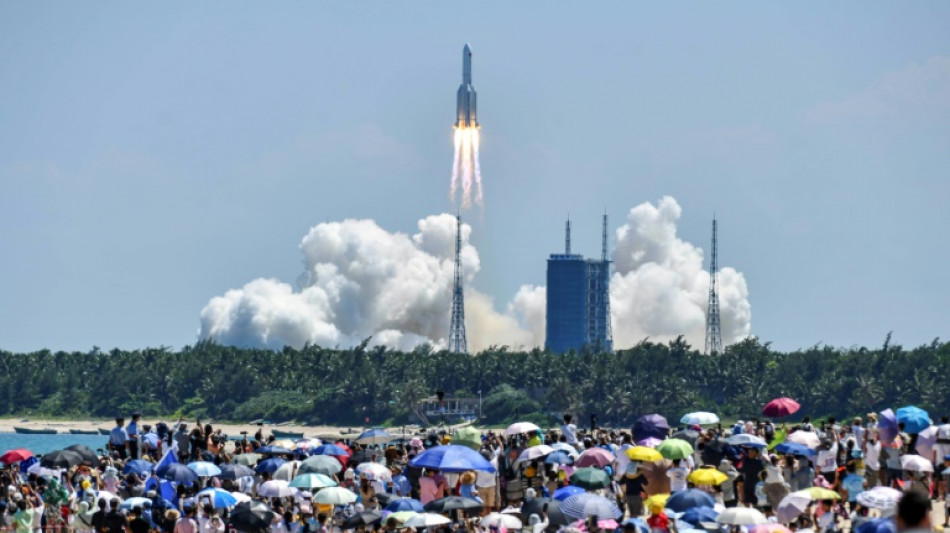
Chinese booster rocket makes uncontrolled return to Earth / Photo: - - CNS/AFP/File

Chinese booster rocket makes uncontrolled return to Earth

A Chinese booster rocket made an uncontrolled return to Earth on Saturday, leading US officials to chide Beijing for not sharing information about the potentially hazardous object's descent.

Text size:

US Space Command "can confirm the People's Republic of China (PRC) Long March 5B (CZ-5B) re-entered over the Indian Ocean at approx 10:45 am MDT on 7/30," the US military unit said on Twitter.

"We refer you to the #PRC for further details on the reentry’s technical aspects such as potential debris dispersal+ impact location," it said.

In a statement posted to its official WeChat profile, the China Manned Space Agency later gave coordinates for an impact area in the Sulu Sea, about 35 miles (57 kilometers) off the east coast of the Philippines' Palawan Island.

"Most of its devices were ablated and destroyed during re-entry," the agency said of the booster rocket, which was used last Sunday to launch the second of three modules China needed to complete its new Tiangong space station.

Malaysia's space agency said it detected rocket debris burning up on re-entry before falling in the Sulu Sea northeast of the island of Borneo.

"The debris of the rocket caught fire while entering the Earth's airspace and the movement of the burning debris also crossed Malaysian airspace and could be detected in several areas including crossing the airspace around the state of Sarawak," it said.

- NASA criticism -

NASA administrator Bill Nelson criticized Beijing on Twitter, saying the failure to share details of the rocket's descent was irresponsible and risky.

"All spacefaring nations should follow established best practices, and do their part to share this type of information in advance," Nelson wrote, "to allow reliable predictions of potential debris impact risk, especially for heavy-lift vehicles, like the Long March 5B, which carry a significant risk of loss of life and property."

He added: "Doing so is critical to the responsible use of space and to ensure the safety of people here on Earth".

The Tiangong space station is one of the crown jewels of Beijing's ambitious space program, which has landed robotic rovers on Mars and the Moon, and made China only the third nation to put humans in orbit.

The new module, propelled by the Long March 5B, successfully docked with Tiangong's core module on Monday and the three astronauts who had been living in the main compartment since June successfully entered the new lab.

When China launched its first Tiangong module in April 2021, there was a similar frenzy around the possibility of damage caused by an unpredictable booster reentry.

Objects generate immense amounts of heat and friction when they enter the atmosphere, which can cause them to burn up and disintegrate. But larger ones such as the Long March-5B may not be destroyed entirely.

In 2020, debris from another Chinese rocket fell on villages in the Ivory Coast, causing structural damage but no injuries or deaths.

China has poured billions of dollars into space flight and exploration as it seeks to build a program that reflects its stature as a rising global power.

T.Ikeda--JT