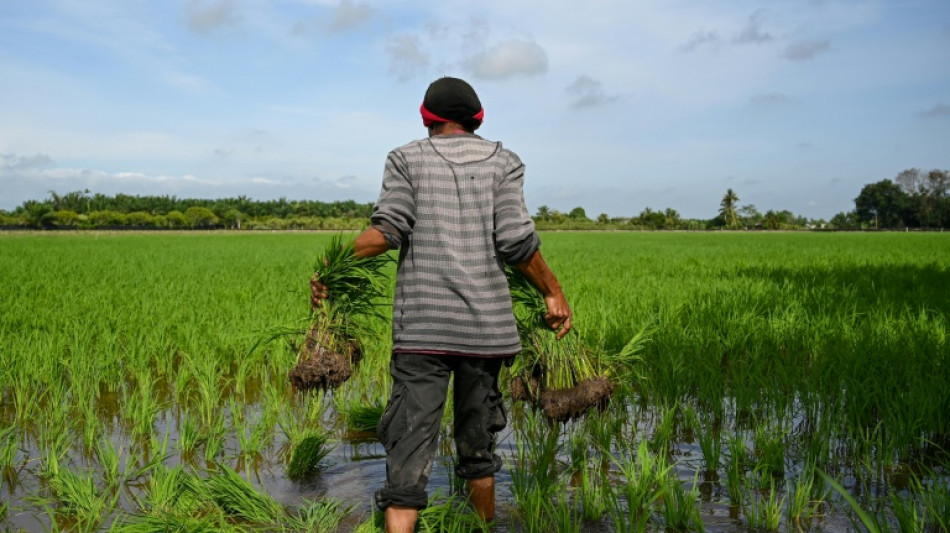
Malaysia plans cloud seeding for drought-hit 'rice bowl' / Photo: Mohd RASFAN - AFP/File

Malaysia is resorting to cloud seeding to bring much-needed rain to the country's "rice bowl" north, where a drought has delayed planting of the staple crop and raised supply fears.
"This year... has been affected by prolonged dry weather, low rainfall and reduced dam water levels," the Minister of Agriculture and Food Security of Malaysia, Mohamad Sabu, told AFP.
The conditions mean farmers have missed two of the three usual planting phases for so-called "wet direct seeding" of rice, a technique that requires fields to be flooded. Dry direct seeding is an alternative, and deadlines for that extend until June.
But farmers argue the technique provides lower yields, and that scattered recent rainfall has rendered it impossible in some fields anyway.
While more than 50 percent of the region's rice fields have been prepared, just a fraction have been planted as farmers await the rain.
Planting has "not been cancelled", Mohamad insisted, but "temporary adjustments and mitigation measures are being implemented".
In Kedah's Muda Agricultural Development Authority areas, the main dam reservoir for the region is at just eight percent, according to local reports.
- High costs -
Farmer Abdul Rashid Yob, who has a three-hectare paddy in the region, told AFP the drought's impact was being compounded by rising fuel costs linked to the war in Iran.
"Even where water is available, many cannot afford to proceed due to high costs."
Rice is a staple crop in Malaysia, which consumes around 2.5 million tonnes a year, around half of which is produced domestically.
Most of that comes from northern peninsular Malaysia, with Kedah the biggest producer.
The region is "strategically important to Malaysia's food security", Mohamad said.
So with farmers facing arid brown fields that should be flooded, lush paddies, Malaysian Prime Minister Anwar Ibrahim this week announced cloud-seeding operations to trigger rain.
The process involves spraying particles such as silver iodide and salt into clouds from aircraft to produce rainfall, and is widely used to affect weather patterns or even tamp down air pollution.
But success depends on atmospheric conditions -- without clouds, seeding will not work. Reports suggest officials hope to begin seeding soon, but no date has been publicly set.
The government has also announced programmes to offset fuel costs, including boosts to existing aid programmes.
- Struggling with conditions -
Fitri Amit, a small-scale rice farmer in Perak region further south, was sceptical of the measures, which he said were often delayed, arriving only once farmers' "capital has already been drained".
"Farmers prefer that support be given by increasing the paddy price," he said, referring to the sale price of cultivated rice.
"If the paddy price is guaranteed, once they sell, they get the money," he told AFP.
Though he is south of worst-hit Kedah, he too has been struggling with dry conditions.
"Irrigation was stopped because the reservoir levels were low," he said.
While Malaysian rice farmers have struggled with drought or erratic rainfall in the past, "this year's challenges are more significant", said Mohamad, citing "prolonged hot weather, lower-than-usual rainfall and declining water reserves in several irrigation dams".
The crisis comes with Asia bracing for a possible return of the El Nino weather phenomenon, which brings worldwide changes in winds, air pressure, and rainfall patterns.
Forecasters say it could develop as soon as May to July, and initial observations suggest it could be particularly strong.
Asia is often heavily affected by El Nino systems, which bring heatwaves and droughts to part of the region, and heavy rains elsewhere.
M.Yamazaki--JT