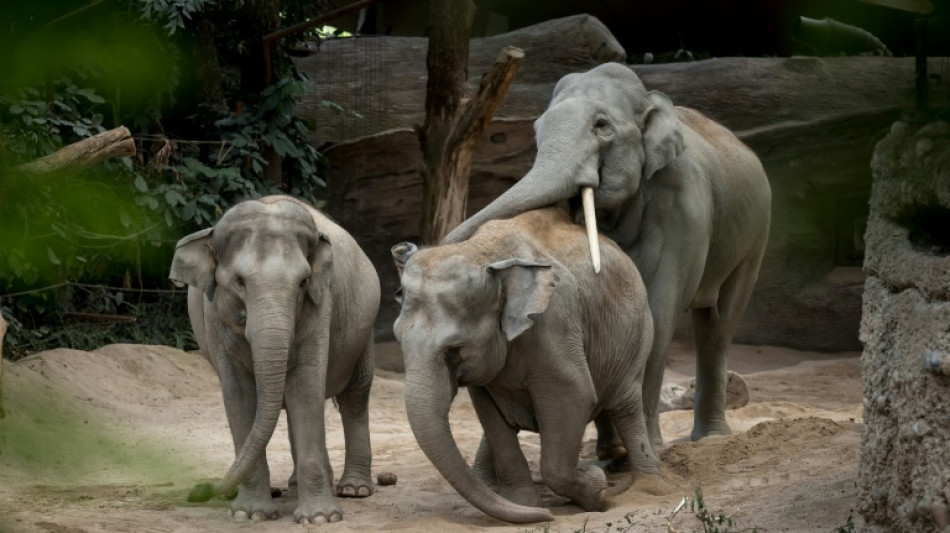
Deadly elephant virus stalks Zurich zoo / Photo: Fabrice COFFRINI - AFP

A deadly virus has swept through Zurich's zoo, killing three Asian elephants in a month and leaving experts stumped as to how to stop its spread.
The zoo overlooking Switzerland's largest city now has only five of the majestic creatures roaming its 11,000-square-metre (118,400-square-foot) elephant enclosure.
Two-year-old bull Umesh was the first to fall victim to the Elephant endotheliotropic herpesvirus (EEHV) at the end of June, followed just days later by his eight-year-old sister Omysha.
Last Saturday, Ruwani, a five-year-old female from a second matriarchal herd also died.
They succumbed at lightning speed to the herpesvirus, which leaves young Asian elephants with internal bleeding and organ failure.
In captivity, this virus is "the main cause of death for elephants between two and eight years", zoo curator Pascal Marty told AFP.
The virus has also been known to kill elephants in the wild, he said, but "it's a bit harder to detect".
- Last goodbye -
The herpesvirus lies latent in nearly all elephants, both in the wild and in captivity, but can in some cases suddenly become deadly, killing its victims in a matter of days.
"We still don't know why it happens and when it happens," Marty said.
The zoo's five remaining Asian elephants -- all adults -- were permitted to spend a few hours gathered around the remains of their young family members and companions.
Marty said it was important to give the animals "enough time (to) say farewell".
"It's very hard to say whether or not they are sad, because sadness is something human," he said.
But he stressed that since elephants are highly social animals, it is vital that they have a chance to realise when a member of their herd is no longer alive.
"It is very important for them to have closure to understand this individual is not part of our group anymore."
Less than a week after the latest death, the giant mammals appear to be going nonchalantly about their daily activities, from swimming in a large pond to searching for food.
They slip their trunks into holes, where a computer programme randomly distributes carrots and dried grass, aiming to make the animals walk and search for food as in the wild.
- Stress -
"It is kind of sad, especially because here in Zurich I think the elephants do have enough space," said frequent visitor Mauro Muller, 29.
Zurich zoo opened its new elephant enclosure in 2014, providing its herds six times more space than they had previously.
But eight years on, the zoo acknowledged it was going through "difficult days".
"It is particularly frustrating that we are powerless against this virus, despite the best veterinary care through the university animal hospital in Zurich," zoo director Severin Dressen said in a statement.
There is no vaccine, and while antivirals exist, they are not very efficient and even when elephants are treated quickly, only about a third of them survive.
"The epidemiology of the disease is still not clear," said Bhaskar Choudhury, a veterinarian and member of the International Union for Conservation of Nature (IUCN) Asian Elephant Specialist Group.
"The virus is shed intermittently by adults but with increasing frequency during stress periods, which is thought to be the source of infection for young calves," he told AFP.
"IUCN is highly concerned with the mortality worldwide in captivity and more so in the wild."
- 'Ambassadors' -
Asian elephants, which can live up to around 60 years old, are listed by the IUCN as an endangered species, with only about 50,000 left in the wild.
Deforestation, urban sprawl and agricultural development have robbed them of their natural habitat, while poaching and the illegal ivory trade also threaten many herds.
"The populations are declining almost everywhere," Marty said, adding that for conservation reasons, "it is also really important to have good and healthy populations of Asian elephants in Europe".
Zurich zoo, he said, has one of the world's most modern elephant enclosures, and is intent on continuing with its mission to breed them.
He described the elephants in the park as "partners" in educating people about the problems wild elephants face.
"Elephants here at the zoo have an important role as ambassadors for their own species," he said.
M.Fujitav--JT