'Not a switch': UAE pushes for fair energy transition / Photo: Giuseppe CACACE - AFP

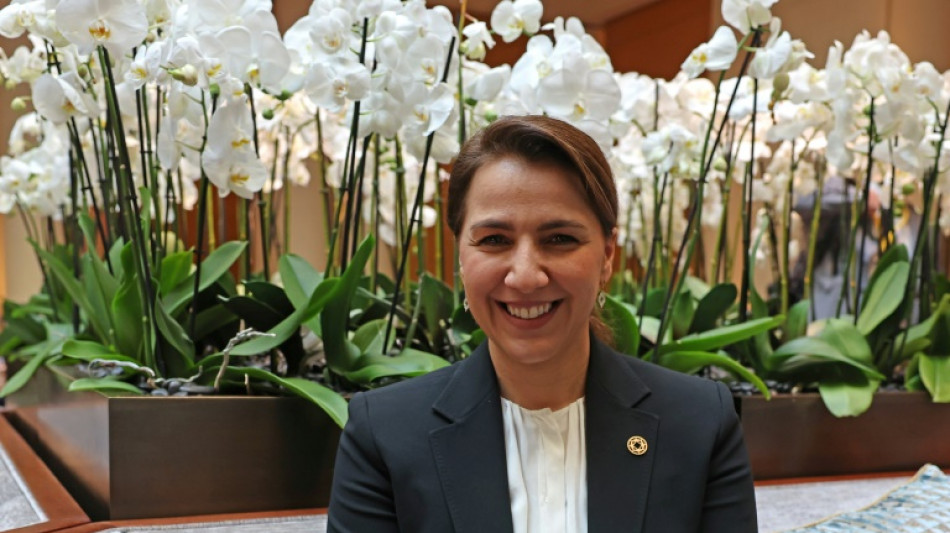
The world's transition to clean energy sources must be "just" and financed by the hydrocarbon trade, the climate change minister of oil-rich United Arab Emirates told AFP.
Mariam Almheiri was interviewed in France where a fierce heatwave set record temperatures as western Europe wilted under a scorching sun and wildfires that devoured forests.
Experts are blaming climate change and predict more frequent extreme weather to come.
"It's not a switch. We're not ready yet. And oil and gas will still be part of the energy mix for some time", she said in an interview Monday as UAE President Sheikh Mohamed bin Zayed Al-Nahyan visited Paris for energy talks.
"We need... a just transition because every country is not at the same level," the minister of climate change and the environment added, stressing the UAE was using its oil and gas wealth to ramp up renewable sources.
"You need to build your equipment from what energy you got to do that," she said. "Clean and renewable energy costs money."
The international community largely agrees that climate change poses an existential threat to the planet and future of mankind.
But action to cut carbon pollution and prepare for the accelerating impact is lagging, as is support for vulnerable countries confronting the ravages of a changing climate.
- 'We will provide' -
Adding to the pressure has been Russia's invasion of Ukraine that has sent food and energy prices spiralling.
Western sanctions aimed at crippling major energy producer Russia have resulted in sharply higher fuel costs in Europe and the United States, with inflation soaring as a result.
This has pushed the Unites States and Europe to try to persuade oil-rich countries like the UAE to increase energy supplies to bring prices back under control.
"Look at what we're going through right now. Months ago, people were pointing their fingers at us going: 'Why are you still producing?' Now they're coming to say: 'Please produce, please produce.'"
A top oil producer in OPEC, the UAE's rapid growth since the 1970s has been driven by its energy wealth.
But having diversified its economy over the decades, the desert country of one million locals and nine million foreigners relies less and less on petrol, with revenues now making up only 30 percent of GDP.
At the same time, it forecasts that the oil and gas industry would need to invest over $600 billion every year until 2030 just to keep up with expected demand.
"We are a country that has oil and gas as a natural resource. We don't have water... so as long as the world needs oil and gas we will provide," said Almheiri.
The country was built on oil, but is spending billions to develop enough renewable energy to cover half of its needs by 2050.
It is building two of the world’s largest solar power plants in the capital Abu Dhabi and Dubai.
It has also joined the nuclear club, with its Barakah nuclear power station, the first in the Arab world.
And last year, it launched a "strategic initiative" targeting carbon neutrality by 2050.
- Two-pronged approach -
Meteorologists are predicting more frequent and intense episodes of extreme weather in coming years.
"The increase in the frequency, duration, and intensity of these events over recent decades is clearly linked to the observed warming of the planet and can be attributed to human activity," the World Meteorological Organisation said.
Heatwaves of the future will depend largely on how rapidly the global economy can decarbonise.
While several towns and cities in France recorded their highest ever temperatures on Monday, the Gulf region is also at risk.
In the region, summer means suffering for anyone working outside, along with risks of dehydration, heat stroke and heart failure.
Countries of the energy-rich Gulf have banned working outdoors in the hottest hours of the day.
A study in the journal Nature Climate Change found that within this century, parts of the Gulf region could be hit by "unprecedented events of deadly heat as a result of climate change".
Almheiri said her country, which next year is hosting the United Nations Climate Change Conference COP28, has adopted a "two-pronged approach" while advocating further investments in oil and gas.
"We are ramping up our renewables because we have targets of where we want to reach, and we are decarbonising our oil and gas."
T.Sasaki--JT