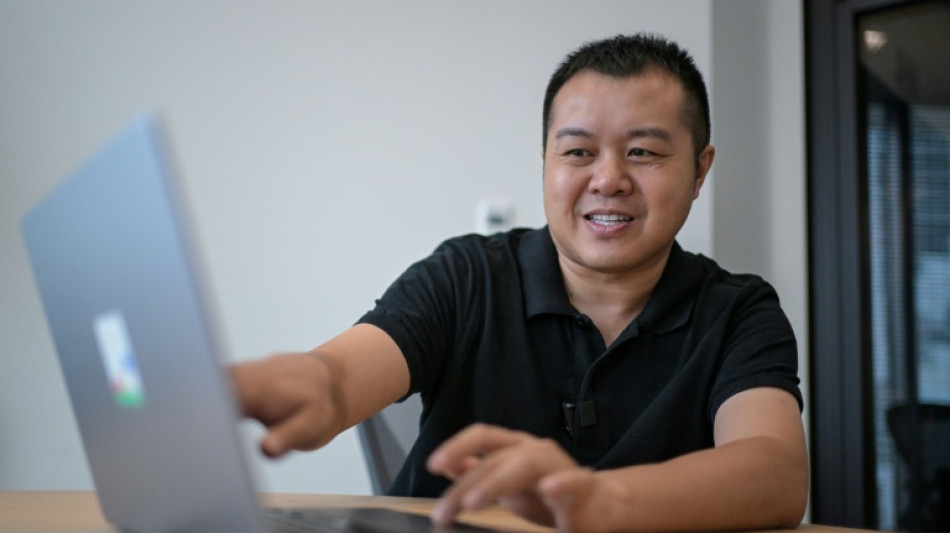
Top Japan start-up Sakana AI touts nature-inspired tech / Photo: Richard A. Brooks - AFP

When David Ha started an AI company in Japan with his former Google colleague, they had a choice: create another huge, energy-intensive tool like ChatGPT, or go their own way.
Since its 2023 launch, the value of their firm Sakana AI has soared past $1 billion, becoming Japan's fastest start-up to reach so-called unicorn status.
"In a space like AI, everyone's kind of doing the same thing. They're just like collecting the world's data, building a gigantic model, sucking up all this energy," Ha told AFP.
For a new venture, "the chance of success is actually quite low, especially in Japan", where the resources to run power-hungry data centres are scarce.
Instead of going head-to-head with top players like OpenAI or Alibaba, Sakana aims to merge existing and new systems, large and small, to develop what it calls "collective intelligence".
In many countries, "people are debating, should I use a Chinese model or should I use a US model?" Ha said, referring to AI foundation models trained on vast amounts of data.
But in today's tumultuous world, "you can imagine... a scenario where a certain provider might turn off their models", he added.
Combining the best aspects of multiple systems means Sakana's AI-powered programmes could in theory "continue to operate", he said, even if "with slightly lower performance at the beginning".
Sakana's approach has won it the support of US chip giant Nvidia as well as Japanese banks and other businesses keen to get ahead in the fast-moving world of generative artificial intelligence.
The word sakana means fish in Japanese, and the start-up says it is inspired by nature, where species from ants to humans collaborate to solve problems.
- 'Soft power' -
Ha, a Hong Kong-born Canadian and long-term Japan resident, is a former Google Brain research scientist who previously traded derivatives for Goldman Sachs.
He founded Sakana AI with ex-Google researcher Llion Jones, co-author of a groundbreaking 2017 machine learning paper, and Ren Ito, who has held positions in Japan's foreign ministry.
Sakana's team numbers more than 100, including contractors, and its unassuming offices are located in a shared Tokyo start-up space.
Japan is pouring tens of billions of dollars into AI and semiconductors, hoping to claw back some of its 1980s tech glory and boost the productivity of its shrinking workforce.
But there is some way to go. In academic institute IMD's 2025 World Competitiveness Ranking, Japan came 35th, with researchers saying it needs to foster entrepreneurship and address labour shortages caused by its ageing population.
"There are a lot of business challenges in Japan", where working environments are "very different" to Europe, China or the United States, Ha said.
But "building from the ground up" is an advantage for Sakana AI, which is "taking advantage of Japan's soft power" to attract talented software engineers.
In starting the company, Ha has put down roots in Japan, which "has its problems" but remains "a leading democracy in Asia", he said.
- Experimentation -
The tools developed by Sakana AI include a Japanese-language chatbot called "Tiny Sparrow" that works offline, protecting users' privacy.
Another trained on historical Japanese literature responds to text queries in samurai-like language.
Some coders have pointed out problems in the output of Sakana projects such as AI Scientist -- a bid to automate scientific discovery, whose paper passed a peer-review process this year -- and in others built to improve the efficiency of AI engineering.
"We have to experiment," Ha said. In academia and business, too, "things may not go your way, and we learn from that".
In any case, "people take these concepts very seriously" and work can progress quickly -- like the evolution of AI-generated video from "blobby" images to hyper-realism, he said.
In May, Sakana announced a "multi-year partnership" with Japanese megabank MUFG to develop "bank-specific AI systems".
While Ha wants to keep Sakana's AI research team small and "niche", the arm of the start-up that helps Japanese businesses and the public sector deploy AI is growing.
"It is a challenge to balance between working on cutting-edge... AI development, and on the business side to deploy trusted solutions that are known to work," he said.
Ha predicts that investors' excitement around AI will inevitably taper.
"Every major technological revolution, from canals to the dot-com boom, has been fuelled by a bubble," he said.
"That speculative investment, while risky, is what funds the foundational breakthroughs."
T.Sato--JT