The Japan Times - Milky Way may not be destroyed in galactic smash-up after all

EUR -
AED 4.276798
AFN 76.973093
ALL 96.541337
AMD 443.660189
ANG 2.0846
AOA 1067.888653
ARS 1669.958677
AUD 1.752514
AWG 2.096182
AZN 1.984351
BAM 1.955625
BBD 2.34549
BDT 142.477215
BGN 1.956439
BHD 0.439061
BIF 3440.791247
BMD 1.164546
BND 1.508565
BOB 8.047278
BRL 6.334667
BSD 1.164496
BTN 104.702605
BWP 15.471612
BYN 3.348
BYR 22825.091832
BZD 2.34209
CAD 1.610159
CDF 2599.265981
CHF 0.936209
CLF 0.027366
CLP 1073.571668
CNY 8.233458
CNH 8.232219
COP 4424.302993
CRC 568.848955
CUC 1.164546
CUP 30.860456
CVE 110.255106
CZK 24.203336
DJF 207.371392
DKK 7.470448
DOP 74.533312
DZD 151.505205
EGP 55.295038
ERN 17.468183
ETB 180.629892
FJD 2.632397
FKP 0.873977
GBP 0.872973
GEL 3.138497
GGP 0.873977
GHS 13.246811
GIP 0.873977
GMD 85.012236
GNF 10119.091982
GTQ 8.9202
GYD 243.638138
HKD 9.065875
HNL 30.671248
HRK 7.535429
HTG 152.446321
HUF 381.994667
IDR 19435.740377
ILS 3.768132
IMP 0.873977
INR 104.760771
IQD 1525.563106
IRR 49041.926882
ISK 149.038983
JEP 0.873977
JMD 186.393274
JOD 0.825709
JPY 180.924237
KES 150.636483
KGS 101.839952
KHR 4662.581612
KMF 491.43861
KPW 1048.137083
KRW 1716.311573
KWD 0.357481
KYD 0.970513
KZT 588.927154
LAK 25252.733992
LBP 104283.942272
LKR 359.197768
LRD 204.961608
LSL 19.736529
LTL 3.438601
LVL 0.704422
LYD 6.330432
MAD 10.755735
MDL 19.814222
MGA 5194.533878
MKD 61.634469
MMK 2445.172268
MNT 4132.506664
MOP 9.338362
MRU 46.438833
MUR 53.651052
MVR 17.938355
MWK 2019.3188
MXN 21.165153
MYR 4.787492
MZN 74.426542
NAD 19.736529
NGN 1688.68458
NIO 42.856154
NOK 11.767853
NPR 167.523968
NZD 2.015483
OMR 0.447772
PAB 1.164595
PEN 3.914449
PGK 4.941557
PHP 68.66747
PKR 326.476804
PLN 4.229804
PYG 8009.281302
QAR 4.244719
RON 5.092096
RSD 117.389466
RUB 88.93302
RWF 1694.347961
SAR 4.370508
SBD 9.584899
SCR 15.774978
SDG 700.4784
SEK 10.946786
SGD 1.508673
SHP 0.873711
SLE 27.603998
SLL 24419.93473
SOS 664.340387
SRD 44.985272
STD 24103.740676
STN 24.497802
SVC 10.190086
SYP 12876.900539
SZL 19.72123
THB 37.119932
TJS 10.684641
TMT 4.087555
TND 3.416093
TOP 2.803946
TRY 49.523506
TTD 7.894292
TWD 36.437508
TZS 2841.64501
UAH 48.888813
UGX 4119.630333
USD 1.164546
UYU 45.545913
UZS 13931.74986
VES 296.437311
VND 30697.419423
VUV 142.156724
WST 3.247609
XAF 655.898144
XAG 0.019993
XAU 0.000277
XCD 3.147243
XCG 2.098812
XDR 0.815727
XOF 655.898144
XPF 119.331742
YER 277.802752
ZAR 19.711451
ZMK 10482.311144
ZMW 26.923584
ZWL 374.983176
  • RBGPF

    0.0000

    78.35

    0%

  • NGG

    -0.5000

    75.41

    -0.66%

  • RELX

    -0.2200

    40.32

    -0.55%

  • SCS

    -0.0900

    16.14

    -0.56%

  • GSK

    -0.1600

    48.41

    -0.33%

  • AZN

    0.1500

    90.18

    +0.17%

  • CMSD

    -0.0700

    23.25

    -0.3%

  • BTI

    -1.0300

    57.01

    -1.81%

  • CMSC

    -0.0500

    23.43

    -0.21%

  • RIO

    -0.6700

    73.06

    -0.92%

  • BCC

    -1.2100

    73.05

    -1.66%

  • BCE

    0.3300

    23.55

    +1.4%

  • VOD

    -0.1630

    12.47

    -1.31%

  • BP

    -1.4000

    35.83

    -3.91%

  • JRI

    0.0400

    13.79

    +0.29%

  • RYCEF

    -0.0500

    14.62

    -0.34%

Milky Way may not be destroyed in galactic smash-up after all
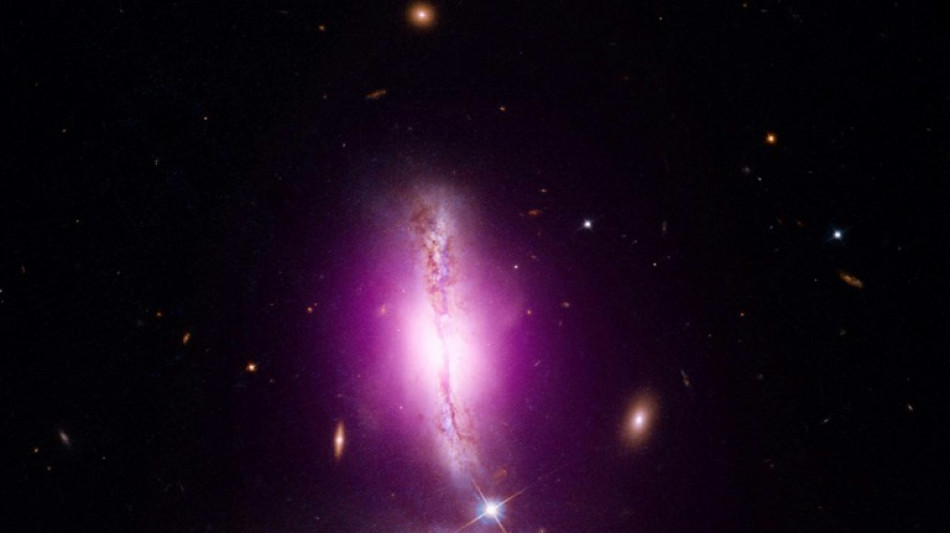
Milky Way may not be destroyed in galactic smash-up after all / Photo: - - NASA/AFP/File

Milky Way may not be destroyed in galactic smash-up after all

The Milky Way may not have a catastrophic collision with another huge galaxy as has been predicted, computer simulations revealed Monday, giving our home galaxy a coin-flip chance of avoiding destruction.

Text size:

But don't worry either way: no galactic smash-up is expected for billions of years, long after our ageing Sun will have burnt away all life on Earth.

The Milky Way and the even-larger galaxy Andromeda are speeding towards each other at 100 kilometres (60 miles) a second, and scientists have long predicted they will collide in around 4.5 billion years.

That would be bad news for our neighbourhood.

Previous research has suggested that the Sun -- and our Earth -- could wind up in the centre of this newly merged "Milkomeda" galaxy and get sucked into its supermassive black hole. Alternatively, the Sun could be shot out into the emptiness of intergalactic space.

However "proclamations of the impending demise of our galaxy seem greatly exaggerated", according to a new study in the journal Nature Astronomy.

There is only a roughly 50 percent chance the Milky Way and Andromeda will smash into each other in the next 10 billion years, the international team of astrophysicists determined.

"It's basically a coin flip," lead study author Till Sawala of the University of Helsinki told AFP.

The researchers ran more than 100,000 computer simulations of our universe's future, using new observations from space telescopes.

A galaxy merger in the next five billion years is "extremely unlikely", Sawala said.

Much more likely is that the galaxies will zoom relatively close to each other -- say, a little under 500,000 light years away.

In only half of the simulations did dark matter then eventually drag the two galaxies together into a cataclysmic embrace.

But this would likely only occur in around eight billion years -- long after our Sun has died, the researchers found.

"So it could be that our galaxy will end up destroyed," Sawala said.

"But it's also possible that our galaxy and Andromeda will orbit one another for tens of billions of years -- we just don't know."

- Galaxy's fate 'open' -

"The fate of our galaxy is still completely open," the study summarised.

The researchers emphasised that their findings did not mean that previous calculations were incorrect, just that they had used newer observations and taken into account the effect of more satellite galaxies.

Future data releases from Europe's recently retired Gaia space telescope as well as Hubble could provide a definitive answer to this question within the next decade, Sawala predicted.

How much all this all matters to us is a matter of debate. The Sun is expected to make Earth inhospitable to life in around a billion years.

"We might have some emotional attachment" to what happens after we're gone, Sawala said.

"I might prefer the Milky Way not to collide with Andromeda, even though it has absolutely no relevance to my own life -- or the lives of my children or great-great grandchildren."

Y.Mori--JT