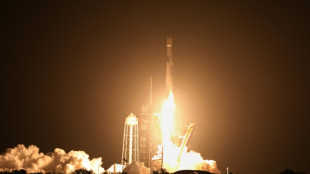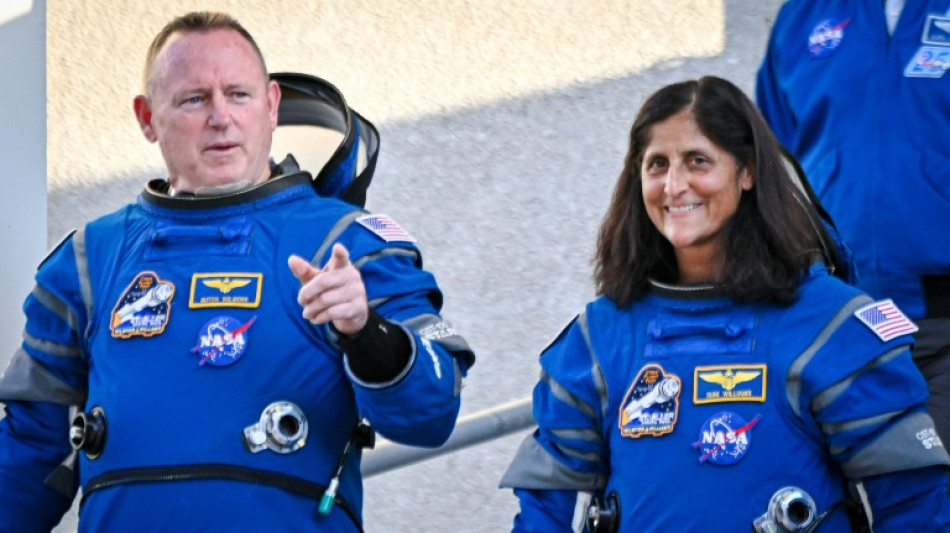
Key Boeing Starliner test mission postponed shortly before launch / Photo: Miguel J. Rodriguez Carrillo - AFP

The first crewed flight of Boeing's Starliner spaceship was dramatically postponed around two hours before launch after a new safety issue was identified, officials said Monday, in a fresh blow to the US aerospace giant.
Astronauts Butch Wilmore and Suni Williams were already strapped in their seats preparing for liftoff when the call for a "scrub" came, in order to give engineers time to investigate anomalous readings from an oxygen relief valve on the second stage of the rocket.
"Standing down on tonight's attempt to launch," tweeted NASA chief Bill Nelson. "As I've said before, @NASA's first priority is safety. We go when we're ready."
The mission comes at a challenging time for Boeing, as a safety crisis engulfs its commercial aviation division.
The test flight, which has already experienced years of delays, is a crucial step for the space agency, which has long sought a second commercial partner to carry astronauts to the International Space Station.
Elon Musk's SpaceX achieved the feat with its Dragon capsule in 2020, ending a nearly decade-long dependence on Russian rockets following the end of the Space Shuttle program.
Clad in Boeing's bright blue spacesuits, the astronauts were helped out of the spaceship then boarded a van to leave the launch tower at Cape Canaveral Space Force Station, returning to their quarters.
The next possible launch window is on Tuesday, then Friday and Saturday, assuming the issue is resolved.
Starliner will be propelled into orbit by an Atlas V rocket made by United Launch Alliance, a Boeing-Lockheed Martin joint venture. Once in space, the crew will take the helm, piloting the craft manually to test its capabilities.
The astronauts, both Navy-trained pilots and space program veterans, have each been to the ISS twice, traveling once on a shuttle and then aboard a Russian Soyuz vessel.
- Hiccups expected -
Starliner, a gumdrop-shaped capsule with a cabin about as roomy as an SUV, is scheduled to rendezvous with the ISS for a week-long stay.
Williams and Wilmore will conduct a series of tests to verify the capsule's functionality before returning to Earth for a parachute-assisted landing in the western United States.
A successful mission would help dispel the bitter taste left by numerous setbacks in the Starliner program.
In 2019, during a first uncrewed test flight, software defects meant the capsule was not placed on the right trajectory and returned without reaching the ISS. "Ground intervention prevented loss of vehicle," said NASA in the aftermath, chiding Boeing for inadequate safety checks.
Then in 2021, with the rocket on the launchpad for a new flight, blocked valves forced another postponement.
The vessel finally reached the ISS in May 2022 in a non-crewed launch. But other problems that came to light -- including weak parachutes and flammable tape in the cabin that needed to be removed -- caused further delays to the crewed test flight, necessary for the capsule to be certified for NASA use on regular ISS missions.
- Exclusive club -
SpaceX's Dragon capsule joined that exclusive club four years ago, following the Mercury, Gemini, Apollo and Space Shuttle programs.
In 2014, the agency awarded fixed-price contracts of $4.2 billion to Boeing and $2.6 billion to SpaceX to develop the capsules under its Commercial Crew Program.
This marked a shift in NASA's approach from owning space flight hardware to instead paying private partners for their services as the primary customer.
SpaceX CEO Elon Musk took a swipe at Boeing, gloating that his company "finished 4 years sooner" despite receiving a smaller contract. He attributed Boeing's delay to "too many non-technical managers" in a post on X.
Once Starliner is fully operational, NASA hopes to alternate between SpaceX and Boeing vessels to taxi humans to the ISS.
Even though the orbital lab is due to be mothballed in 2030, both Starliner and Dragon could be used for future private space stations that several companies are developing.
S.Yamada--JT