The Japan Times - No brain, no problem: Tiny jellyfish can learn from experience

EUR -
AED 4.30282
AFN 77.5919
ALL 96.489516
AMD 446.751458
ANG 2.097695
AOA 1074.386737
ARS 1699.031673
AUD 1.767888
AWG 2.111868
AZN 1.987765
BAM 1.955588
BBD 2.358544
BDT 143.214439
BGN 1.956761
BHD 0.441452
BIF 3462.423785
BMD 1.171633
BND 1.513829
BOB 8.092121
BRL 6.497058
BSD 1.170973
BTN 104.923599
BWP 16.47121
BYN 3.441626
BYR 22964.000811
BZD 2.355144
CAD 1.616051
CDF 2997.624825
CHF 0.931208
CLF 0.027205
CLP 1067.228913
CNY 8.249407
CNH 8.240866
COP 4489.040371
CRC 584.836454
CUC 1.171633
CUP 31.048266
CVE 110.25302
CZK 24.336809
DJF 208.527342
DKK 7.468942
DOP 73.35203
DZD 152.301451
EGP 55.787644
ERN 17.57449
ETB 181.917833
FJD 2.675654
FKP 0.875688
GBP 0.874495
GEL 3.145768
GGP 0.875688
GHS 13.449539
GIP 0.875688
GMD 85.529546
GNF 10235.931481
GTQ 8.973025
GYD 244.99338
HKD 9.115707
HNL 30.849648
HRK 7.534068
HTG 153.531352
HUF 386.375167
IDR 19667.495062
ILS 3.747057
IMP 0.875688
INR 105.047456
IQD 1534.039863
IRR 49325.736013
ISK 147.215756
JEP 0.875688
JMD 187.369641
JOD 0.830721
JPY 184.36871
KES 151.017792
KGS 102.459486
KHR 4699.429211
KMF 492.086008
KPW 1054.469152
KRW 1733.548819
KWD 0.35996
KYD 0.975898
KZT 605.996741
LAK 25362.35245
LBP 104864.00584
LKR 362.562153
LRD 207.267479
LSL 19.644449
LTL 3.459527
LVL 0.708709
LYD 6.34731
MAD 10.733734
MDL 19.824846
MGA 5325.421358
MKD 61.543313
MMK 2460.76473
MNT 4160.603437
MOP 9.38562
MRU 46.863908
MUR 54.08284
MVR 18.101237
MWK 2030.579364
MXN 21.106848
MYR 4.779071
MZN 74.864055
NAD 19.644449
NGN 1709.165624
NIO 43.095317
NOK 11.862076
NPR 167.877759
NZD 2.030891
OMR 0.451301
PAB 1.170973
PEN 3.943472
PGK 4.98148
PHP 68.802378
PKR 328.087851
PLN 4.205019
PYG 7856.146378
QAR 4.269136
RON 5.089535
RSD 117.367748
RUB 94.251423
RWF 1705.014739
SAR 4.394757
SBD 9.544997
SCR 17.753147
SDG 704.740941
SEK 10.857585
SGD 1.514201
SHP 0.879028
SLE 28.177977
SLL 24568.55608
SOS 668.027414
SRD 45.039321
STD 24250.431258
STN 24.497443
SVC 10.24593
SYP 12956.454967
SZL 19.641866
THB 36.59048
TJS 10.790828
TMT 4.100714
TND 3.427628
TOP 2.821011
TRY 50.163924
TTD 7.94817
TWD 36.984891
TZS 2899.790709
UAH 49.51292
UGX 4188.544887
USD 1.171633
UYU 45.975005
UZS 14077.470391
VES 330.587471
VND 30837.372518
VUV 141.802401
WST 3.26631
XAF 655.885734
XAG 0.016994
XAU 0.000266
XCD 3.166396
XCG 2.11048
XDR 0.815711
XOF 655.885734
XPF 119.331742
YER 279.3186
ZAR 19.596622
ZMK 10546.097944
ZMW 26.494121
ZWL 377.26525
  • SCS

    0.0200

    16.14

    +0.12%

  • JRI

    -0.0500

    13.38

    -0.37%

  • CMSC

    -0.1200

    23.17

    -0.52%

  • NGG

    -0.2800

    76.11

    -0.37%

  • CMSD

    -0.0300

    23.25

    -0.13%

  • RIO

    0.6900

    78.32

    +0.88%

  • BCC

    -2.9300

    74.77

    -3.92%

  • VOD

    0.0400

    12.84

    +0.31%

  • RBGPF

    0.0000

    80.22

    0%

  • BCE

    -0.0100

    22.84

    -0.04%

  • GSK

    0.3200

    48.61

    +0.66%

  • RYCEF

    0.2800

    15.68

    +1.79%

  • RELX

    0.0800

    40.73

    +0.2%

  • AZN

    0.7500

    91.36

    +0.82%

  • BTI

    -0.5900

    56.45

    -1.05%

  • BP

    0.6300

    33.94

    +1.86%

No brain, no problem: Tiny jellyfish can learn from experience
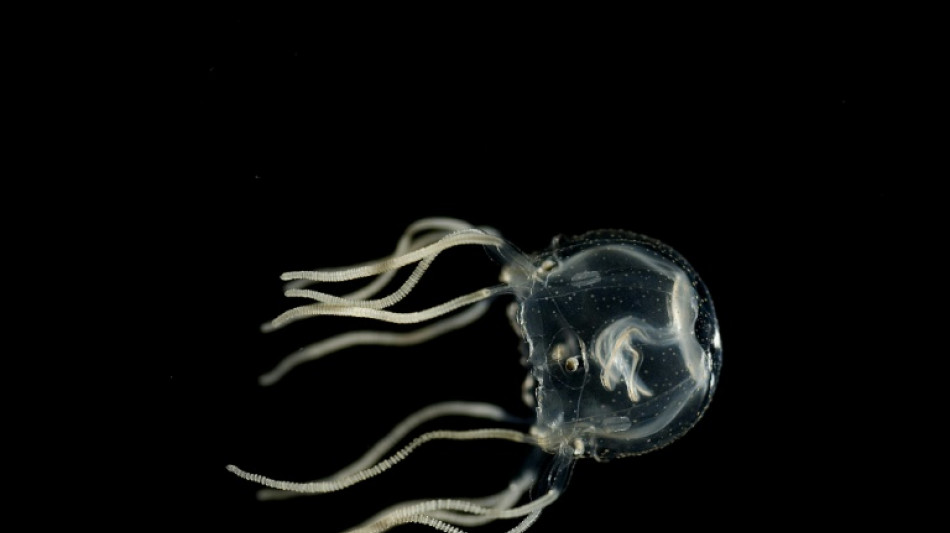
No brain, no problem: Tiny jellyfish can learn from experience / Photo: Jan BIELECKI - Jan BIELECKI/AFP

No brain, no problem: Tiny jellyfish can learn from experience

Caribbean box jellyfish are barely a centimetre long and have no brain.

Text size:

But these gelatinous, fingernail-sized creatures are capable of learning from visual cues to avoid swimming into obstacles -- a cognitive ability never before seen in animals with such a primitive nervous system, researchers said on Friday.

Their performance of what is called "associative learning" is comparable to far more advanced animals such as fruit flies or mice, which have the notable benefit of having a brain, the researchers said.

The Caribbean box jellyfish, or Tripedalia cystophora, is known to be able to navigate through murky water and a maze of submerged mangrove roots.

These scenarios throw up plenty of dangers that could damage the jellyfish's fragile gelatinous membrane which envelops its bell-shaped body.

But they avoid harm thanks to four visual sensory centres called rhopalia, each of which has lens-shaped eyes and around a thousand neurons.

For comparison, fruit flies are packing 200,000 neurons in their tiny brains.

Cnidarians -- the animal group which includes jellyfish, sea anemones and coral -- are brainless, instead getting by with a "dispersed" central nervous system.

Despite this considerable disadvantage, the Caribbean box jellyfish responds to what is called "operant conditioning," according to the study in the journal Current Biology.

This means they can be trained to "predict a future problem and try to avoid it," said Anders Garm, a marine biologist at the University of Copenhagen and the study's lead author.

Garm told AFP that this capacity is "more complex than classical conditioning," which is best known for Russian neurologist Ivan Pavlov's experiments showing that dogs cannot help but salivate when they see their food bowl.

- 'Very intriguing' -

To test the jellyfish, the researchers put them in a small, water-filled tank with stripes of varying darkness on the glass walls to represent mangrove roots.

After a few bumps into the walls, the jellyfish quickly learned to move through the parts of the enclosures where the bars were least visible.

If the bars were made more prominent, the jellyfish never hit the walls, remaining safely in the centre of the tank. However this was not ideal for scrounging around for food.

If the stripes were removed entirely, the jellyfish constantly ran into the walls of the tank.

"If you separate the two stimuli, there is no learning," Garm concluded.

The jellyfish learned their lesson in between three to six tries, "which is basically the same amount of trials for what we would normally consider an advanced animal, like a fruit fly, a crab or even a mouse," he said.

They said their research supports the theory that even animals with a very small number of neurons are capable of learning.

That such a simple organism is able to achieve this feat "points to the very intriguing fact that this may be a fundamental property of nerve systems," Garm said.

Cnidarians are a "sister group" to the animal group that includes most other animals -- including humans.

Garm suggested that some 500 million years ago, a common ancestor of the two groups could have developed a nervous system that was already able to learn by association.

K.Okada--JT