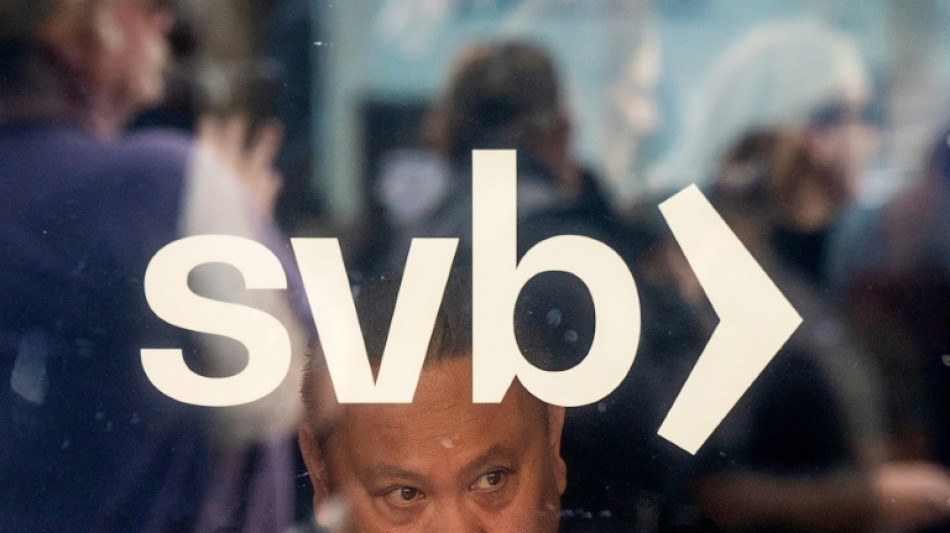
Two weeks of banking turbulence / Photo: NOAH BERGER - AFP/File

After three US regional lenders collapsed and UBS swooped to buyout troubled Credit Suisse to avoid a wider crisis, AFP looks back at the last two weeks of banking turbulence:
- Silvergate Bank -
The turmoil begins the night of March 8 with a liquidation announcement from Silvergate Bank, a US regional lender and favourite among the cryptocurrency crowd.
The California business had been swept up in several crypto mishaps, particularly the implosion of exchange platform FTX, before facing a wave of sudden withdrawals.
On March 10 the crypto banking giant says it plans to close.
- Silicon Valley Bank -
On the same night of March 8, Silicon Valley Bank announces it is facing a huge run of unexpected withdrawals.
In an attempt to raise cash, the bank loses $1.8 billion in the sale of a bond portfolio whose value dropped following interest rate hikes by the US Federal Reserve.
SVB, a key lender to startups across the US since the 1980s and the country's 16th-largest bank by assets, had been hit by the tech sector slowdown as cash-hungry companies rushed to get their hands on their money.
The announcement by SVB spooks investors and clients, and sparks a run on deposits.
On March 10 the bank collapses -- the biggest US banking failure since the 2008 financial crisis -- prompting regulators to seize control the same day.
The Federal Deposit Insurance Corporation (FDIC) takes over the bank and says it will protect insured deposits -- those up to $250,000 per client.
In a statement on March 12, the Federal Reserve, the Treasury Department and the FDIC step in, announcing that SVB depositors will have access to "all of their money" starting Monday March 13, and American taxpayers will not have to foot the bill.
So far regulators have been unable to find a buyer for SVB and are now considering breaking up the bank, according to Bloomberg.
- Signature Bank -
The March 12 statement also reveals that Signature Bank, the 21st-largest in the United States, has been automatically closed and its customers will benefit from the same measures as those at SVB.
On March 19 the FDIC says it has struck a deal to sell most of the assets of Signature Bank to Flagstar Bank, a subsidiary of New York Community Bancorp.
Signature Bank held deposits of $88.6 billion as of December 31, the FDIC statement says, adding that the bank's 40 branches will open under Flagstar on Monday.
- First Republic Bank -
San Francisco-based First Republic Bank -- the 14th largest US bank by assets -- sees its stock market valuation plunge as of March 9 and its shares tumble over the next week.
On March 16, Wall Street titans including JP Morgan, Bank of America and Citigroup pledge to deposit $30 billion into the lender.
But despite the rescue package, on Sunday ratings agency Standard & Poor's (S&P) downgrades First Republic's long-term issuer credit rating from BB+ to B+.
The agency warns it could further lower the bank's rating if there is no progress in stabilising deposits.
First Republic Bank makes assurances that with the $30 billion injection the lender is "well positioned to manage short-term deposit activity."
- Credit Suisse -
On March 15 the shares of Credit Suisse, Switzerland's second-largest bank and considered the "weakest link" in the Swiss banking sector, go into freefall.
In a bid to calm the markets, Credit Suisse announces it will borrow 50 billion francs ($54 billion) from the Swiss central bank to reinforce the group.
After recovering some ground on March 16, Credit Suisse shares close down eight percent the next day at 1.86 Swiss francs as the Zurich-based lender struggles to regain investors confidence.
In a crunch weekend, UBS -- Switzerland's biggest bank -- says Sunday it will buy Credit Suisse for $3.25 billion in hopes of stopping a wider international banking crisis.
The takeover will create a banking giant unprecedented in the history of Switzerland, where banking is a core part of the national identity.
burs-eab/jmy/lth
K.Hashimoto--JT