The Japan Times - Once in 50,000-year comet may be visible to the naked eye

EUR -
AED 4.333353
AFN 77.919498
ALL 96.666351
AMD 448.571977
ANG 2.11258
AOA 1082.011069
ARS 1712.98824
AUD 1.763088
AWG 2.126854
AZN 2.025469
BAM 1.960047
BBD 2.36801
BDT 143.691354
BGN 1.956122
BHD 0.444874
BIF 3474.257556
BMD 1.179947
BND 1.517301
BOB 8.142644
BRL 6.592724
BSD 1.175688
BTN 105.408108
BWP 15.507499
BYN 3.419646
BYR 23126.956092
BZD 2.364603
CAD 1.617654
CDF 2666.679794
CHF 0.929231
CLF 0.027209
CLP 1067.651204
CNY 8.307946
CNH 8.278843
COP 4474.027651
CRC 586.175107
CUC 1.179947
CUP 31.268589
CVE 110.504444
CZK 24.321122
DJF 209.365268
DKK 7.470903
DOP 73.590081
DZD 152.980489
EGP 56.036264
ERN 17.699201
ETB 182.248946
FJD 2.68727
FKP 0.876855
GBP 0.87352
GEL 3.168182
GGP 0.876855
GHS 13.435112
GIP 0.876855
GMD 86.721894
GNF 10279.360704
GTQ 9.010524
GYD 246.013068
HKD 9.177708
HNL 30.995424
HRK 7.53809
HTG 153.964266
HUF 390.965917
IDR 19818.385435
ILS 3.764903
IMP 0.876855
INR 105.615858
IQD 1540.437861
IRR 49675.757575
ISK 147.823328
JEP 0.876855
JMD 187.686684
JOD 0.836578
JPY 183.999127
KES 152.094636
KGS 103.18626
KHR 4717.241431
KMF 494.397688
KPW 1061.906058
KRW 1747.902117
KWD 0.362421
KYD 0.979923
KZT 606.353863
LAK 25470.189472
LBP 105287.36251
LKR 364.058852
LRD 208.102704
LSL 19.640858
LTL 3.484076
LVL 0.713738
LYD 6.379959
MAD 10.764525
MDL 19.908137
MGA 5296.758919
MKD 61.560742
MMK 2477.705585
MNT 4192.834221
MOP 9.423018
MRU 46.870958
MUR 54.241958
MVR 18.24174
MWK 2038.741146
MXN 21.172376
MYR 4.795303
MZN 75.364268
NAD 19.640858
NGN 1716.373708
NIO 43.274134
NOK 11.876624
NPR 168.676923
NZD 2.021095
OMR 0.453692
PAB 1.175948
PEN 3.95988
PGK 5.002883
PHP 69.435116
PKR 329.353692
PLN 4.231678
PYG 7944.136342
QAR 4.298113
RON 5.089349
RSD 117.412973
RUB 92.331647
RWF 1712.711147
SAR 4.425657
SBD 9.61273
SCR 16.186219
SDG 709.746945
SEK 10.831982
SGD 1.516296
SHP 0.885266
SLE 28.377331
SLL 24742.897476
SOS 670.853623
SRD 45.317621
STD 24422.515203
STN 24.553411
SVC 10.289295
SYP 13046.547711
SZL 19.632879
THB 36.707903
TJS 10.818241
TMT 4.129814
TND 3.439553
TOP 2.841029
TRY 50.53614
TTD 7.994322
TWD 37.143521
TZS 2910.602925
UAH 49.488522
UGX 4237.181235
USD 1.179947
UYU 46.089869
UZS 14106.566477
VES 332.933359
VND 31069.177595
VUV 143.412431
WST 3.284953
XAF 657.381431
XAG 0.016936
XAU 0.000263
XCD 3.188865
XCG 2.119292
XDR 0.81746
XOF 657.292109
XPF 119.331742
YER 281.431348
ZAR 19.691898
ZMK 10620.929206
ZMW 26.571974
ZWL 379.942369
  • SCS

    0.0200

    16.14

    +0.12%

  • RBGPF

    0.0000

    80.22

    0%

  • BTI

    0.3200

    56.77

    +0.56%

  • CMSD

    -0.0500

    23.2

    -0.22%

  • BCC

    -0.5400

    74.23

    -0.73%

  • AZN

    0.1900

    91.55

    +0.21%

  • RIO

    1.7800

    80.1

    +2.22%

  • NGG

    0.3000

    76.41

    +0.39%

  • CMSC

    -0.0500

    23.12

    -0.22%

  • BCE

    -0.1100

    22.73

    -0.48%

  • GSK

    -0.0200

    48.59

    -0.04%

  • JRI

    -0.0100

    13.37

    -0.07%

  • RYCEF

    -0.3200

    15.36

    -2.08%

  • RELX

    0.2500

    40.98

    +0.61%

  • BP

    0.2000

    34.14

    +0.59%

  • VOD

    0.0400

    12.88

    +0.31%

Once in 50,000-year comet may be visible to the naked eye
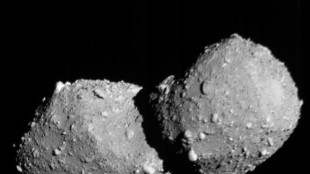
Once in 50,000-year comet may be visible to the naked eye / Photo: Dan Bartlett - NASA/AFP

Once in 50,000-year comet may be visible to the naked eye

A newly discovered comet could be visible to the naked eye as it shoots past Earth and the Sun in the coming weeks for the first time in 50,000 years, astronomers have said.

Text size:

The comet is called C/2022 E3 (ZTF) after the Zwicky Transient Facility, which first spotted it passing Jupiter in March last year.

After travelling from the icy reaches of our Solar System it will come closest to the Sun on January 12 and pass nearest to Earth on February 1.

It will be easy to spot with a good pair of binoculars and likely even with the naked eye, provided the sky is not too illuminated by city lights or the Moon.

The comet "will be brightest when it is closest to the Earth", Thomas Prince, a physics professor at the California Institute of Technology who works at the Zwicky Transient Facility, told AFP.

Made of ice and dust and emitting a greenish aura, the comet is estimated to have a diameter of around a kilometre, said Nicolas Biver, an astrophysicist at the Paris Observatory.

That makes it significantly smaller than NEOWISE, the last comet visible with an unaided eye, which passed Earth in March 2020, and Hale–Bopp, which swept by in 1997 with a potentially life-ending diameter of around 60 kilometres.

But the newest visit will come closer to Earth, which "may make up for the fact that it is not very big", Biver said.

While the comet will be brightest as it passes Earth in early February, a fuller moon could make spotting it difficult.

For the Northern Hemisphere, Biver suggested the last week of January, when the comet passes between the Ursa Minor and Ursa Major constellations.

The new moon during the weekend of January 21-22 offers a good chance for stargazers, he said.

"We could also get a nice surprise and the object could be twice as bright as expected," Biver added.

Prince said another opportunity to locate the comet in the sky will come on February 10, when it passes close to Mars.

- 'Rare visitor' -

The comet has spent most of its life "at least 2,500 times more distant than the Earth is from the Sun", Prince said.

Biver said the comet was believed to have come from the Oort Cloud, a theorised vast sphere surrounding the Solar System that is home to mysterious icy objects.

The last time the comet passed Earth was during the Upper Paleolithic period, when Neanderthals still roamed Earth.

Prince said the comet's next visit to the inner Solar System was expected in another 50,000 years.

But Biver said there was a possibility that after this visit the comet will be "permanently ejected from the Solar System".

Among those closely watching will be the James Webb Space Telescope. However, it will not take images, instead studying the comet's composition, Biver said.

The closer the comet is to Earth, the easier it is for telescopes to measure its composition "as the Sun boils off its outer layers", Prince said.

This "rare visitor" will give "us information about the inhabitants of our Solar system well beyond the most distant planets", he added.

M.Saito--JT